
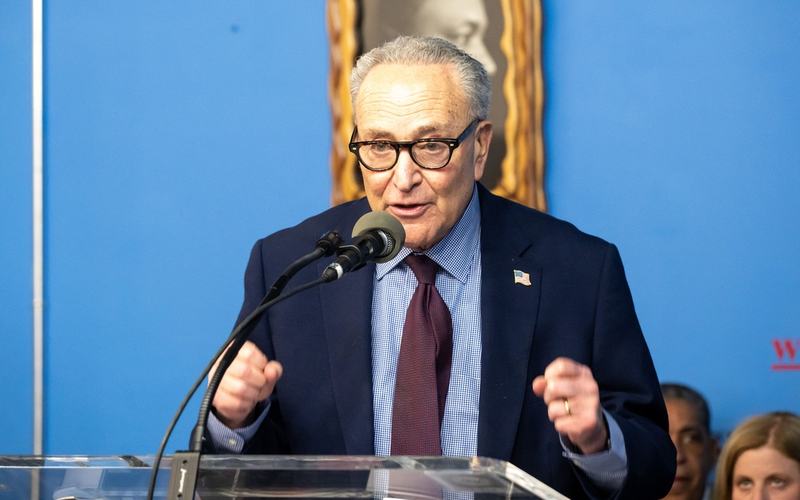
Senate Minority Leader Chuck Schumer is confronting open resistance from a cluster of newly elected Democratic senators who have said they will not back him—or remain uncommitted—as the party prepares to elect its next leader in the chamber, even after Democrats’ strong midterm performance that is poised to return him to the majority leader’s role. The 75-year-old New York Democrat, who has spent more than five decades in elective office, has led the Senate Democratic caucus since 2017 and insists he has the votes, but the pushback from freshmen underscores longstanding progressive and generational frustration with party leadership.
Schumer’s political career began in 1974, when he was elected to the New York State Assembly at age 23, becoming one of the youngest members of the state legislature at the time. He served there until 1980, then won a seat in the U.S. House of Representatives in 1980 and represented Brooklyn and Queens districts for 18 years. In 1998, he defeated three-term Republican Senator Al D’Amato and has served in the Senate since he was sworn in. With more than 27 years in his office, he marks New York’s longest-serving senator. He became Senate Democratic leader in 2017 (succeeding Harry Reid), served as majority leader from 2021 to 2025, and returned to the minority leader role in 2025. By the time the new Congress convenes in January 2027, he will have been in Congress for roughly 45 years and in public office for more than half a century.
Democrats flipped multiple Republican-held seats in the 2026 midterms, including in Kansas, Maine, Michigan, South Carolina, Texas, and others, putting them on track for a majority of roughly 54 to 56 seats depending on remaining uncalled races in Alaska and Mississippi. The gains, which included major upsets in states Donald Trump carried comfortably in 2024, have been credited in part to candidate recruitment and the party’s focus on affordability and economic issues. Schumer has repeatedly stated he expects to be reelected as majority leader. “The issue is not me. I’ll be reelected as majority leader,” he told reporters. “But the issue is focusing on the American people and what they want.”
Unlike the House speaker election, which requires a majority of the full chamber, Senate party leaders are chosen by a majority of their own caucus in a secret ballot. Schumer therefore needs support from roughly half of the Democratic senators, not a broader consensus. As of Friday, no sitting Democratic senator has publicly announced a challenge, and no alternative candidate has formally entered the race. Speculative names mentioned in recent months include Chris Van Hollen of Maryland, Chris Murphy of Connecticut, Brian Schatz of Hawaii (who is expected to seek the No. 2 whip position following Dick Durbin’s retirement), and Cory Booker of New Jersey, but none have stepped forward.
The resistance is concentrated among incoming freshmen. Kansas Senator-elect Adam Hamilton, a moderate who became the first Democrat to win a Kansas Senate seat in 94 years, has said he will not support Schumer and wants “new younger leadership, young blood.” Maine’s Troy Jackson has stated he told Schumer he would “support somebody else.” Michigan’s Abdul El-Sayed, a progressive, has declined to back Schumer and has pointed to Van Hollen as a preferred alternative focused on issues like getting money out of politics and Medicare for All. Others who have called for new leadership or withheld commitments include Illinois’s Juliana Stratton, Minnesota’s Peggy Flanagan, New Hampshire’s Chris Pappas, Texas’s James Talarico, and South Carolina’s Annie Andrews, who told Fox News it is “time for generational change on both sides of the aisle.”
Schumer’s critics within the broader Democratic base and progressive circles have faulted his approach during Trump’s second term, particularly his role in advancing a Republican-backed government funding measure with limited concessions. Petitions urging Democrats to replace him have gathered tens of thousands of signatures. At the same time, many in the caucus appear inclined to credit him for the midterm gains and prioritize unity heading into a Congress where Democrats will control both chambers and seek to constrain the Trump administration on issues ranging from the economy to judicial nominations. Vermont Senator Peter Welch has acknowledged criticism of Democratic efforts while noting there is no indication of a formal leadership challenge, saying Schumer “did an incredible job on this campaign.”
The leadership election is expected in the coming weeks. Analysts note that while the freshman defections highlight a desire for change that spans progressive and more moderate newcomers, they are unlikely on their own to block Schumer unless a credible alternative organizes broader support among the existing caucus. One floating compromise idea discussed before the election was for Schumer to serve another term with an understanding he would step aside later, potentially clearing a path for a next-generation leader.
For now, Schumer remains the clear favorite to reclaim the majority leader post he previously held, even as the incoming class signals that the party’s internal debate over generational change is far from settled.

Comments
No comments yet. Be the first to share your thoughts.