
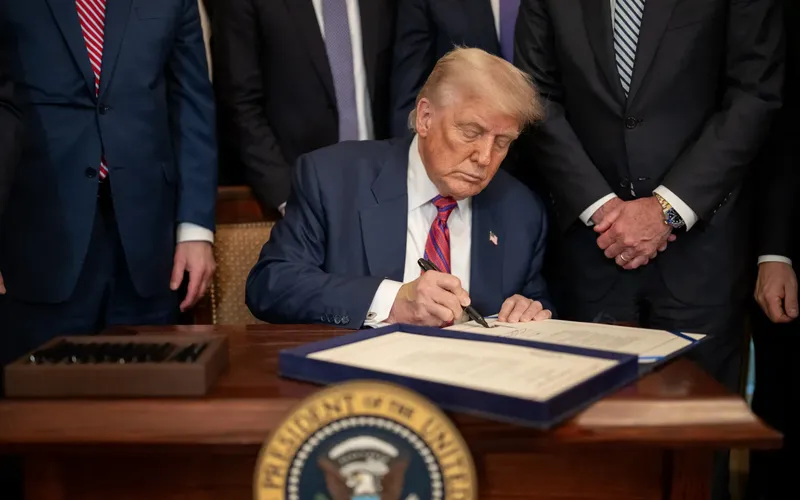
President Donald Trump announced Saturday that he has approved new federal fuel economy standards aimed at replacing Biden-era requirements that his administration has characterized as an effective mandate pushing automakers and consumers toward electric vehicles.
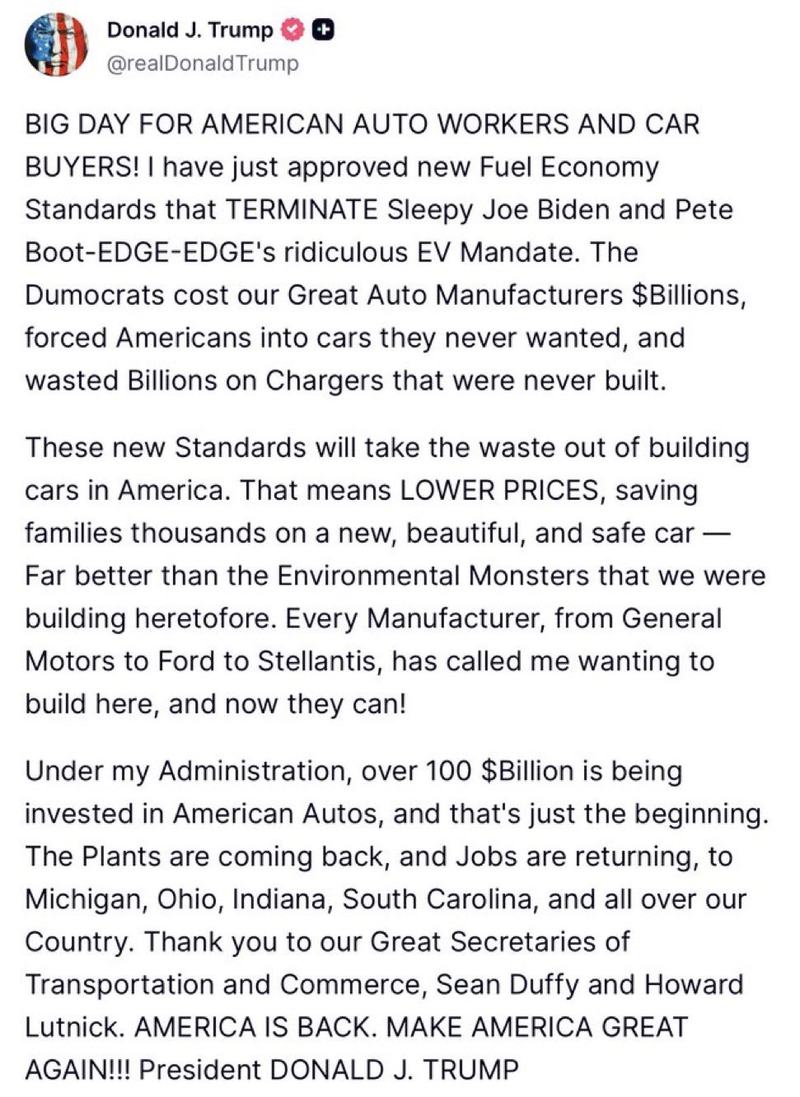
Trump made the announcement in a Truth Social post, saying the new standards would “TERMINATE” what he called the Biden administration’s “ridiculous EV Mandate.” He argued the previous policies increased costs for automakers and pushed Americans toward vehicles they did not want to buy.
The new rules involve the federal Corporate Average Fuel Economy, or CAFE, program, which sets minimum fuel economy requirements for passenger cars and light trucks. NHTSA has previously described the program as regulating how far vehicles must travel on a gallon of fuel.
Trump did not release the technical details of the final standards in his Saturday announcement. His administration had previously proposed resetting the requirements for passenger cars and light trucks through model year 2031, with NHTSA projecting an industrywide average of roughly 34.5 miles per gallon by 2031 under that proposal.
The administration has argued that reducing the regulatory burden would make vehicles less expensive to manufacture and purchase. NHTSA previously said its CAFE reset would return the program to standards that could be met with conventional gasoline and diesel vehicles, rather than relying on increasing electric vehicle adoption.
Trump said the new standards would mean “LOWER PRICES” for consumers and claimed families could save thousands of dollars when purchasing a new vehicle. Those savings are administration projections rather than guaranteed reductions in the price of every vehicle.
The White House and Transportation Department have made changes to CAFE rules a major part of Trump's broader effort to reverse Biden-era policies affecting the automobile industry. In June 2025, NHTSA issued a rule establishing the legal framework for resetting the CAFE program, while noting that the rule itself did not immediately change existing fuel economy standards.
Trump also pointed to investment by major American automakers, including General Motors, Ford and Stellantis, as evidence that his administration's policies are encouraging more domestic manufacturing. He said more than $100 billion is being invested in the American auto industry and cited manufacturing activity in Michigan, Ohio, Indiana and South Carolina.
The administration has connected those investments to its broader economic policies, including tariffs and regulatory changes. Automakers, however, have cited a combination of factors when announcing individual investments, including tariffs, consumer demand and changes in federal electric vehicle policy.
Trump credited Transportation Secretary Sean Duffy and Commerce Secretary Howard Lutnick with helping develop the new standards.
The announcement represents another major step in Trump's effort to move federal transportation policy away from the Biden administration's emphasis on increasing vehicle efficiency and electric vehicle adoption. The precise requirements and their impact on automakers and consumers will depend on the final technical standards issued by the administration.

Comments
No comments yet. Be the first to share your thoughts.