
President Donald Trump has turned aside Iran’s latest offer to reopen the Strait of Hormuz and has indicated to aides that U.S. strikes could resume after the midterm elections.
Trump rejected the seven-day framework Tehran floated through Qatari mediators. He has also made clear that the maritime blockade of Iranian ports will stay in force. Administration officials believe continued economic pressure is more likely to produce an acceptable deal than any immediate concession.
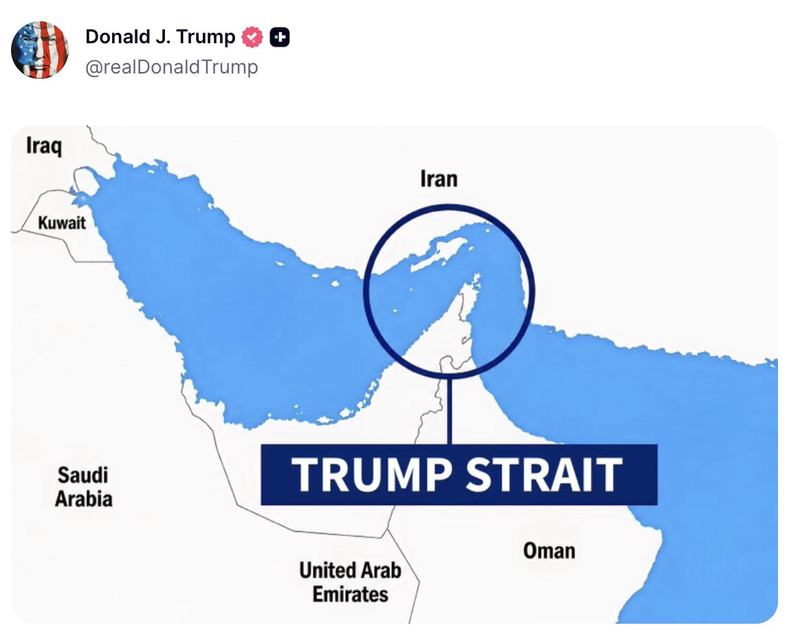
Trump reinforced the message Friday night by posting a map on Truth Social with the waterway circled and labeled “TRUMP STRAIT.”
Officials describe the president as still unconvinced that Iran will meet his core nuclear demands. No final decision has been made on the size or timing of any new military campaign. Trump is said to be wary of depleting munitions needed for other contingencies, though that calculation could shift in the weeks ahead and may be influenced by the midterm results.
Indirect talks have not stopped. Mediators continue to shuttle messages on both the nuclear file and the status of the strait. At the same time, a U.S.-led effort to keep commercial tankers moving through Hormuz has lessened the immediate pressure for a quick settlement. One U.S. official called the recent exchanges “positive” and “constructive.”
Iranian Foreign Minister Abbas Araghchi outlined the rejected plan publicly: Washington would lift the blockade, ease oil sanctions, unfreeze assets, and observe a broader ceasefire. In return, Iran would reopen the strait and open nuclear talks. Araghchi insisted the seven-day clock would start only after the United States accepted the terms and placed the next move squarely on Washington.
The proposal was an attempt to revive elements of a June understanding that collapsed after Iran resumed attacks on shipping. Tehran wants a return to those earlier terms. Diplomats have privately acknowledged the country’s economic distress to Arab intermediaries, yet the Islamic Revolutionary Guard Corps remains resistant to new formulas and prefers arrangements that would give Iran a formal role in managing the waterway.
Washington sees little incentive to yield its current leverage. State Department spokesman Tommy Pigott said the United States is cutting Iran’s financial lifelines and that Trump “holds all the cards.” Roughly 40 million barrels of oil moved through the strait in a recent 48-hour period, and U.S. forces have redirected more than 120 vessels to enforce the blockade.
Nuclear differences remain stark. A senior Iranian official told Reuters that even if the Hormuz plan were accepted, Tehran would not abandon domestic enrichment or export its highly enriched uranium. Iranian President Masoud Pezeshkian has said the stockpile could be diluted and subjected to verification, but that still falls short of Washington’s demands.
On the military front, an IRGC spokesman vowed continued action against U.S. targets until Iranian conditions are met and claimed the country’s missiles can defeat layered American air defenses.
In his United Nations speech earlier in the week, Trump warned Iran to move quickly, restated that a nuclear weapon is unacceptable, and insisted midterm politics would not drive his decisions on the issue.
For now, the president has rejected the current Iranian offer, kept economic and maritime pressure in place, and left open the possibility of resumed strikes after November.

Comments
No comments yet. Be the first to share your thoughts.