
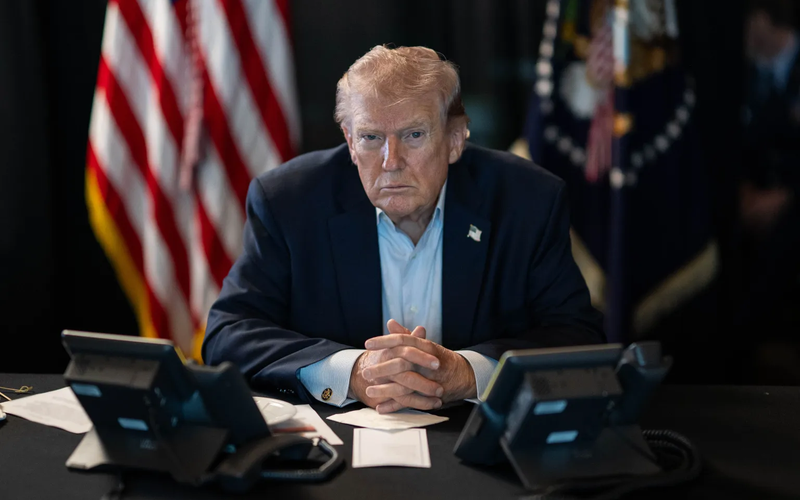
President Donald Trump stated on Saturday that he was reviewing a new proposal from Iran to end the war between the two nations. Speaking to reporters at Palm Beach International Airport in West Palm Beach, Florida, before boarding Air Force One for a trip to Miami, Trump said, "I'll let you know about it later," adding that "they're going to give me the exact wording now."
The proposal, described by Iranian state media as a 14-point response to a prior U.S. offer, was delivered through Pakistani intermediaries. It calls for resolving all issues and ending the war within 30 days, rather than the two-month ceasefire suggested by the United States. Other elements include guarantees against future U.S. aggression, withdrawal of American forces from Iran's periphery, an end to the U.S. naval blockade of Iranian ports, release of frozen Iranian assets, reparations payments, lifting of sanctions, cessation of fighting in Lebanon, and a new governance mechanism for the Strait of Hormuz.
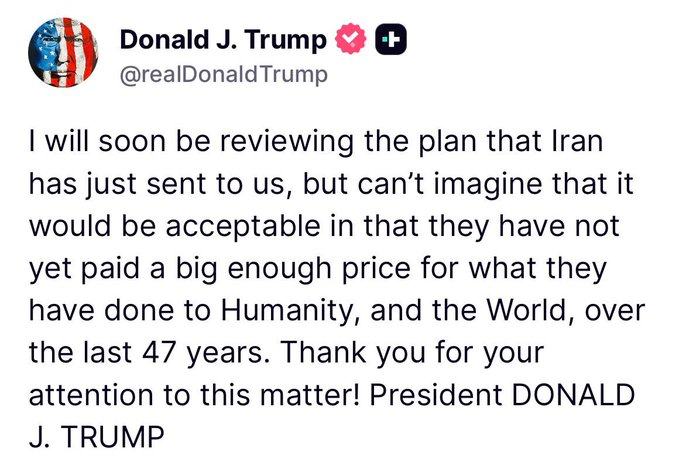
Trump later posted on Truth Social that he would "soon be reviewing the plan that Iran has just sent to us, but can't imagine that it would be acceptable in that they have not yet paid a big enough price for what they have done to Humanity, and the World, over the last 47 years." This skepticism echoes his rejection of an earlier Iranian proposal on Friday, when he described himself as "not satisfied" with its terms.
A fragile ceasefire has held between U.S. and Iranian forces for about three weeks, since early April. Trump notified Congress on Friday that hostilities had "terminated," as no direct fire had been exchanged since then. However, the U.S. maintains a naval blockade imposed on April 13, which has redirected 48 commercial ships attempting to pass through the Strait of Hormuz in recent weeks. Traffic in the strait, through which about 20% of global oil and natural gas trade flows, has plummeted by 90% due to Iran's closure and threats.
The conflict erupted on February 28, 2026, when the United States and Israel launched strikes on Iranian nuclear facilities and leadership targets, following the collapse of indirect negotiations that began in 2025. Those talks, mediated in locations including Oman and Italy, foundered over Iran's nuclear program, missile capabilities, support for proxies like Hezbollah and the Houthis, and control of the Strait of Hormuz. Trump had set multiple deadlines for a deal, including a 60-day ultimatum that expired without agreement, leading to the military action.
The U.S. framework demands the complete end to Iran's nuclear enrichment, destruction of key sites like Natanz and Fordow, missile limits, restrictions on proxy activities, and full reopening of the strait, in exchange for sanctions relief. Iran has countered with offers of temporary enrichment halts, IAEA inspections, and joint projects, but insists on its sovereign rights.
Complicating matters, Israel continues strikes in southern Lebanon against Hezbollah, with at least seven killed on Saturday, straining a separate U.S.-brokered ceasefire there since mid-April. Over 2,600 have died in Lebanon since early March. Iran views the U.S. blockade as a ceasefire violation, while American officials warn shipping firms against paying Tehran for passage.
The war has triggered global economic ripples, with rising energy prices and supply disruptions. With approval ratings under pressure amid the conflict's costs, Trump faces calls to secure a resolution while upholding demands that Iran dismantle its nuclear ambitions and cease regional aggression.

Comments
No comments yet. Be the first to share your thoughts.