
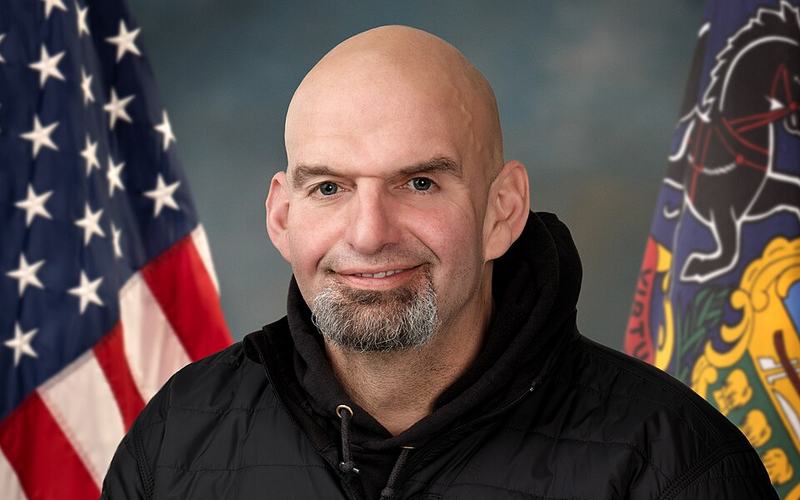
President Donald Trump publicly encouraged Democratic Sen. John Fetterman of Pennsylvania to switch parties Saturday, arguing that the senator would be better suited to the Republican Party as political divisions within the Democratic caucus continue to draw attention ahead of the November midterm elections.
“I'd love to see him as a Republican,” Trump told reporters at Joint Base Andrews after returning to Washington from a rally in Tennessee. “He does better as a Republican than he does as a Democrat.”
Trump’s comments represent a direct appeal to a senator who has increasingly broken with his party on several high-profile issues, including immigration and Israel. Fetterman was once viewed as a rising Democratic star following his 2022 Senate victory, but his willingness to challenge positions held by fellow Democrats has fueled speculation about his political future.
Fetterman, however, has repeatedly rejected the idea of becoming a Republican. In a May opinion piece for The Washington Post, he described himself as a “terrible Republican who still votes overwhelmingly with Democrats,” pushing back against speculation that his disagreements with the party could lead to a formal switch.
His relationship with Democratic colleagues has faced additional strain following his appearance in a video for the Republican midterm convention last month. In the video, Fetterman praised Pennsylvania’s Republican Sen. Dave McCormick and criticized what he characterized as extremism and socialism within his own party.
“I’m always going to stand with America,” Fetterman said. “I’m always going to reject the extremes and socialism and that anti-American way of life.”
Those comments have raised questions about whether Fetterman could face a difficult path if he seeks the Democratic nomination for another Senate term. While he has continued to identify as a Democrat, his willingness to publicly criticize elements of the party could complicate relationships with activists and voters who expect greater party unity.
A representative for Fetterman did not immediately respond to a request for comment on Trump’s latest appeal.
The exchange comes as Republicans and Democrats prepare for a closely watched midterm election that could determine control of the Senate. Democrats need to gain four seats to secure a 51-seat majority, making competitive races and potential changes in party affiliation especially significant.
Republicans are facing political headwinds tied to Trump’s unpopularity and economic fallout from the war with Iran, factors that have encouraged Democrats to view a Senate takeover as a more attainable goal. Nevertheless, winning four additional seats remains a substantial challenge.
A party switch by Fetterman could have major consequences if the Senate is closely divided. If Democrats secured a 51-seat majority, his continued presence in the caucus could give him additional influence in negotiations over legislation and other Senate business. Leaving the party could alter that political calculation, depending on the chamber’s final balance of power.
Senate history offers examples of party switches changing the balance of power. In 2001, Vermont Sen. Jim Jeffords left the Republican Party and became an independent who caucused with Democrats, giving them control of the Senate. In 2009, Pennsylvania Sen. Arlen Specter left the Republican Party to join the Democrats, helping the party move closer to a filibuster-proof majority.
For now, Fetterman has shown no indication that he intends to follow either path. Trump’s public invitation nevertheless highlights the political significance of the Pennsylvania senator’s independence at a time when even a single senator’s affiliation could matter in a closely divided chamber.

Comments
No comments yet. Be the first to share your thoughts.