
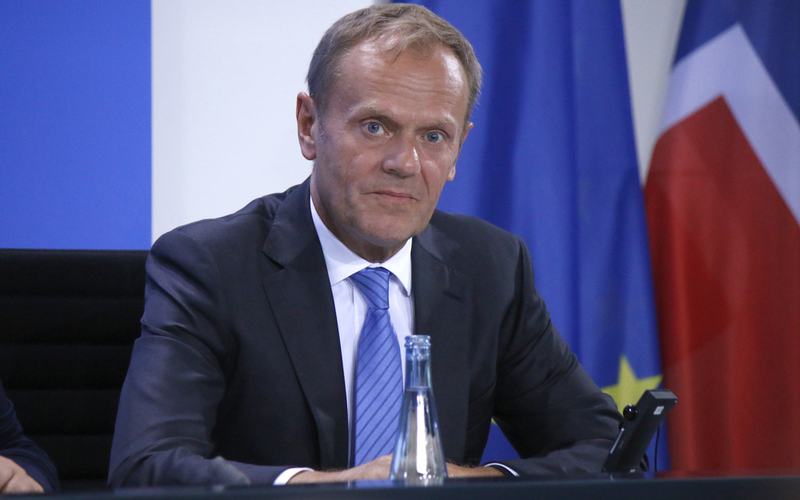
Police raided the grounds of Poland's Constitutional Tribunal in Warsaw, the country's top constitutional court, and prevented its president, Bogdan Święczkowski, along with Vice President Bartłomiej Sochański, from entering the premises in a move that has sparked accusations of a coup.
The move came after Anna Korwin-Piotrowska, a judge aligned with Prime Minister Donald Tusk's government that was elected to the tribunal due to the support of Tusk's ruling coalition, announced one-month suspensions of the two officials. The tribunal's own website confirmed the suspensions of Święczkowski and Sochański, as well as claiming leadership of the court would fall to Korwin-Piotrowska herself.
However, the court's official account later denounced the action outright as a "coup d'état," claiming the website had been unlawfully taken over and that Święczkowski remained in office as Korwin-Piotrowska had never been sworn in by the president as is therefore not a judge.
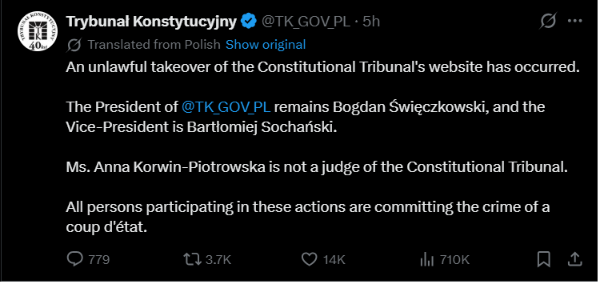
Despite this, police acted on a report from Korwin-Piotrowska of potential threats and public order risks amid Law and Justice party protests outside the building. They detained three people and refused Święczkowski and Sochański access.
This crisis builds on years of judicial reform battles. The Law and Justice party (PiS), in power from 2015 to 2023, faced accusations of reshaping the Constitutional Tribunal to align with its priorities, prompting EU disputes. Tusk's coalition, which took office in late 2023, pledged to reverse those changes but has been slowed by a largely paralyzed tribunal amid challenges over valid judges and oaths.
The incident has fueled widespread claims of a coup d'état from the nationalist opposition, the tribunal itself, and spectators worldwide, with opposition leader Jarosław Kaczyński calling the events the start of a "police state" leading toward authoritarianism.
Supporters of the opposition quickly gathered in Warsaw outside the tribunal, chanting against Tusk and holding religious symbols in protest.
🚨🇵🇱Polish patriots take to the streets of Warsaw to defend their country from the EU and Donald Tusk!
— Mario ZNA (@MarioBojic) October 30, 2026
Tusk has seized the Constitutional Tribunal in Warsaw, carrying out a blatant coup d'état!
President Karol Nawrocki has just landed in Warsaw to stop the chaos!…
Tusk posted on X amid the events on Friday. His post, while not admitting any personal involvement, defended the move as necessary. He justified the incident to restore the rule of law after years of what he called “PiS-lawlessness”.
"There is no other way," he wrote.

The government has long accused PiS-appointed judges of blocking parliament-elected nominees and prioritizing national law over EU rulings, contributing to past fines from Brussels. Tusk's coalition has faced repeated obstacles in the form of vetoes from Polish President Karol Nawrocki, an ally of the nationalist opposition elected in 2025.
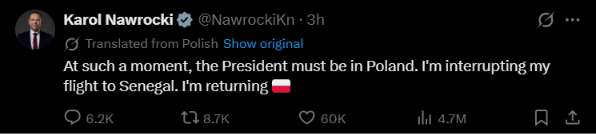
President Nawrocki was out of the country on a state visit to Senegal when the events unfolded. He ordered his plane turned around mid-flight and returned immediately to Warsaw after the news broke of the incident. "At a moment like this, the President must be in Poland," he posted to X.
In another direct response to the developments from a Polish official, Poland's Ambassador to China, Jakub Kumoch, resigned from his post on Friday. He stated on X that "in light of the events in the country, I have concluded that it is not possible for me to continue serving as the Ambassador of the Republic of Poland." Kumoch submitted his resignation and requested recall effective immediately.
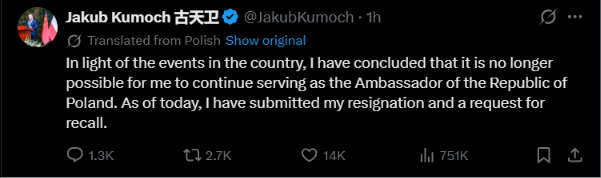
Foreign Minister Radosław Sikorski acknowledged the move, describing it as an unprofessional end to the mission and stating that Kumoch no longer represents the Republic. Presidential advisor Marcin Przydacz, on the other hand, praised Kumoch's decision as an act of courage against what he called the government's violation of law and forceful attack on the Constitutional Tribunal.
Reactions from international officials varied on Friday evening. American Ambassador to Poland, Tom Rose, addressed the crisis in a statement, describing the events as "very serious" and noting an "unprecedented confrontation over the government’s use of state power and the independence and authority of a constitutional institution." Rose emphasized that both sides offer different accounts and urged all parties to "take a deep breath" to avoid escalation or an outbreak of violence.
"America is on Poland’s side," Rose wrote. He finished by saying that "Poland has come too far and accomplished too much to let political differences, no matter how strongly felt, put any of that at risk."
The events unfolding tonight at Poland’s Constitutional Tribunal are very serious indeed. We appear to be witnessing an unprecedented confrontation over the government’s use of state power and the independence and authority of a constitutional institution.
— Ambassador Tom Rose (@USAmbPoland) October 30, 2026
Both sides offer…
The European Commission issued a statement that similarly urged de-escalation, with further warnings that any undermining of judicial bodies could trigger rule-of-law proceedings against member states.
These confrontations occur ahead of Poland's next parliamentary elections in 2027, raising stakes for both sides in a deeply polarized political landscape between Tusk's coalition and the right-wing opposition backed by the president. How this event will impact the future direction of Poland is still unclear, but Nawrocki's swift return on Friday evening and reactions from the international community signal that the actions from Tusk's government have elevated the constitutional standoff to new heights.

Comments
No comments yet. Be the first to share your thoughts.