
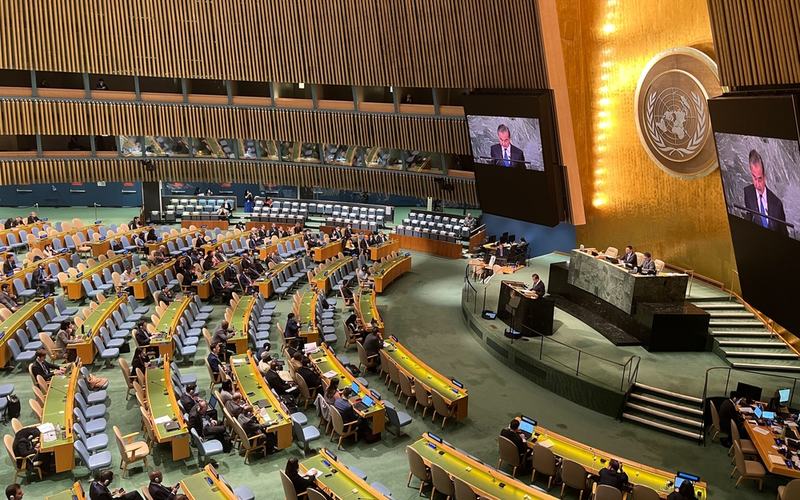
The United Nations General Assembly’s annual vote condemning the U.S. trade embargo against Cuba recorded its lowest level of support since the resolution became a regular feature of the body’s proceedings in the 1990s, signaling a shift in international backing for the communist government’s campaign against American sanctions.
On Wednesday, 130 countries voted in favor of the resolution, down from 165 in 2025 and 187 in 2024. Fourteen countries voted against it, while others abstained or did not participate. The changing tally gave the United States a stronger showing against a measure that has traditionally attracted overwhelming support.
The resolution calls on Washington to end its restrictions on trade with Cuba. The United States maintains that the policy is intended to limit resources flowing to the communist government, which has ruled the island for decades. The restrictions include exceptions for food and medicine, and Cuba continues to trade with countries around the world.
Havana routinely blames the U.S. embargo for the island’s economic hardship. Critics of the regime argue that central planning, government control of the economy and corruption have also played major roles in Cuba’s longstanding poverty.
The vote reflected a range of changes in national positions. Argentina, Colombia and Paraguay were among the countries voting against the resolution. Ukraine, which has accused Havana of supporting Russia’s invasion through the involvement of Cuban nationals in Russian military operations, also opposed it. The United Arab Emirates and Morocco joined the opposing bloc.
Several European countries that have supported Ukraine in its war against Russia, including Germany, Italy, Poland and the Netherlands, abstained. Albania, South Korea, the Solomon Islands and Palau were also among those that did not support the resolution.
Other countries, including Venezuela and Syria, were absent from the vote. Their nonparticipation came despite their historical ties to Havana.
Independent Cuban outlet CubaNet identified several notable changes compared with the previous year. Colombia, the United Arab Emirates, Slovenia and Trinidad and Tobago shifted from supporting the resolution in 2025 to opposing it this year. Another 17 countries abstained after voting in favor last year. Bosnia and Herzegovina, Czechia, Costa Rica, Ecuador, Lithuania and Morocco also moved from abstention to opposition, according to the outlet.
Only Madagascar and Nauru supported the resolution this year after abstaining in 2025.
U.S. Ambassador to the United Nations Mike Waltz welcomed the results, arguing that the growing number of countries refusing to support the resolution reflected increasing resistance to the Cuban government’s messaging.
“Today nearly triple the number of nations voted no, abstained, or just chose not to vote,” Waltz wrote, adding that the international community was beginning to push back against what he described as Cuban regime propaganda. He also called attention to allegations of corruption and political oppression in Cuba.
Waltz appeared alongside Orlando Gutiérrez-Boronat, an organizer with the Assembly for the Cuban Resistance, and José Daniel Ferrer, leader of the Patriotic Union of Cuba, a prominent dissident organization.
The vote followed a broader American diplomatic campaign focused on the Cuban government’s human rights record and the wealth of its ruling elite. Earlier in the week, Waltz presented evidence at the General Assembly concerning the wealth of the Castro family and senior Communist Party figures, including claims involving luxury property and personal assets.
The presentation triggered a confrontation with Cuban representatives, who interrupted Waltz as he spoke. Cuban Foreign Minister Bruno Rodríguez was among those involved in the disruption. Waltz’s spokesman, J.P. Freire, was allegedly confronted by a Cuban diplomat who attempted to take his phone. Waltz later said Secretary of State Marco Rubio had signed paperwork to expel the diplomat involved.
The previous week, the U.S. mission also hosted an event titled “Cuba Libre: The Oppression that Havana Hides,” where victims of the Cuban government’s repression described their experiences. A Ukrainian diplomat addressed allegations that Russia was using Cuban nationals as expendable fighters in its war against Ukraine, with Havana accused of allowing the practice to continue.
The General Assembly resolution is nonbinding and does not itself change U.S. sanctions policy. Nevertheless, the lower vote total offers a measure of the declining international support for Cuba’s annual diplomatic effort, even as the government continues to seek relief from American restrictions.

Comments
No comments yet. Be the first to share your thoughts.