
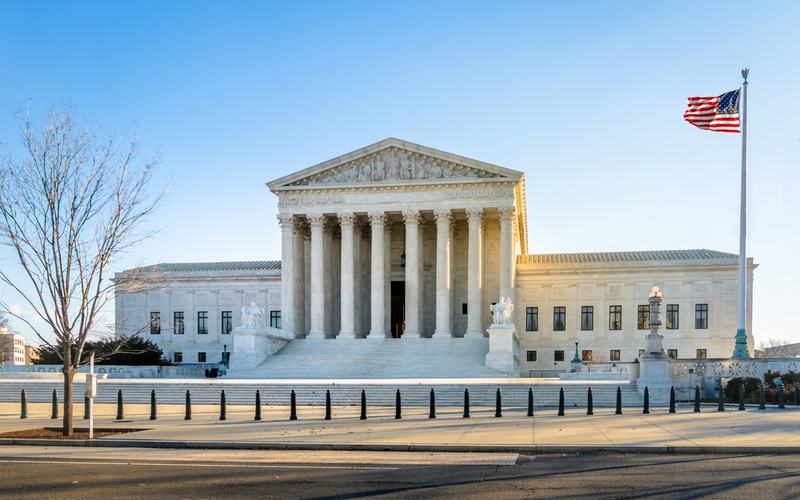
The Supreme Court on Tuesday declined to restore immigration judges’ authority to place deportation proceedings on hold through a practice known as “administrative closure,” rejecting an emergency request from three cities and an immigrant legal advocacy organization.
The justices issued a brief, one-sentence order without explaining their decision. No justice publicly dissented. The ruling leaves in place a lower court decision that permanently invalidated the Biden administration’s regulation governing the practice.
Administrative closure had been used by immigration judges for decades to manage crowded court dockets by temporarily removing certain cases from active consideration. Judges could use the procedure when separate proceedings involving an immigrant might affect whether deportation could proceed, including pending visa petitions or appeals of criminal convictions.
The Trump administration and Texas have argued that the practice allowed immigrants living in the United States illegally to remain in the country indefinitely, effectively providing a form of amnesty without a final resolution of their immigration cases. Ending administrative closure is part of President Donald Trump’s broader effort to tighten immigration enforcement.
In 2024, the Biden administration formally established rules for administrative closure, arguing that the procedure helped immigration judges manage their caseloads and promote fair treatment. That regulation replaced a 2020 rule adopted during Trump’s first term, which had been blocked by the courts.
After Trump returned to office in 2025, the Justice Department’s Executive Office for Immigration Review, which oversees the immigration court system, announced that it would not defend the Biden-era regulation against a legal challenge.
Texas subsequently sued the federal government, arguing that the regulation allowed judges to “effectively grant indefinite amnesty to aliens illegally present in this country.”
On June 22, the Trump administration and Texas jointly asked U.S. District Judge Reed O’Connor to approve an agreement declaring the Biden rule unlawful. O’Connor, who sits in the Northern District of Texas, approved the agreement that day and blocked the regulation nationwide.
Baltimore, New Haven, Connecticut, Columbus, Ohio, and Centro Legal de la Raza, an immigrant legal services organization, sought to intervene in the case to defend the regulation. The cities argued that they have substantial immigrant populations and would be affected by the policy change. O’Connor rejected their request to participate.
The cities and the advocacy group then sought emergency relief from the Supreme Court after the 5th U.S. Circuit Court of Appeals declined to suspend the agreement while the challengers pursued their appeal.
In their Supreme Court filing, the challengers accused the administration of using a coordinated lawsuit with Texas to eliminate a regulation it opposed without following the procedures normally required to change federal agency rules. They described the case as “manufactured litigation” between “ideologically aligned” parties.
“The need for interim relief is underscored by the collusion that infected this suit from its inception,” the challengers argued.
The Supreme Court’s decision does not provide a detailed explanation of its reasoning, and the broader legal dispute can continue through the appeals process. For now, however, the nationwide block on the Biden-era administrative closure regulation remains in effect.

Comments
No comments yet. Be the first to share your thoughts.