
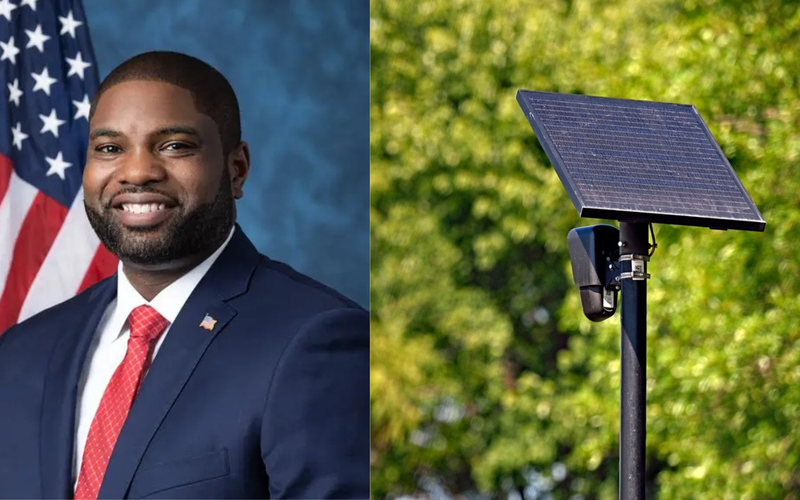
Florida Representative Byron Donalds has expressed support for removing Flock cameras, praising Governor Ron DeSantis’ recent decision to remove the automatic license plate readers from state highways.
Flock cameras capture images of vehicle license plates and store data on vehicle movements, which police departments use to investigate crimes such as stolen-vehicle cases and locate suspects. Currently, there are 120,000 cameras operating in 49 states
“I agree with the Governor 1000% on that,” Donalds said. “The Fourth Amendment is never up for discussion. Other states might take away civil liberties, but that’s not going to happen in Florida. The same way we protect your First Amendment rights and your Second Amendment rights, we take your Fourth Amendment rights very seriously.”
Donalds, who is the Republican nominee vying for DeSantis’ office as the outgoing governor has reached the end of his term, is among the many politicians calling for the removal and/or slowdown of Flock camera installations.
DeSantis’ comments regarding the Flock cameras have more so been against the notion of turning Florida into a surveillance state rather than removing a tool used by officers for immigration enforcement.
CHECK THIS OUT: How DeSantis’ Endorsement Changes the Game for Byron Donalds' Bid For Governor
“They will say that they’ve used them on apprehensions of some illegal aliens. And so, I don’t doubt that. And if that’s being done very targeted, then we can have a conversation,” DeSantis said in an interview with Eric Bolling.
The two Florida Republicans are the latest among many politicians rejecting the use of AI cameras in the U.S. Opposition to the Flock cameras has become a bipartisan issue, with Texas Gov. Greg Abbott freezing state spending on Flock Safety cameras on Monday after an investigation revealed significant taxpayer funding for the automated license plate readers.
Abbott halted funding just before reports detailed that at least $30 million had been spent by one state agency.
Republican Reps. Thomas Massie of Kentucky and Tim Burchett of Tennessee proposed federal legislation to withhold funding from agencies that use the cameras or to ban federal purchases of similar technology. Sen. Josh Hawley, R-Mo., launched an inquiry into Flock's data practices.
Cambridge, Massachusetts, voted unanimously last year to pause its system after initial approval, citing risks of data access by federal immigration authorities. Other cities in Washington, Oregon, Arizona, and Texas suspended contracts over similar fears, especially after a brief Flock pilot with the Department of Homeland Security.
Local examples include Macon County, North Carolina, where a Republican commissioner described unanimous opposition uniting residents.
Monroe County, Indiana, ended its contract early despite acknowledging crime-solving benefits. Austin and Bandera, Texas, also terminated agreements.
Critics highlight privacy risks, potential misuse by officers for personal stalking, and warrantless tracking of law-abiding citizens.
Florida Attorney General James Uthmeier warned that punishment for misuse of Flock cameras could include criminal consequences, telling law enforcement officers they could face criminal consequences if they misuse data collected to track private citizens.
Public retaliation against Flock has continued, with numerous arrests made for vandalizing the cameras. Those who have rejected the camera’s implementation share their concerns about data sharing, saying that the use of Flock has been unregulated and needs built-in safeguards. Defenders of Flock, namely law enforcement, have reported a sharp drop in vehicle-related crimes, including burglaries.
While the debates continue, politicians across the country have responded to the public backlash against Flock, hoping voters recognize their efforts ahead of the November elections.

Comments
No comments yet. Be the first to share your thoughts.