
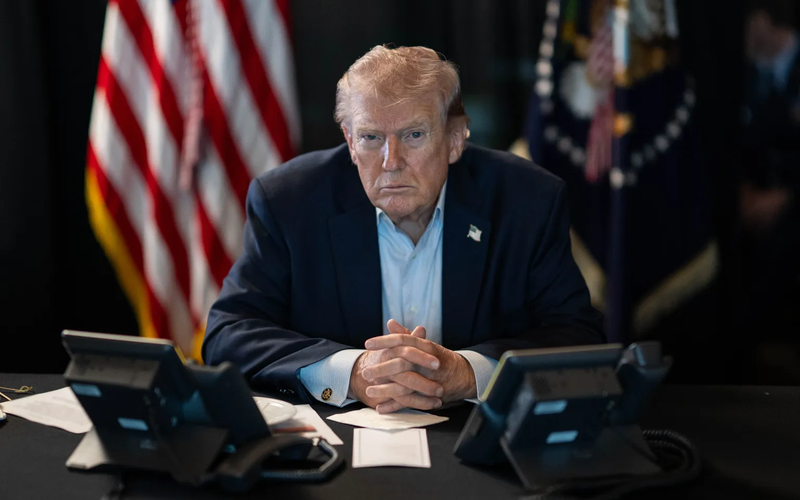
President Donald Trump announced Tuesday evening that the United States will pause "Project Freedom," a recently launched military operation to guide stranded commercial vessels through the Strait of Hormuz.
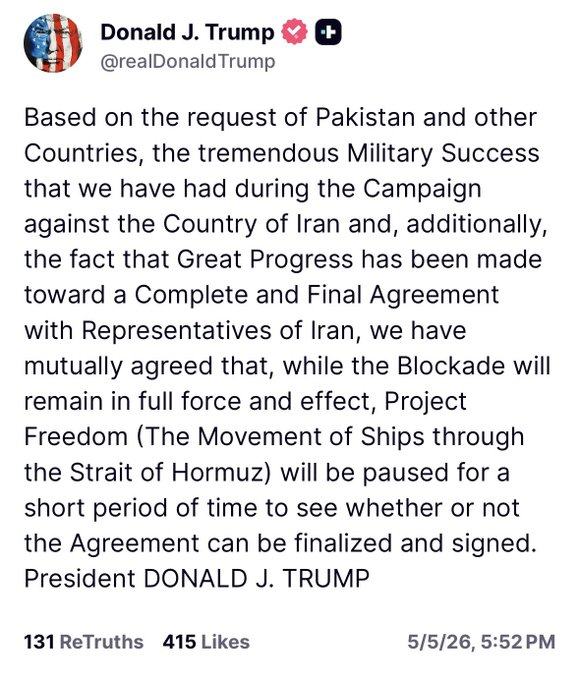
Trump made the decision via a post on Truth Social, citing a request from Pakistan and other countries, recent military successes against Iran, and substantial progress toward a final agreement with Tehran. "Project Freedom (The Movement of Ships through the Strait of Hormuz) will be paused for a short period of time to see whether or not the Agreement can be finalized and signed," Trump stated. He emphasized that the U.S. naval blockade of Iranian ports and ships would remain fully in effect.
Launched on Monday, May 4, Project Freedom aimed to restore freedom of navigation through the strait, a vital chokepoint for about one-fifth of the world's seaborne oil trade. U.S. Central Command provided support using guided-missile destroyers, more than 100 land- and sea-based aircraft, multi-domain unmanned platforms, and roughly 15,000 service members. The effort created an enhanced security area on the southern side of the strait to protect against Iranian aggression.
In its brief operation, the mission successfully guided two U.S.-flagged merchant vessels and at least one other, such as a Maersk ship, safely out of the Persian Gulf. U.S. forces also cleared Iranian mines from a safer route farther from Iran's coast and contacted dozens of trapped neutral vessels. Over 1,500 ships carrying around 22,500 mariners from 87 countries had been stuck inside the gulf due to Iran's effective blockade.
The strait has been choked off for weeks amid ongoing tensions. Iran has conducted attacks on commercial shipping, including nine incidents since an April 8 ceasefire, seized two container ships, and deployed mines, drones, missiles, and small boats. During Project Freedom's initial transits, Iran fired at U.S. warships and vessels, prompting U.S. forces to sink six Iranian boats and intercept threats without sustaining hits.
The operation followed the conclusion of Operation Epic Fury, a U.S. combat campaign against Iran that ended last week after meeting a 60-day threshold notified to Congress. Defense Secretary Pete Hegseth described Project Freedom as defensive and separate, noting American ships had led the way despite risks. Secretary of State Marco Rubio called it a "protective bubble" and the first step to counter Iran's "economic arson."
Progress in talks comes as Iran's foreign minister visited Beijing for discussions, part of a diplomatic push. The U.S. has demanded Iran cease attacks, disclose mines, and allow humanitarian corridors, backing a UN Security Council resolution. Oil prices have risen sharply, with U.S. gasoline averaging $4.50 per gallon, up 50% since the conflict escalated in February.
The pause offers a diplomatic window but leaves the blockade intact and the strait closed to most traffic. Officials have not ruled out resuming operations or stronger actions if negotiations fail.

Comments
No comments yet. Be the first to share your thoughts.