
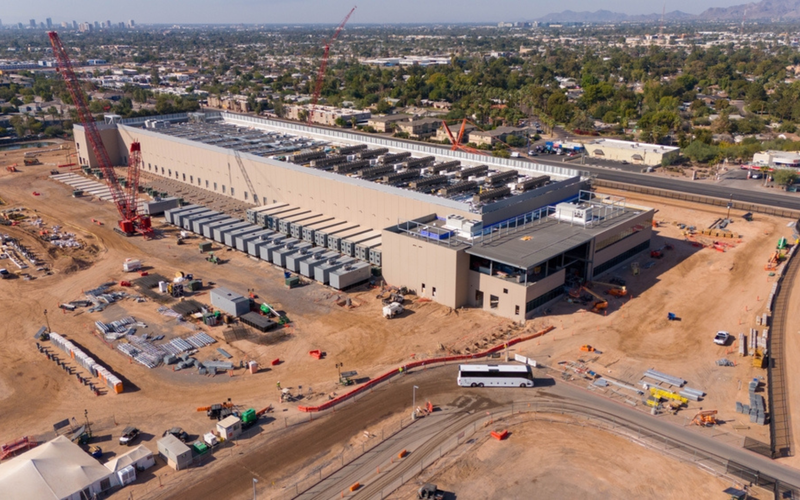
Data centers are purpose-built facilities that house thousands of servers, storage systems, and networking equipment to process, store, and transmit vast amounts of digital information.
They support everyday cloud services as well as the intensive computing required for artificial intelligence training and inference.
The recent surge in data center construction stems primarily from the generative Artificial Intelligence boom that began with the public release of tools like ChatGPT in late 2022.
Companies including Amazon, Microsoft, Google, and Meta have dramatically increased capital spending on AI infrastructure, with projections exceeding $700 billion in 2026 alone.
U.S. data center construction spending rose from $27 billion in 2024 to an estimated $41 billion in 2025, with the annualized rate approaching $53 billion entering 2026.
As of August, 4,713 US data center facilities across 52 states and territories. According to the US Data Center Map, 3,567 are operational, 307 are under construction, and 751 are planned or approved.
How Data Centers Impact the Environment
Environmental concerns are a hot-button issue regarding data centers, as massive water use has caused fear of draining local water supplies.
A study by the Florida Water & Pollution Control Operators Association notes that one large facility can use as much water as a small city, adding that the water is not used as a raw material but rather to keep servers cool.
Several means can be used to maintain data center cooling, which the study states include: Air cooling, evaporative cooling, closed-loop water cooling, direct liquid cooling and immersion, and free cooling.
While there are several means of cooling servers, water cooling is the most common method in data centers worldwide, accounting for roughly 75-90% of installations, according to the study.
Bipartisan Support Against Data Centers
Opposition has mounted rapidly from both political parties. A Gallup poll found roughly seven in ten Americans oppose building a data center near their home. Concerns center on massive electricity consumption that drives up utility rates for residents, heavy water usage for cooling, noise pollution, land consumption, and limited local job creation.
More than 800 groups across 49 states are actively opposing roughly 1,500 planned projects, and at least 75 facilities worth about $130 billion faced delays or blocks in the first quarter of 2026.
Politicians have shifted positions ahead of the midterms. Democratic governors, including Pennsylvania's Josh Shapiro and New York's Kathy Hochul, have imposed strict restrictions or a one-year moratorium on large-scale projects.
In Texas, Republican Gov. Greg Abbott reversed his enthusiasm and paused new approvals pending further review.
Initially, Texas was promoted as a hub for AI facilities; however, pushback from county governments and residents prompted Abbott to reconsider his approach, calling for a prohibition on data centers in rural neighborhoods and outlining guardrails requiring projects to bring in their own power, reuse water, and avoid passing costs to ratepayers.
How Are AI Companies Responding?
Faced with local moratoriums and rising political pressure, technology firms are pivoting away from traditional infrastructure to invest in next-generation grid technology and community benefits. These companies are aiming to overcome physical constraints of power and water to sustain the artificial intelligence boom, focusing on cleaner energy storage, municipal infrastructure, and local job creation.
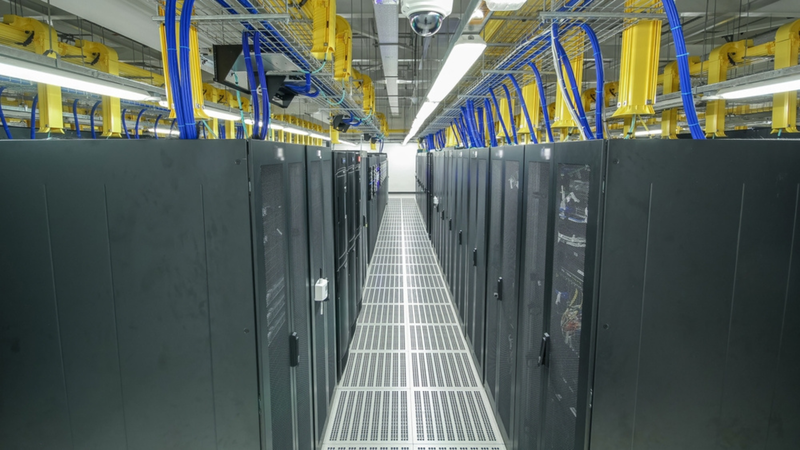
Leading AI companies have announced initiatives to reduce the environmental strain data centers cause.
An example includes the use of Battery Energy Storage Systems, or BESS, which are essentially large batteries that store electricity when it’s available and release it when it’s needed. This makes them ideal for data centers, which require a constant, reliable power supply.
Utilizing lithium-ion batteries, the same type found in smartphones and electric cars, BESS can react almost instantly, much faster than diesel generators, helping data centers stay online without interruption, while producing no emissions when in use.
Oracle, an AI company, has offered funding for youth programs and pledged to invest $50 million in water and wastewater systems in New Mexico amid work on Project Jupiter, a $165 billion data center complex planned near the Mexican border.
In addition, Oracle announced plans with an agricultural technology company to install sensors that will provide farmers with real-time data on water use, estimating this will save about 21 million gallons annually.
The sudden rise of data centers has, in turn, created thousands of construction jobs throughout the country to meet demand. Economically, data center development has provided well-paying opportunities for full-time staff, such as technicians, security personnel, and facility managers.
According to the World Resources Institute, at Google’s data center in central Ohio, salaries range from about $74,000 for a data center technician to more than $160,000 for an operations manager.
The apparent pros and cons of data centers have kept discussions ongoing, with both sides making convincing arguments about the need and scale of facilities across the country.

Comments
No comments yet. Be the first to share your thoughts.