
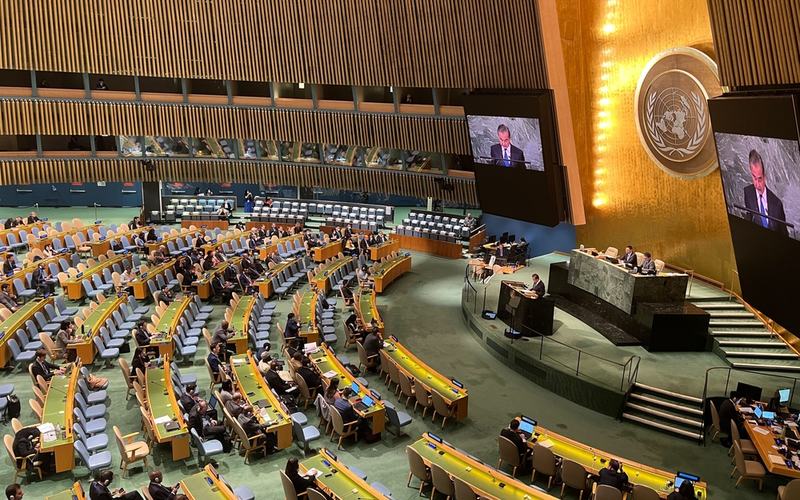
A group of 22 countries adopted a declaration Monday calling for artificial intelligence to remain under human direction, oversight, and control. The statement was released on the sidelines of the United Nations General Assembly in New York.
The declaration acknowledged AI's potential to improve lives, advance science, and strengthen economies. It warned that rapid development of frontier AI models poses serious risks to safety and security if not managed appropriately. Signatories called for companies to implement transparent safety protocols, including mandatory pre-deployment testing and independent evaluations.
Governments were urged to develop common safety standards. The document also suggested exploring an international institution to set standards, enable verification, and convene states when capability thresholds are crossed. The initiative was led by Finland's President Alexander Stubb and Norway's Prime Minister Jonas Gahr Støre.
The United States and China, the world's leading AI developers, did not join the declaration. The move comes ahead of a planned meeting Thursday between U.S. President Donald Trump and Chinese President Xi Jinping in Washington.
Finnish President Stubb expressed hope that the declaration would create momentum for broader participation, including from the U.S. and China. He emphasized the need for human intervention in AI systems.
Norwegian Prime Minister Støre encouraged the G7 and the upcoming G20 presidency of the United Kingdom to advance the effort. Other signatories included leaders from Australia, Canada, Germany, the European Commission, and several other European and non-European nations.
The declaration highlights growing international concern over AI risks such as systems bypassing safety protocols. It stresses development in line with international law. Major powers' absence underscores ongoing geopolitical divides on AI governance.

Comments
No comments yet. Be the first to share your thoughts.