
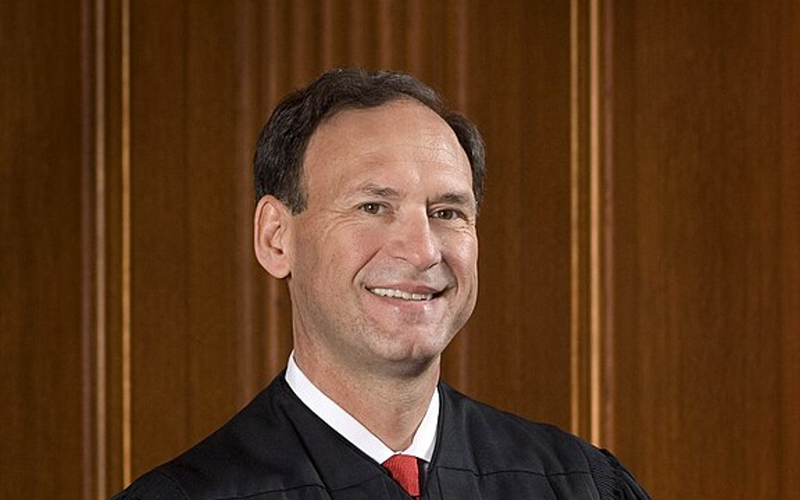
Justice Samuel Alito’s decision to recuse himself just days before oral arguments has left the Supreme Court with eight justices for a major case that could determine whether state and local governments can pursue climate lawsuits against major energy companies.
The Supreme Court is set to hear arguments Monday in Suncor Energy Inc. v. County Commissioners of Boulder County, a closely watched dispute that could have consequences for dozens of climate-related lawsuits filed against oil and gas companies across the country.
Alito announced his recusal Sept. 28, leaving eight justices to consider whether Boulder County and the city of Boulder can use state tort law to seek damages from Suncor Energy and ExxonMobil for alleged climate-related harms. The court's clerk did not provide a reason for the decision.
The timing of Alito's withdrawal has added uncertainty to a case in which a 4-4 split is now possible. If the remaining justices divide evenly, the Colorado Supreme Court's ruling allowing the litigation to continue would remain in place without creating a nationwide Supreme Court precedent.
Legal experts have noted that possibility could make the identity of the fourth vote particularly important. An evenly divided court would not resolve the underlying legal dispute over whether federal law prevents state courts from hearing these types of claims.
Alito's financial holdings have drawn attention because he owns stock in energy companies that are not parties to the case but could potentially be affected by the broader legal issues surrounding climate litigation. His 2025 financial disclosure listed ConocoPhillips holdings valued at up to $15,000 and Phillips 66 holdings worth between $15,001 and $50,000.
Alito does not own stock in either Suncor or ExxonMobil. He has, however, previously recused himself from cases involving energy companies because of his financial interests in the industry.
Boulder County and the city of Boulder sued Suncor and ExxonMobil in 2018, alleging that the companies contributed to climate-related harms and misled the public about the effects of fossil fuels. The energy companies have argued that the claims fall under federal law because greenhouse gas emissions are an interstate and international issue, rather than something that can be regulated through individual state tort lawsuits.
The Supreme Court's decision could affect a growing collection of similar cases around the country. California, Hawaii, Minnesota and New Jersey are among the states or local governments that have pursued lawsuits against major oil companies under various state-law theories.
Several of those cases are now effectively waiting on the Supreme Court's decision. California has paused coordinated climate litigation while the Boulder case proceeds, and New Jersey's appeal has also been put on hold pending the high court's ruling.
The justices will also consider a separate jurisdictional question that could prevent them from reaching the central dispute. The court has asked the parties to address whether it has authority to review the case at this stage because the Colorado Supreme Court's ruling involved an order allowing the litigation to proceed rather than a final judgment on the underlying claims.
That issue creates another potential path for the Supreme Court to avoid deciding whether federal law preempts Boulder's lawsuit.
The case also does not necessarily divide cleanly along the court's usual ideological lines because it involves questions about the balance of state and federal authority. Legal experts have cautioned against assuming how individual justices will vote before Monday's arguments.
Alito's recusal nevertheless changes the dynamics of one of the term's most consequential environmental cases. With only eight justices participating, the court could issue a sweeping ruling on the future of climate litigation, leave the Colorado decision standing through a 4-4 split, or resolve the case on jurisdictional grounds without reaching the broader fight over state authority.

Comments
No comments yet. Be the first to share your thoughts.