
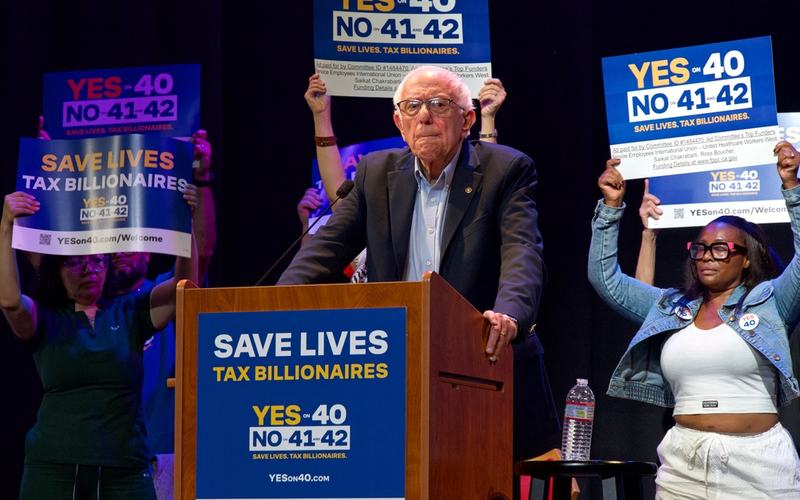
California voters have rejected Proposition 40 in the November 2026 election, defeating a high-profile one-time wealth tax on the state’s billionaires. With roughly 70% of votes counted in early tallies, the measure trailed with “No” at about 53.7–55.6% and “Yes” at 44–46%, according to Associated Press and state figures. It needed a simple majority to pass; a call from the Decision Desk late on Friday evening declared that it fell short.
Sponsored primarily by SEIU-United Healthcare Workers West, Prop 40 would have imposed a one-time 5% tax on the net worth of individuals and trusts with assets valued over $1 billion who were California residents as of January 1, 2026. The tax targeted accumulated wealth, including stocks, business holdings, and other assets, and was payable over up to five years. Proponents estimated it could raise around $100 billion (or “tens of billions,” per the Legislative Analyst’s Office), with 90% directed to healthcare services to offset federal cuts to Medi-Cal and related programs. the remainder was intended to be used for food assistance, education, and administration.
Senator Bernie Sanders made the initiative a personal priority and was among its most vocal advocates. He repeatedly called it “the most important ballot measure in the nation,” rallied crowds in Los Angeles and San Francisco, and framed the fight as a litmus test for confronting extreme wealth inequality. He was joined by Representative Ro Khanna, the California Democratic Party, the California Nurses Association, and other progressive and labor groups. They argued that billionaires’ wealth has grown far faster than ordinary incomes and that the tax would provide a temporary backfill for permanent federal healthcare cuts.
The failure lands as more than a single ballot loss. In a year when Democrats made substantial national gains, candidates associated with Sanders’ progressive wing underperformed relative to non-endorsed Democrats. Sanders-endorsed candidates outperformed Kamala Harris’s 2024 margins by roughly five to six points on average, while candidates outside his orbit posted gains of roughly 14 points or more. The gap suggests the midterms reflected a broader backlash against the opposing party more than a mandate for the most left-wing economic agenda. That underperformance, and now a failed ballot initiative in a blue stronghold like California, is raising questions about whether Sanders’ endorsement and the progressive machine that accompanies it have become liabilities even in favorable conditions.
Opponents to Prop 40, including business groups, the California Teachers Association, Planned Parenthood Affiliates of California, and tech figures, called it poorly designed, a one-time fix for ongoing needs, and likely to accelerate capital flight that would reduce future income-tax revenue. The opposition campaign spent heavily against the measure's passage, some estimates placing the cost in the hundreds of millions.
California Governor Gavin Newsom was one of the measure’s most prominent critics. He argued a state-level wealth tax would be counterproductive because “wealth is movable” and billionaires can relocate, taking their income-tax contributions with them. He warned it was already prompting departures and would harm California’s budget and competitiveness more than it helped.
Newsom has instead advocated a national approach, including a federal minimum tax on billionaires, sweeping changes to inheritance rules, and other measures to address the perceived problem without state-by-state flight risk. He personally lobbied backers to withdraw the initiative and endorsed Proposition 42, an opposing measure which would ban new taxes on personal property including financial assets and most retroactive taxes.
Newsom’s stance created a split within the California Democratic Party. While the state party and progressives endorsed the tax, many establishment figures and some unions sided with the governor. He framed Prop 40 as “poorly written” and focused too narrowly on one spending category.
To Newsom's point, California has seen significant out-migration of businesses and high-net-worth individuals since he took office in 2019. Trackers and reports document hundreds of company headquarters or major operations relocations. A Hoover Institution analysis noted 352 headquarters moved out of state from 2018–2021. Notable examples include Tesla and SpaceX, Oracle, Chevron, Hewlett Packard Enterprise, Charles Schwab, McKesson, CBRE, Palantir, and others in tech, energy, finance, and consumer sectors. Many cited high taxes, regulation, costs, and business climate. While overall firm departure rates are modest (around 3% in some studies), larger employers have been disproportionately likely to leave, and net business exits have exceeded inflows in recent years.
Among the ultra-wealthy, at least a half-dozen to low double-digit number of billionaires shifted residency, assets, or primary ties out of state in connection with the Prop 40 threat or broader conditions. Google co-founders Larry Page and Sergey Brin were one such example, as were Peter Thiel, Travis Kalanick, and others. Analyses estimated these moves removed roughly 30% of the potential Prop 40 tax base. That equates to tens of billions in potential state revenue. Broader IRS and Census data show net outflows of higher-income households as well. For example, California lost roughly $24 billion in adjusted gross income from departing filers in 2021–2022 alone, with leavers wealthier on average than those arriving. Population has also seen periods of net domestic loss, though international migration has partially offset it. High earners account for a large share of state income-tax revenue, so sustained departures raise long-term fiscal concerns even as California continues to attract venture capital and startups.
Results were still being finalized as of the weekend, with mail ballots continuing to arrive. The projected failure of Prop 40 removes the immediate threat of the one-time levy, but the debate has put on display intraparty tensions over progressive taxation, capital mobility, and California’s reliance on a relatively small number of high earners. It also works to show a narrower point that, even in deep-blue California with Sanders’ full-throated advocacy, the progressive economic agenda he has long championed could not carry the day.

Comments
No comments yet. Be the first to share your thoughts.