
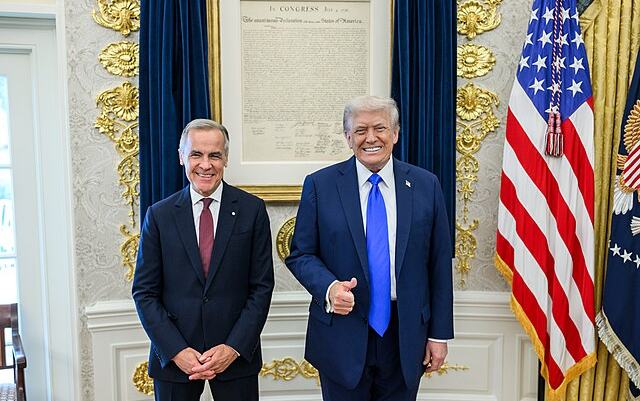
Canadian Prime Minister Mark Carney said Saturday, November 14, that Canada and the United States are making progress toward a potential bilateral trade agreement following a lengthy conversation with President Donald Trump and senior administration officials. Carney's comments came as he announced that Canada had substantially concluded free-trade negotiations with the Association of Southeast Asian Nations (ASEAN) and completed separate negotiations with the Philippines, advancing Ottawa's efforts to diversify its trading relationships amid Trump's tariffs.
Speaking to reporters in Manila, Carney said he held a "long, substantive conversation" with Trump shortly before departing for his international trip. U.S. Trade Representative Jamieson Greer and Trump's new White House chief of staff, Stephen Miller, also participated in the discussion.
"We are making progress. There is the possibility of a deal, a bilateral deal. But we're not yet there," Carney said.
The Canadian prime minister also made clear that Ottawa would not accept an agreement that undermines its domestic automotive industry, which has been affected by U.S. tariffs. Canada suspended trade negotiations in August after Washington made last-minute demands that the Canadian government considered unacceptable. The United States subsequently imposed 50% tariffs on approximately $20 billion in Canadian goods, prompting Canada to introduce retaliatory tariffs in September. The two countries have since resumed discussions.
Canada and the United States maintain one of the world's largest trading relationships, making the outcome of negotiations significant for businesses and industries on both sides of the border. A potential agreement could reduce tariffs affecting major sectors, including steel and aluminum.
Trump said before the midterm elections that the two countries were "very close" to reaching an agreement. Carney, however, said Washington had backed away from demands involving Canadian culture, French-language protections and Canada's ability to negotiate separate trade agreements with other countries.
U.S. tariffs on Canadian products also became an issue during the midterm elections, with Democrats blaming the trade measures for contributing to higher prices and pledging to challenge them. The Democratic victories have added another consideration for Ottawa as it weighs whether to accept an agreement that reduces some of Trump's tariffs while leaving others in place or continue pursuing broader tariff relief as Congress prepares to challenge the administration's trade policies.
While negotiations with Washington continue, Carney is pursuing new economic partnerships to reduce Canada's reliance on the American market. On Saturday, he announced that Canada had substantially concluded free-trade negotiations with ASEAN, a regional bloc representing nearly 700 million people. The Canadian government estimates the agreement could add nearly 2 billion Canadian dollars, approximately $1.4 billion, to the country's economy and create almost 14,000 jobs, particularly in agriculture and manufacturing. Officials hope to sign the agreement next year.
Carney also announced the completion of separate trade negotiations with the Philippines. The proposed agreement would cover more than 90% of tariff lines, according to the prime minister, and the Canadian government estimates it could help triple Canadian exports to the Philippines by 2035. The agreement is also expected to be signed next year.
The announcements are part of Carney's broader effort to expand Canada's international trade beyond the United States. He has made doubling Canadian exports to countries other than the U.S. by 2035 a central economic objective.
Carney traveled to Manila after attending the European Political Community summit in Ireland. He is in the Philippine capital ahead of a three-day ASEAN summit beginning Sunday, where leaders from Southeast Asia and their international partners are gathering to discuss regional and global issues.
His itinerary also includes the Francophonie summit in Cambodia and the Asia-Pacific Economic Cooperation summit in China. During the China visit, Carney is scheduled to meet with Chinese President Xi Jinping.
The Canadian government is pursuing expanded trade relationships across Europe and Asia while continuing negotiations with its largest trading partner. Although Carney said a bilateral agreement with Washington remains possible, he acknowledged that the two countries have not yet reached a deal.

Comments
No comments yet. Be the first to share your thoughts.