
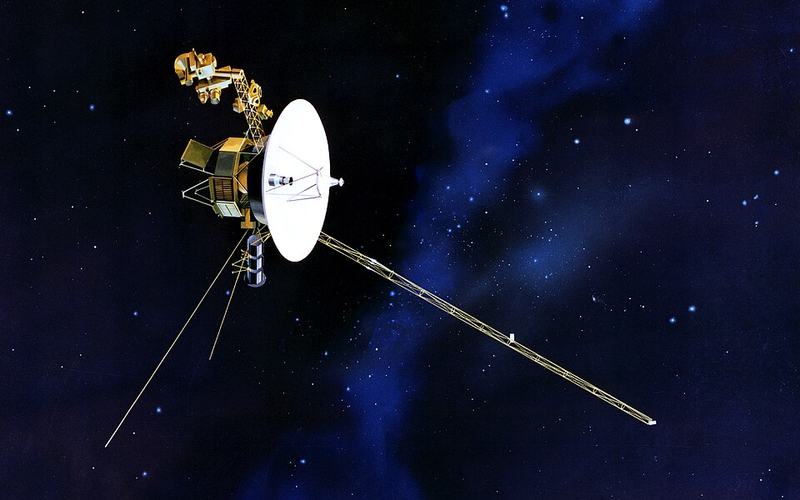
NASA’s Voyager 1 spacecraft is expected to become the first human-made object to reach a distance of one light-day from Earth on Wednesday, November 18, marking another milestone in its nearly 49-year journey through interstellar space.
The spacecraft, launched in 1977, is now more than 16 billion miles (26 billion kilometers) from Earth. Once it reaches the one light-day mark, signals traveling at the speed of light will require precisely 24 hours to reach the planet. NASA estimates Voyager 1 will need another 18,000 years to travel one light-year and considerably longer before approaching another star.
Project manager Suzanne Dodd, who has worked on the Voyager missions since 1984, described the spacecraft as an ambassador for Earth traveling between the stars while continuing to provide valuable scientific information.
“It's a national treasure,” Dodd told The Associated Press, calling the mission “really extraordinary.”
NASA is marking the milestone by encouraging people around the world to participate in a public celebration Tuesday evening. Participants are being asked to use their phones or flashlights to create a wave of golden light after sunset, spelling out the letters V-G-R in Morse code. The letters serve as Voyager's call sign.
Voyager 1 and its twin, Voyager 2, continue to transmit scientific and engineering data despite their age and occasional technical problems. Both spacecraft are traveling at approximately 38,000 mph (61,000 kph) toward different regions of space. Although Voyager 1 launched two weeks before its twin, Voyager 2 is not expected to reach the one light-day milestone until 2035.
Voyager 1 flew past Jupiter in 1979 and Saturn in 1980, providing scientists with important observations before eventually leaving the solar system. NASA considers the spacecraft to have entered interstellar space in 2012, making it the first human-made object to reach the region between star systems. Voyager 2 also visited Jupiter and Saturn, along with Uranus and Neptune, before entering interstellar space in 2018.
The spacecraft continue to send back information about their largely unexplored surroundings, including measurements of magnetic fields, pressure, dust and galactic cosmic rays. Dodd has compared their work to that of weather satellites, providing scientists with information about an environment no spacecraft had previously explored.
A small flight-control team at NASA's Jet Propulsion Laboratory in Pasadena, California, sends commands to the Voyagers approximately once a week. The workload increases when technical problems arise, sometimes requiring assistance from retired engineers who previously worked on the mission.
Controllers completed another power-conservation effort in September to extend the operating lives of the plutonium-powered spacecraft. In October, NASA briefly lost contact with Voyager 1 and is still investigating the cause of the communication disruption.
Despite those challenges, Dodd said the spacecraft have continued operating through decades of technical difficulties, comparing Voyager 1 to “the little engine that could.” The mission has also earned multiple entries in Guinness World Records, including its distinction as the farthest-traveling human-made object.
Voyager 1 also captured one of the most famous images in space exploration. In 1990, from beyond Neptune, the spacecraft photographed Earth as a tiny speck in the distance. The image became known as the “Pale Blue Dot.”
Cornell University astronomer Carl Sagan, who was part of the imaging team, reflected on the photograph when it was introduced to the public that year.
“On that blue dot, that's where everyone you know and everyone you ever heard of and every human being who ever lived, lived out their lives. It's a very small stage in a great cosmic arena,” Sagan said.
The Planetary Society's Bill Nye also highlighted the mission's lasting significance, saying that people around the world have been touched by the Voyager spacecraft even though most of those alive today were born after their launch. The organization was co-founded by Sagan in 1980.
Sagan also helped develop another defining feature of the mission: the Golden Record. Both Voyager spacecraft carry a 12-inch (30-centimeter) gold-plated phonographic record containing greetings in 55 languages, along with images and diagrams intended to introduce Earth and humanity to anyone who might eventually discover them.
Among the recordings is a greeting from Sagan's son Nick, who was 6 years old at the time: “Hello from the children on Planet Earth.” Each spacecraft also carries a stylus and instructions explaining how the record can be played.
Dodd described the Golden Record as “a time capsule of life on Earth from 1977,” adding that she hopes someone might discover it a thousand years from now.

Comments
No comments yet. Be the first to share your thoughts.