
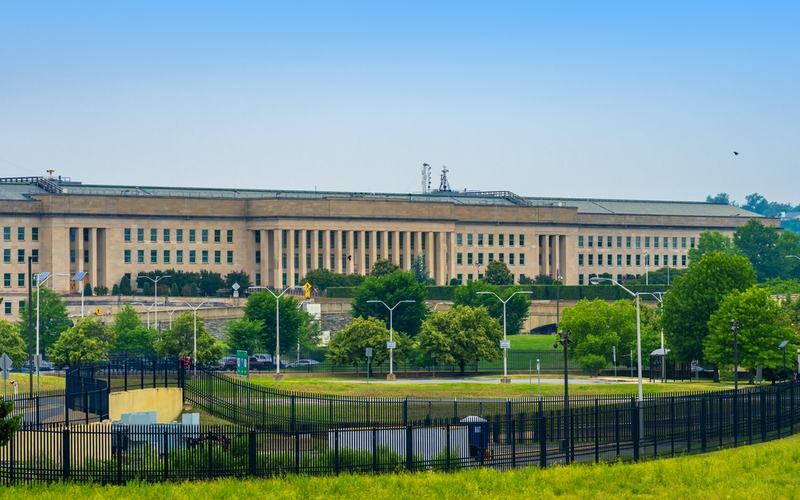
President Donald Trump's $1.15 trillion defense authorization proposal is facing a major battle in Congress as Democrats push for spending cuts and tighter congressional oversight of military operations against Iran, putting the annual National Defense Authorization Act (NDAA) at risk of breaking a 65-year streak of passage.
The NDAA establishes Pentagon policy, authorizes military programs and provides the framework for national defense priorities. The administration is seeking $1.15 trillion in defense spending, with an additional $350 billion proposed through a third budget reconciliation package. If both proposals advance, total defense funding could reach approximately $1.5 trillion.
Democrats in both the House and Senate have resisted the legislation, seeking hundreds of billions of dollars in spending reductions and restrictions on the administration's ability to conduct further military operations against Iran. The dispute has created another major partisan confrontation over Trump's national security agenda.
"The politics are absolutely dismal between the two branches right now," Mackenzie Eaglen, a defense budget expert at the American Enterprise Institute, told The Hill.
Eaglen warned that allowing the NDAA's longstanding bipartisan passage record to collapse could make future agreements on military policy and funding more difficult.
"Once redlines are crossed, it is difficult to go backward. I fear the necessary and bipartisan NDAA is fragile in this new era but hope I'm wrong," she said.
The legislation has already encountered unusually close votes on Capitol Hill. The House Armed Services Committee approved its version of the bill 44-12 in June, with only half of its Democratic members voting in favor. The full House passed the measure in July by a narrow 216-212 vote, with six Democrats supporting it and seven Republicans opposing it.
The Senate has faced even greater difficulty advancing its version. Democrats blocked a procedural effort to move the legislation forward over disagreements about defense spending and the administration's military campaign against Iran. The vote failed 50-46, falling short of the 60 votes required.
Senate Majority Leader John Thune, R-S.D., also voted against advancing the measure, preserving the opportunity for the chamber to reconsider it later. Senate Armed Services Committee Chairman Roger Wicker, R-Miss., criticized the Democratic opposition as "unprecedented."
The Iran conflict has emerged as one of the central disputes. Pentagon figures put the estimated cost of the military campaign at $47.1 billion as of October 16, an increase of $3.5 billion from early September, according to Stars and Stripes.
Democrats have challenged Trump's February 28 decision to launch military operations without congressional authorization and are seeking provisions that would limit future strikes against Tehran. Their demands would give Congress a greater role in determining the scope and continuation of military action.
Republicans are expected to defend the administration's proposed defense spending levels, while Democrats are seeking concessions on both funding and military authority. The negotiations also involve the Pentagon's effort to formally rename the Department of Defense as the Department of War, a proposal that has drawn Democratic opposition.
Despite the growing disagreements, congressional negotiators are hoping to resolve the outstanding issues after the November midterm elections, with the goal of completing the legislation by Thanksgiving.
House Speaker Mike Johnson, R-La., has emphasized the importance of reaching an agreement, pointing to the security challenges facing the United States.
"It's very important," Johnson told Punchbowl News. "You know, we're in very dangerous times. There's a lot going on. We have to come together and get it done."
The NDAA has passed annually for 65 consecutive years, making it one of Congress's most consistent bipartisan legislative achievements. A failure to reach an agreement this year would break that record and leave major defense policy and funding questions unresolved.

Comments
No comments yet. Be the first to share your thoughts.