
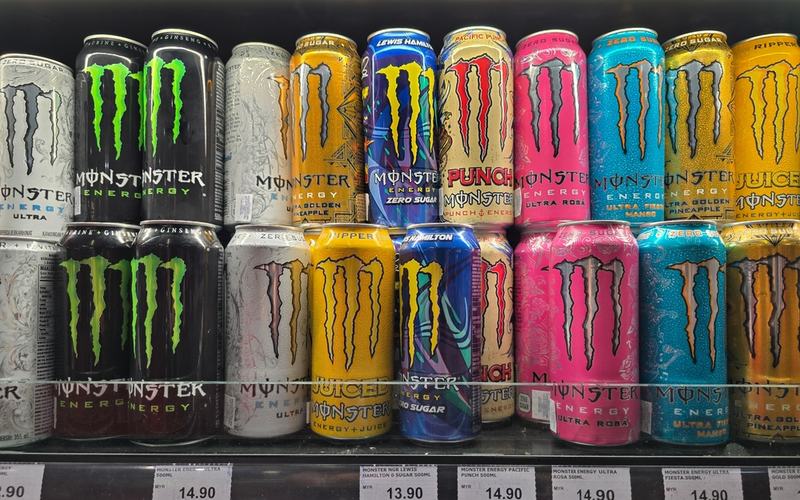
Doctors are raising new concerns about the risks energy drinks can pose to children and teenagers following a sponsorship agreement between Monster Energy and the Big 12 Conference.
The coalition has asked Big 12 leaders to pause the partnership and called on the NCAA to review how energy drinks are marketed to young people. The doctors say their concerns extend beyond Monster and include energy drinks generally, particularly because of the high amounts of caffeine and other stimulants many products contain.
The Big 12's agreement with Monster includes co-branded logos on football and basketball jerseys, playing fields and courts, as well as digital and social media promotions. Doctors involved in the effort worry that those partnerships could make energy drinks appear similar to ordinary sports drinks in the eyes of young athletes.
“Kids are going to see energy drinks now promoted by the universities and the athletes that they admire and want to emulate,” said Dr. Matthew Nelson, an Idaho cardiologist involved with the effort. “The kids will think of them as sports drinks, which they’re not.”
Medical organizations, including the American Academy of Pediatrics, recommend that children and teenagers avoid energy drinks. The academy recommends that adolescents ages 12 to 18 consume no more than 100 milligrams of caffeine per day, while younger children are discouraged from consuming caffeine.
Energy drinks can contain substantially more caffeine than that. Depending on the product, a single serving can contain between 80 and 300 milligrams of caffeine. By comparison, an 8-ounce cup of coffee generally contains about 80 to 100 milligrams, while some soft drinks contain 50 milligrams or less.
Doctors warn that excessive caffeine and other stimulants can increase heart rate and place additional stress on the cardiovascular and nervous systems. Potential effects include abnormal heart rhythms, elevated blood pressure, agitation, sleep problems, dehydration and, in severe cases, seizures.
Dr. Tamara Hannon, an Indiana pediatrician who chairs the American Academy of Pediatrics' nutrition committee, said children with existing conditions such as high blood pressure can face particularly serious risks. She also cautioned that otherwise healthy children can experience complications when consuming excessive amounts of stimulants.
One case frequently cited by doctors is the 2017 death of 16-year-old Davis Cripe of South Carolina. According to the coroner at the time, Cripe had no known heart condition but consumed a Mountain Dew and a latte from McDonald's before drinking an energy drink. He later experienced an arrhythmia and died.
Cripe's father, Sean Cripe, said the family had warned his son that energy drinks were unhealthy but did not understand that they could potentially be deadly.
The doctors' concerns come as energy drink consumption remains common among teenagers. According to the federally funded Monitoring the Future survey conducted by the University of Michigan, 23% of 12th graders, 20% of 10th graders, and 18% of eighth graders reported consuming energy drinks daily.
Monster defended its products, noting that caffeine is found in many common foods and beverages and saying that mainstream energy drinks have been sold globally for more than three decades. The company also pointed to labeling that warns that its products are not intended for children, pregnant or nursing women, or people who are sensitive to caffeine.
The American Beverage Association, which represents Monster and other major companies in the energy drink industry, said its members voluntarily disclose caffeine amounts on product labels and do not sell or market energy drinks in K-12 schools.
The Big 12 said energy drinks are already part of the collegiate athletics landscape and that beverage companies are seeking ways to connect with sports fans.
The NCAA, meanwhile, said it does not have authority over conference or school sponsorship agreements. The association said it provides schools with educational resources regarding caffeine and student-athlete health and has recently had a cardiac advisory group examine the issue.
Doctors and health officials emphasize that energy drinks should not be confused with sports drinks. Sports drinks are designed primarily to replace fluids and electrolytes lost during physical activity, while energy drinks contain stimulants such as caffeine.
The debate over the Big 12 partnership is therefore extending beyond one sponsorship deal, with doctors warning that greater exposure to energy drinks through college sports could influence how younger athletes view the products.

Comments
No comments yet. Be the first to share your thoughts.