
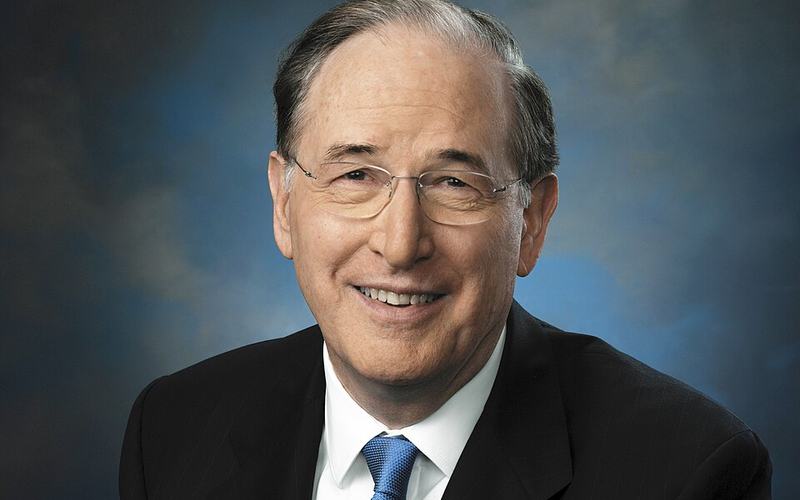
Former Democratic Sen. John D. “Jay” Rockefeller IV of West Virginia, a member of one of America’s wealthiest and most prominent families who spent nearly five decades in public service, has died at age 89. Rockefeller died Thursday night at his home in Washington, D.C., according to his family and public broadcasting officials. No cause of death was immediately provided.
Rockefeller represented West Virginia in the U.S. Senate for 30 years, serving five terms from 1985 to 2015 after previously completing two terms as the state’s governor. Throughout his political career, he focused heavily on expanding government healthcare programs, fighting poverty, protecting coal miners’ benefits and supporting military veterans.
Born in New York City on June 18, 1937, Rockefeller was the great-grandson of oil magnate John D. Rockefeller, founder of Standard Oil and one of the wealthiest Americans in history. His family included several prominent political and business figures, including his uncle Nelson Rockefeller, who served as governor of New York and vice president of the United States, and his uncle Winthrop Rockefeller, who served as governor of Arkansas.
Despite his family’s Republican political tradition, Jay Rockefeller became a Democrat after moving to West Virginia in the 1960s. His decision followed a formative period working in impoverished Appalachian communities through a national service program. From 1964 to 1966, he lived in the small mining town of Emmons, where he worked on community projects and efforts to improve access to healthcare.
Rockefeller later described the experience as the defining influence on his political career. He entered public office in 1966 after winning election to the West Virginia House of Delegates, served as the state's secretary of state beginning in 1968 and eventually won the governorship in 1976. After two terms as governor, he was elected to the U.S. Senate in 1984.
One of his most significant legislative contributions came in 1997, when he helped establish the Children's Health Insurance Program, a federal-state initiative that provides medical coverage to children in families that earn too much to qualify for Medicaid but cannot afford private insurance. He also supported former President Bill Clinton’s unsuccessful effort to establish a broad national healthcare system and later backed former President Barack Obama’s Affordable Care Act, signed into law in 2010.
During the debate over Obama's healthcare legislation, Rockefeller unsuccessfully pushed for a government-run public insurance option that would have competed with private health insurance plans. He argued that such a program would provide another coverage choice for Americans, particularly those facing high costs or limited access to private insurance.
Rockefeller also sought to protect the healthcare benefits of coal miners and their families, reflecting the importance of the coal industry to West Virginia's economy. Although he generally supported the state's coal and steel industries, he opposed Republican efforts in 2012 to prevent federal regulation of emissions from coal-fired power plants, drawing criticism from industry leaders.
His Senate career also included a significant role in the debate over the Iraq War. Rockefeller voted in 2002 to authorize the use of military force against Iraq under President George W. Bush. However, after the invasion began in 2003 and U.S. forces failed to find the weapons of mass destruction cited by the administration as a central justification for the war, Rockefeller publicly expressed regret over his vote.
“If I had known then what I know now, I would have voted against it,” Rockefeller told the Charleston Gazette in 2004.
He later became one of the administration's most prominent congressional critics on the issue. As chairman of the Senate Intelligence Committee, Rockefeller oversaw an investigation into the intelligence used to justify the invasion. A 2008 committee report concluded that Bush, Vice President Dick Cheney and other senior administration officials had exaggerated intelligence findings and failed to adequately communicate disagreements within the intelligence community.
When the report was released, Rockefeller accused the administration of misleading the American public about the relationship between Iraq and the terrorist network responsible for the September 11, 2001, attacks.
“Representing to the American people that the two had an operational partnership and posed a single, indistinguishable threat was fundamentally misleading and led the nation to war on false premises,” he said.
Beyond healthcare and intelligence oversight, Rockefeller chaired the Senate Commerce, Science and Transportation Committee and the Senate Veterans Affairs Committee. He worked on broadband expansion in rural communities, consumer protections, and legislation addressing health and safety concerns among military veterans.
Although he came from a family with extraordinary wealth, Rockefeller built his political career in a state that was far less affluent. His inherited fortune helped finance his campaigns, including his successful 1984 Senate bid, in which he spent millions of dollars of his own money. He was frequently compared with West Virginia's other longtime senator, Robert Byrd, who wielded considerable influence in Congress before his death in 2010.
Rockefeller announced in 2013 that he would not seek a sixth Senate term. He said at the time that helping people in need had been the defining purpose of his public service.
“Championing those most in need has been my life's calling, and I will never stop fighting to make a difference for the people who mean so much to me,” he said.
Rockefeller was married to Sharon Percy Rockefeller, a public television executive and the daughter of former Republican Sen. Charles Percy of Illinois. They had four children and nine grandchildren. He was succeeded in the Senate by Republican Shelley Moore Capito, who won the seat in 2014.

Comments
No comments yet. Be the first to share your thoughts.