
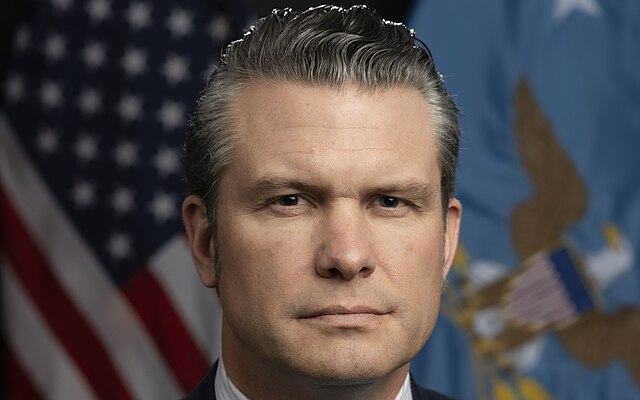
Secretary of War Pete Hegseth announced a sweeping restructuring of the U.S. military Wednesday, including a 20% reduction in general and admiral positions, tougher physical standards, an expanded focus on combat readiness and a major push toward autonomous warfare.
Speaking to junior officers and enlisted personnel at Marine Corps Base Quantico in Virginia, Hegseth announced that the military will reduce the number of positions designated for generals and admirals by 20% by Jan. 1, 2027. The move doubles the 10% reduction Hegseth ordered last year and affects roughly 800 general and flag officer positions across the military.
The change primarily targets positions rather than immediately removing 20% of the officers currently serving. Some positions can be eliminated while others can be downgraded to lower ranks as the Pentagon seeks to reduce what Hegseth describes as unnecessary layers of senior leadership and bureaucracy.
Hegseth presented the cuts as part of a broader effort to return the military to what he calls a “warrior ethos,” with greater emphasis on combat readiness, physical fitness, discipline and battlefield performance. He also reiterated his campaign against what he calls “wokeness” inside the military.
“We are no longer the woke department or the weak department,” Hegseth said. He also used blunt language to describe the standards he expects from service members, saying the military would have “no fatties, no beardos, no weirdos, no wimps, no radicals — just warriors.”
The Pentagon has already eliminated diversity, equity and inclusion programs and moved to prohibit the use of race, sex or ethnicity as factors in military promotions, assignments and other personnel decisions. Hegseth has also pushed tougher enforcement of physical fitness, weight and grooming requirements.
Hegseth is also changing how the military evaluates its future senior commanders. Earlier this month, he announced the Joint Warfighter Evaluation, an assessment for Army colonels and Navy captains being considered for promotion to general or admiral that is intended to test their ability to fight and adapt in complex combat situations.
Military education is another target of the restructuring. Hegseth has directed the service academies to stop appointing civilian professors to new tenured positions, while existing faculty members will retain their tenure. He has argued that the academies should remain focused on preparing future officers for military service and combat leadership.
Hegseth is simultaneously pushing a major expansion of autonomous weapons and drone technology. He announced the creation of the Autonomous Warfare Command, a new four-star command focused on developing, testing and deploying autonomous and robotic systems. The command is expected to begin operating in October 2027.
He also announced Project Agincourt, an initiative intended to accelerate the development and deployment of unmanned systems. The name references the Battle of Agincourt, where the English longbow played a decisive role against a much larger French force.
Another initiative, Project Meridian, will examine how warfare could change in the coming years. The project will involve SpaceX and Tesla CEO Elon Musk, Anduril founder Palmer Luckey, and former House Speaker Newt Gingrich, with a report expected within 120 days.
Hegseth also announced a “Fortress America” effort aimed at strengthening military installations against attacks on critical infrastructure, including by improving energy supplies and supply chains.
The broader restructuring comes after Trump and Hegseth have removed or pushed out more than two dozen senior military leaders since taking office. Critics in Congress have questioned whether the rapid turnover and additional cuts could remove experienced officers from the military’s leadership ranks.

Comments
No comments yet. Be the first to share your thoughts.