
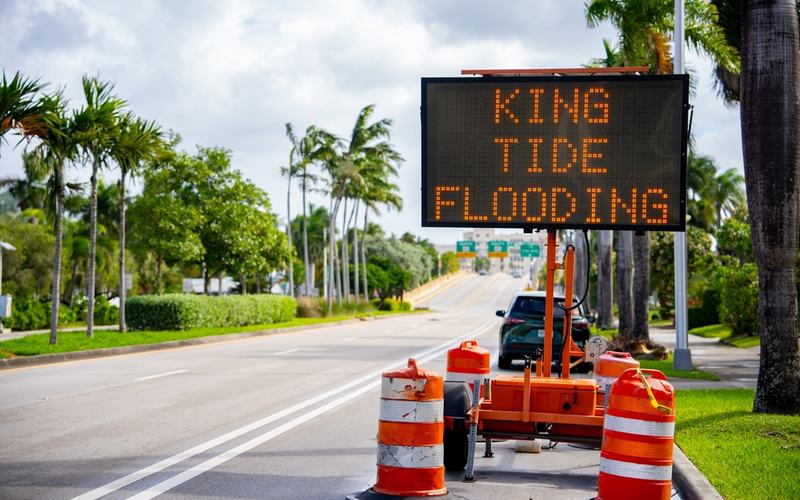
King tides peaking Tuesday triggered widespread coastal flooding along Florida's east coast and parts of California's west coast.
The astronomical high tides, driven by the full Hunter's Moon and lunar perigee, combined with onshore winds to push water levels well above normal. In South Florida, neighborhoods in Fort Lauderdale, Miami-Dade, Palm Beach, Martin, St. Lucie, Indian River, and Brevard counties saw roads submerged, vehicles stranded, and some homes and businesses threatened. High surf damaged the Juno Beach Pier, which officials closed indefinitely. Beach erosion prompted closures of dune crossovers in areas like Satellite Beach.
King tides represent the highest predictable tides of the year and result directly from the alignment of the sun, Earth, and moon when the moon reaches its closest point to Earth in its elliptical orbit. This gravitational alignment increases the tidal range without any connection to long-term sea level trends. The event on October 27 aligned with the Hunter's Moon, the full moon following the Harvest Moon, which occurs annually in the fall.
Peak times varied by location, with morning and evening high tides expected around 9 to 11 a.m. and 9 to 11 p.m. in many spots. The South Florida Water Management District flagged October 27 as one of the year's highest tide dates. Flooding began before the peaks and persisted afterward in low-lying areas.
California coastal communities also faced record impacts. San Diego's tide gauge hit 8.14 feet, nearly 1.5 feet above predictions and just shy of the all-time record. Los Angeles recorded its highest levels in over a century. Newport Beach saw floodwaters reach multimillion-dollar homes. Warnings extended through Thursday in some areas.
The National Weather Service issued coastal flood warnings, high surf advisories, and rip current alerts. Winds gusting up to 46 mph worsened conditions in Florida. Experts noted the event as predictable and tied to the lunar cycle rather than sudden anomalies.
Local officials urged residents to monitor real-time tide charts and avoid flooded roadways to prevent vehicle damage. Many communities have installed temporary barriers and pumps in recent years to manage these recurring seasonal events. The flooding follows similar patterns seen in prior years during fall king tide seasons, which run through late fall and into winter.
Businesses along affected shorelines reported temporary closures and lost revenue as access became limited. Tourism-dependent areas worked to clear debris quickly once waters receded. Emergency management teams remained on standby but reported no major injuries or broad property destruction beyond typical nuisance flooding.

Comments
No comments yet. Be the first to share your thoughts.