
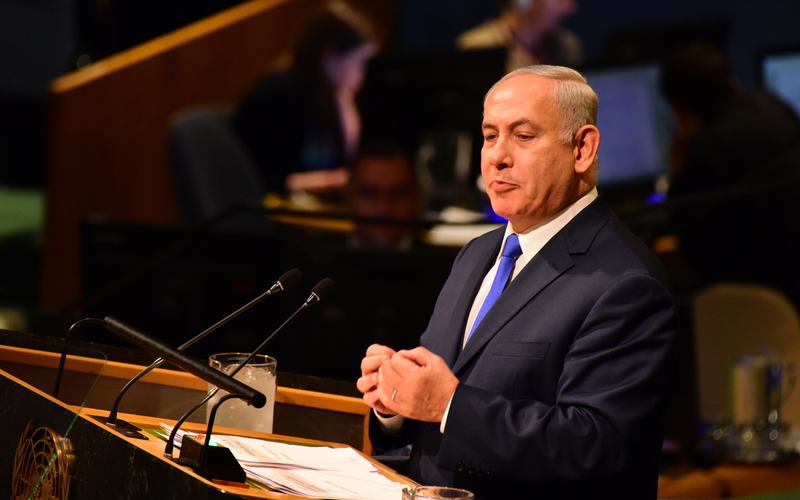
Israeli Prime Minister Benjamin Netanyahu defended his continued leadership Wednesday by comparing the intelligence failures that preceded Hamas’ Oct. 7, 2023, massacre to those surrounding the attacks on Pearl Harbor and Sept. 11, 2001. He argued that intelligence breakdowns alone should not require a national leader to resign.
“There was blindness here,” Netanyahu said during an interview with Army Radio. “And I can tell you: There was also blindness at Pearl Harbor, when the Japanese bombed the United States. Yes, there was blindness. There was also blindness on September 11, at the Twin Towers.”
He pointed to former Presidents Franklin D. Roosevelt and George W. Bush as examples of leaders who remained in office after major intelligence failures.
“Nobody said: Okay, you have to go home. They didn't say that to Roosevelt; they didn't say that to President Bush,” Netanyahu said.
The remarks come amid continued scrutiny of Israel’s security establishment and the government’s handling of warnings before Hamas launched its attack, killing approximately 1,200 people in Israel and taking hostages into Gaza.
Netanyahu said he had not recognized the warning signs before the attack, explaining that security officials repeatedly assessed Hamas as deterred and did not anticipate an imminent large-scale assault.
“If they had woken me up, they knew I'd have woken everybody and canceled Nova and put the air force on alert,” Netanyahu said in a separate television interview, referring to the Nova music festival that was targeted during the massacre.
He also addressed reports that Egyptian intelligence chief Abbas Kamel visited Israel shortly before the attack and warned Israeli officials that Hamas was preparing a major assault unless Israel agreed to an arrangement involving prisoner releases and economic concessions.
Netanyahu confirmed that Kamel had been in Israel but denied meeting or speaking with him. He said Kamel spent approximately 50 minutes in the country and questioned which Israeli officials had met with him.
“The head of the Egyptian intelligence was here. He spent something like 50 minutes on the ground. I want to know who he met,” Netanyahu said.
Netanyahu’s office previously denied receiving an early warning from Egypt, adding that the prime minister had not communicated with Kamel since his government was formed. Netanyahu had hosted the Egyptian intelligence chief in Jerusalem in 2021.
The prime minister also defended his proposal for a national inquiry committee with equal representation from the governing coalition and opposition. He suggested that the panel could follow the model of the bipartisan U.S. commission established to investigate the Sept. 11 attacks.
Netanyahu argued that a government-appointed investigation would lack credibility among opposition supporters, while a state commission appointed through Israel’s existing judicial framework would face rejection from many of his own supporters.
He also denied blocking a viable hostage-release agreement, arguing that the proposed terms amounted to capitulation and would not have guaranteed the return of every hostage.
Beyond the investigation into Oct. 7, Netanyahu discussed Israel’s ongoing confrontation with Iran and its regional allies. He warned that an Iranian attack ahead of Israel’s Oct. 27 election and the U.S. midterm elections would prompt an unprecedented response.
“As long as I am prime minister, Iran will not have nuclear weapons,” he said, estimating that Israel had achieved approximately 60% of its security objectives against Iran and its allies. He separately put progress against Hamas and Hezbollah at 90%, while reiterating that eliminating Hamas remained his objective in Gaza.
Netanyahu said he was not immediately ordering a new Gaza operation because doing so so close to the Israeli election could prompt accusations that he was launching a war for political purposes.
He described the election as closely contested and said he preferred to form another right-wing coalition with his current partners. Any potential opposition partners, he added, would have to accept his security policies and opposition to Palestinian statehood.
Former Israeli military chief Gadi Eisenkot, who is challenging Netanyahu politically, sharply criticized the prime minister following his earlier television interview. Eisenkot called Netanyahu “a liar” who was “dangerous to Israel,” arguing that the prime minister’s claim to be uniquely capable of protecting the country had collapsed years earlier.

Comments
No comments yet. Be the first to share your thoughts.