
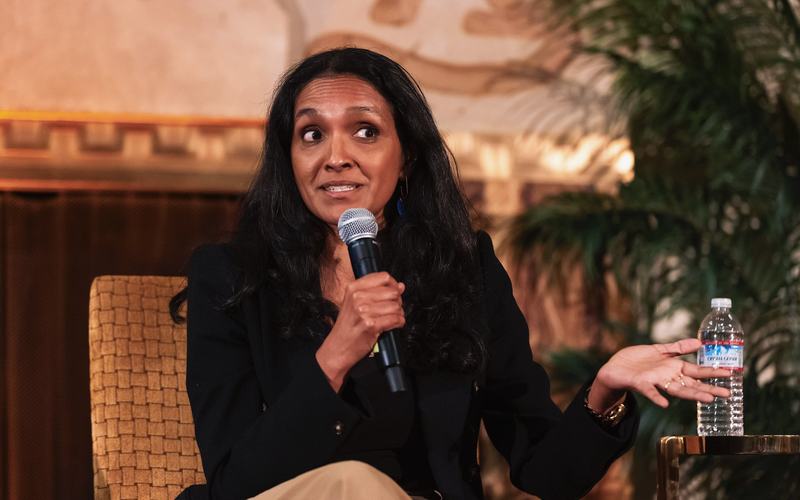
Los Angeles voters delivered a sharp rebuke to the city’s political establishment on November 3, electing City Councilmember Nithya Raman as the next mayor and ending the tenure of incumbent Karen Bass. Raman, a 45-year-old India-born urban planner and Democratic Socialists of America member, secured roughly 52–53 percent of the vote to Bass’s 47–48 percent, with about three-quarters of ballots counted when Bass conceded on Thursday. The result marks the first time a challenger has unseated a sitting Los Angeles mayor in more than two decades.
Bass, 73, a former longtime U.S. congresswoman who became the city’s first Black woman mayor in 2022, called Raman to congratulate her and issued a statement accepting the outcome. “While this is not the outcome we hoped for, the people of Los Angeles have spoken,” she said. “I have committed to ensuring a smooth and seamless transition.” She reflected on the “honor of serving the city that raised me.”
Raman’s victory is notable for its speed and the circumstances of her entry. She had initially endorsed Bass, a onetime ally who had supported her own 2024 City Council reelection. In early February, just hours before the filing deadline, Raman launched her own campaign after deciding the night before that the city had reached a “breaking point.” The move angered many elected Democrats who had lined up behind the incumbent. She advanced from the June primary (where Bass led with about 34 percent, Raman took 29 percent, and reality television personality Spencer Pratt placed third at roughly 25 percent) to the November runoff.
The race centered on persistent urban challenges. Homelessness, with roughly 44,000 people unhoused in the city, remained a dominant issue. Raman, who has focused on affordable housing and renter protections on the council, criticized the cost and accountability of Bass’s Inside Safe program while arguing for more effective results. Bass highlighted reductions in some districts and defended her record. Public safety and policing also featured prominently; Raman called for the ouster of Police Chief Jim McDonnell over concerns about federal immigration operations, while Bass warned against disruption ahead of the 2028 Olympics.
Bass’s standing was further damaged by criticism of the city’s response to the devastating January 2025 Palisades fire, which killed 12 people and destroyed more than 6,800 structures. The blaze began while she was abroad in Ghana for a presidential inauguration, leaving many voters with the impression that the fire department was unprepared and the administration slow to respond. Analysts widely cited this as a factor that eroded her support and never fully recovered.
Raman positioned herself as a progressive pragmatist offering “a city that works,” emphasizing basics like fixing sidewalks, streetlights, and potholes alongside broader progressive goals. Her support drew heavily from younger voters, a generational contrast with Bass’s stronger performance among those over 50. Late-arriving ballots from progressive-leaning voters steadily widened her lead after early returns showed Bass narrowly ahead on election night. She celebrated at the Greek Theatre plaza in Griffith Park, later telling reporters she was deeply honored and would work to earn the trust of all Angelenos, including those who backed Bass. She highlighted the significance of the city electing an immigrant mayor “at this moment in American history.”
The outcome advances a broader progressive wave. Raman joins New York City Mayor Zohran Mamdani as a DSA-backed leader of one of the nation’s two largest cities, though she has rejected being cast simply as a West Coast version of him. None of her City Council colleagues endorsed her, and major labor and business interests largely backed Bass, along with high-profile Democrats including Governor Gavin Newsom, former Vice President Kamala Harris, and former House Speaker Nancy Pelosi. Raman’s win also makes her the first South Asian (and Indian American) mayor of Los Angeles.
With a short transition before taking office in early December, Raman faces immediate tasks: addressing homelessness and housing affordability, rebuilding trust on public safety, managing city finances, and preparing for major events including the Super Bowl in 2027 and the 2028 Summer Olympics. A special election will fill her City Council seat representing a district that includes parts of Hollywood Hills and beyond.
Bass leaves after a single term marked by sharp criticism. The last incumbent mayor defeated was James Hahn, who lost to Antonio Villaraigosa in 2005. For Los Angeles, the result signals a clear desire for change after years of frustration with the status quo. Whether Raman can deliver on her vision while navigating the practical demands of governing the nation’s second-largest city will define the next chapter at City Hall.

Comments
No comments yet. Be the first to share your thoughts.