
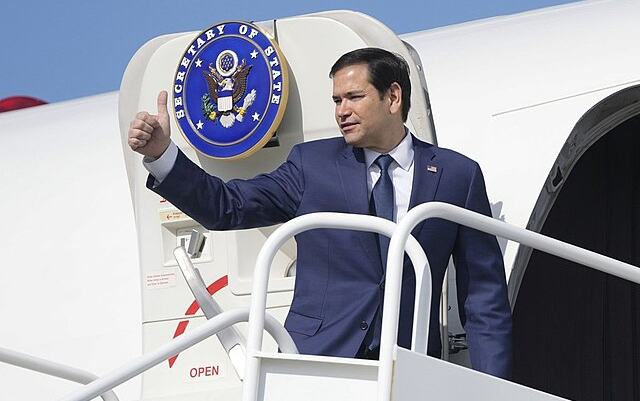
US Secretary of State Marco Rubio stated on Tuesday that negotiators have completed 99 percent of the work on a bilateral trade agreement between the United States and India.
Speaking during a visit to Mumbai, Rubio told reporters that only minor technical details remain. "I think 99 percent of the work is done," he said in an interview. "We are weeks, not months away from finalizing it."
The comments came as Rubio met with Indian External Affairs Minister Subrahmanyam Jaishankar. The two officials reviewed progress on the long-running talks and reaffirmed their commitment to an early conclusion. Rubio noted that the remaining issues center on precise wording and interpretation of phrases in the text.
Negotiations have spanned more than a year and a half under the Trump administration. Recent high-level discussions have included conversations between President Donald Trump and Prime Minister Narendra Modi, as well as meetings involving US Trade Representative Jamieson Greer and Indian Commerce Minister Piyush Goyal.
Rubio emphasized that both sides must reach full agreement before any announcement. "You can't afford for a relationship of this magnitude to be threatened by announcing a deal and it turning out the deal wasn't finalized," he said.
The prospective agreement aims to expand bilateral trade, which already exceeds hundreds of billions of dollars annually. US officials have highlighted opportunities in energy cooperation, with Rubio scheduled to visit Reliance Industries' Jamnagar refinery on Wednesday to discuss increased purchases of American crude and refined products.
Indian officials have expressed similar optimism. Commerce Minister Piyush Goyal recently described the first tranche of the deal as finalized, pending final legal drafting and confirmation of competitive tariff advantages for India.
The progress reflects sustained diplomatic engagement between the two nations on economic and strategic matters. Rubio described the overall trajectory of US-India relations as positive, pointing to cooperation in areas such as defense and technology alongside trade.

Comments
No comments yet. Be the first to share your thoughts.