

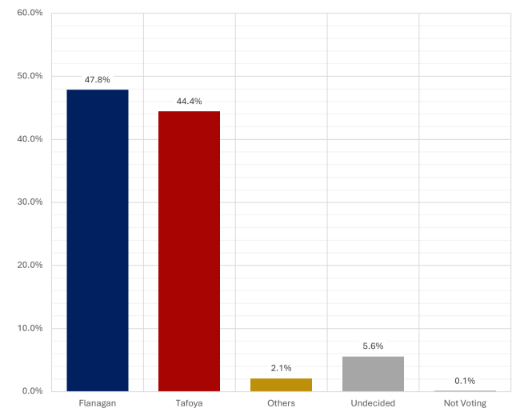
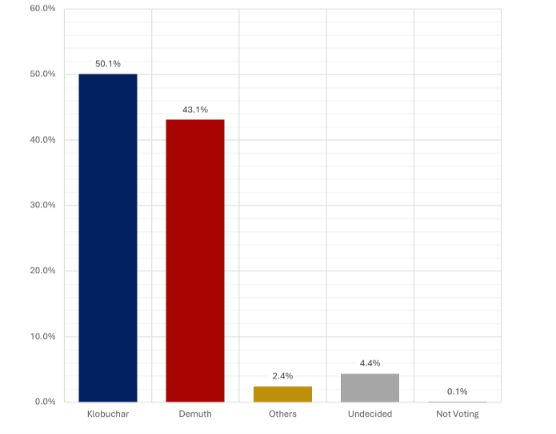
New polling from Victory Insights shows Democrat Peggy Flanagan leading Republican Michele Tafoya by 3.4 points in Minnesota's 2026 U.S. Senate race, with 5.6 percent still undecided. On its face, that is a Democratic edge. Dig into the crosstabs, however, and the race is more competitive than the topline numbers imply—especially compared with the governor’s race, where the same poll shows Amy Klobuchar leading Lisa Demuth by a clearer 7-point margin.
On the overall ballot, Flanagan stands just shy of 48 percent, with Tafoya above 44 percent. The 3.4-point gap between the two is smaller than the 5.6 percent of voters still undecided, leaving room for the race to shift.
In comparison, Klobuchar holds a more commanding lead over Demuth in the Minnesota gubernatorial race, with a margin of 7 points.
Despite trailing by 3 points, Tafoya may be closer than she initially appears due to the composition of undecided voters. Among those voters, Tafoya has more than twice Flanagan’s positive name ID, lower negative ratings, and a higher average rating. Twenty-four percent of undecided voters rate Tafoya higher than Flanagan; only 9 percent reverse that preference. Their party identification also tilts toward the Republican: 37 percent identify as Republicans and just 9 percent as Democrats. In short, the undecided pool is not a neutral reservoir. It currently leans in Tafoya’s direction, and if she can win an overwhelming majority of undecided voters, the race could tilt in her direction.
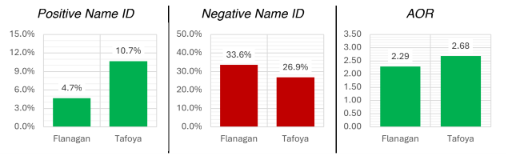
Intensity of support tilts heavily in Tafoya's favor as well. Fifty-eight percent of Tafoya’s voters hold an “extremely positive” opinion of her, compared with only 41 percent of Flanagan voters who feel the same way about their candidate. Tafoya is also the only figure tested in the poll with an average opinionated rating above neutral. Roughly 11 percent of voters still have no opinion of her (versus 6 percent for Flanagan), giving her more room to define herself in the final stretch. The poll notes that a meaningful share of voters who dislike both candidates still prefer Tafoya as the “lesser of two evils."
Performance among key groups further narrows the practical gap. Among nonpartisans—the median voter in this purple electorate—Tafoya carries an 11-point relative improvement over Demuth, who trails Klobuchar by 20 points with the same group. In the suburbs, Tafoya leads by 2 points while Demuth trails by 4. Among voters who have not yet cast a ballot, Tafoya holds a narrow 46–45 percent edge; Flanagan’s advantage is concentrated among those who have already voted early. Suburban women, often considered the quintessential swing demographic, prefer Flanagan by only 5 points, a much smaller margin than Klobuchar’s 14-point edge over Demuth with the same group.
Minnesota US Senate Poll
— Victory Insights (@VictoryPolling) October 28, 2026
47.8% Flanagan (+3.4)
44.4% Tafoya
2.1% Others
5.6% Undecided
Oct. 21-22, 2026
1,194 Likely Voters
Commissioned by Michele Tafoya
Full Report: https://t.co/9VqF0rFpTe pic.twitter.com/RdM3M3ciUN
The recent Victory Insights result sits squarely in the middle of the recent non-outlier polling cluster. Early October surveys showed similar headline results. Rasmussen Reports had Flanagan at 48 percent and Tafoya at 45 percent. Trafalgar Group showed essentially the same split. SurveyUSA and Mason-Dixon also both found Flanagan leads in the 3- to 4-point range. Across these surveys, the margin has consistently appeared in the low-to-mid single digits, with a non-trivial undecided share remaining.
One clear outlier is a New York Times/Siena College poll that showed Flanagan ahead by roughly 14 points. That result is an extreme departure from the rest of the field; most other public polling this fall has clustered between a statistical tie and a Flanagan lead of about 4 points. The Victory Insights numbers align with that broader pattern rather than the NYT figure, reinforcing the view of a competitive contest in which modest shifts among remaining undecided and nonpartisan voters could still matter.
The New York Times acknowledged that their poll could be an outlier, admitting that their lack of party affiliation data in Minnesota could make their survey "something like a 2026 equivalent of the Selzer poll showing Kamala Harris ahead in neighboring Iowa."
Nevertheless, these patterns do not erase Flanagan’s lead or the strong Democratic advantage in early voting.
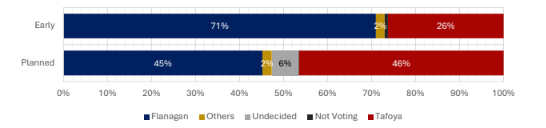
However, they do suggest that a simple reading of “Flanagan leads the race” understates Tafoya’s position. With undecided voters currently more favorable to her, stronger intensity among her supporters, and better relative performance than the other Republican on the ballot, the Senate race remains within reach if Tafoya can turn out the GOP base while converting a significant share of the remaining nonpartisan and undecided voters.
The poll’s executive summary frames the race in essentially these terms: the path runs through those undecided and nonpartisan voters, and turnout will decide whether the early-vote Democratic firewall holds.

Comments
No comments yet. Be the first to share your thoughts.