
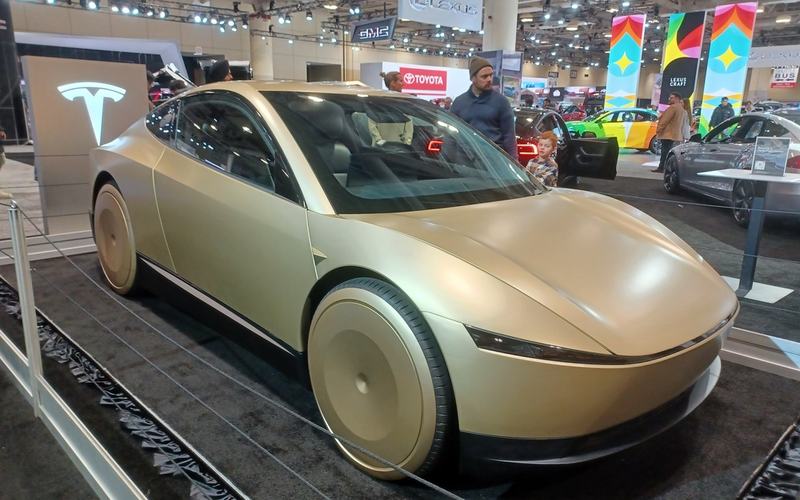
Tesla has finally pulled back the curtain on its next-generation Roadster, nearly nine years after first announcing the electric sports car in 2017. The company’s October 15 unveiling featured a dramatic demonstration at a SpaceX testing facility in McGregor, Texas, where the vehicle drove up a massive curved ramp, launched into the air, performed a midair flip, and landed safely.
🚀 Tesla Roadster stuck in traffic? NO PROBLEM!
— Greg 🇺🇸 ✭ (@GregB_TX) October 16, 2026
Why sit in a traffic jam when you can just fly over it? 😂
Elon Musk might be taking “the sky’s the limit” literally!
Would you drive a flying Tesla? 🚗💨 pic.twitter.com/7IIqUa6utF
The demonstration showcased technology developed in collaboration with SpaceX, including cold-gas thrusters designed to provide acceleration beyond what conventional tires can deliver. The vehicle used a fan-based suction system to remain attached to the curved ramp as it climbed upside down before launching into the air. In another demonstration, the Roadster leaped over several vehicles, including a Tesla Semi, before flipping and landing.
“Turns out the future does have flying cars,” Tesla and SpaceX CEO Elon Musk said during the event. Tesla Vice President of Vehicle Engineering Lars Moravy echoed the sentiment, declaring, “Flying cars are real.”
Tesla claims the Roadster can accelerate from zero to 60 mph in less than one second in certain configurations. The company demonstrated the acceleration during the unveiling, while Musk said the vehicle could eventually target speeds approaching half the speed of sound. Tesla listed a top speed exceeding 230 mph for the vehicle, although the more ambitious speed target remains a stated goal rather than a demonstrated production-car capability.
The company outlined three versions of the Roadster: Performance, Thrust and Rocket. The Performance model is designed for road use and seats two people. The Thrust version adds rear-mounted cold-gas thrusters and is intended for racing, while the single-seat Rocket version features a more extensive thruster system designed to provide forward, upward, and rotational movement.
Tesla says the models will offer more than 300 miles of range, with claimed zero-to-60 mph times of under 1.6 seconds for Performance, under 0.9 seconds for Thrust and under 0.59 seconds for Rocket. The company has not explained how the Rocket model's flight capabilities would affect its eligibility for ordinary public-road use.
Despite the spectacular demonstration, major questions remain about the vehicle's price, production readiness, and delivery schedule. Tesla said production is expected to begin in 2028, although the company previously promised deliveries beginning in 2020 after unveiling the original concept in 2017.
Tesla has also begun seeking substantial reservation payments. The company's reservation page listed a $50,000 payment for the Performance version and $250,000 for the Thrust version. The Rocket model is being offered through an invitation-only process. Tesla has not announced final retail pricing, though earlier expectations placed the vehicle's cost above $250,000.
The long delay has left early reservation holders waiting for years to see whether the Roadster would move beyond its original concept. The latest unveiling offered the clearest demonstration yet of the company's ambitions, but a dramatic prototype demonstration is not the same as delivering a production vehicle to customers.
The Roadster also highlights Musk's broader effort to bring Tesla and SpaceX technology closer together. Tesla has presented the car as a showcase for extreme acceleration and engineering, while critics may question how practical its most unusual features will be for everyday drivers.
For now, Tesla has delivered the spectacle Musk promised. Whether the company can turn the flying-car demonstration into a production vehicle by 2028 remains the next major test.

Comments
No comments yet. Be the first to share your thoughts.