
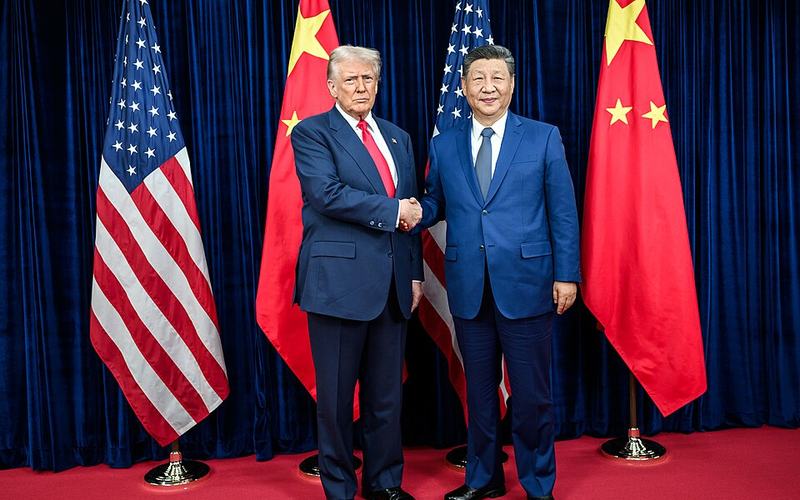
President Donald Trump is heading to Asia this week for a series of high-profile diplomatic meetings, including a planned gathering with Chinese President Xi Jinping and Russian President Vladimir Putin, as he seeks to demonstrate American influence abroad following major Republican losses in the midterm elections.
The trip will begin in the Philippines, where Trump is scheduled to meet Tuesday with Southeast Asian leaders concerned about China's growing influence and military activity in the region. He will then travel to China on Wednesday for the Asia-Pacific Economic Cooperation summit, where he is expected to hold his third in-person meeting of the year with Xi and meet with Putin. Trump has also expressed interest in discussing the countries' nuclear stockpiles, although China has historically been reluctant to participate in arms-control negotiations.
The White House says Trump will sign a trade agreement with Thailand in Manila and participate in additional commercial agreements and a leaders' dinner, where he will serve as the guest of honor. In Shenzhen, trade is expected to be a major focus ahead of his meetings with Xi and Putin.
The international visit comes at a difficult political moment for Trump. Republicans suffered significant losses in the midterms and are set to lose control of Congress in January, giving Democrats greater power to investigate the administration and challenge its policies. Attention is also beginning to shift toward potential Republican and Democratic contenders for the 2028 presidential election.
Former Deputy Secretary of State Kurt Campbell said presidents have sometimes turned toward international diplomacy during periods of domestic political difficulty. He pointed to former President Barack Obama’s 2014 trip to Beijing shortly after Democrats lost control of the Senate and former President George W. Bush’s 2006 visit to the Asia-Pacific region after Republicans lost Congress.
Trump previously used an Asia trip to secure a trade truce with China and investment commitments from Japan and South Korea. This time, however, his ability to use tariffs and military action as negotiating tools could face greater resistance from a Democratic-controlled Congress. His administration's handling of the war with Iran and its trade policies have also become sources of political pressure.
The president's Super Intelligence agenda and U.S. restrictions on advanced chip exports to China could also become points of contention. Nvidia has faced scrutiny over allegations that restricted chips were diverted to Chinese companies through intermediaries, while former CEO Jensen Huang's reported relationship with a woman suspected of having ties to Chinese intelligence has added further attention to the controversy. Administration officials said they do not expect the Nvidia allegations to dominate the trip, and Trump is not expected to confront Xi directly about the issue.
Trump will be accompanied by Elon Musk, the head of SpaceX and Tesla, who has served as a frequent adviser to the president. Musk spent at least $445 million supporting Republican efforts to retain control of Congress, and Democrats have indicated they intend to investigate his relationship with the administration. His presence on the trip could add another point of interest for lawmakers examining the administration's ties to major business figures.
Democrats have already signaled they will closely examine the president's meetings and any agreements reached during the visit. Rep. Gregory Meeks of New York, the top Democrat on the House Foreign Affairs Committee, said lawmakers would be watching the trip closely. Meeks and other Democrats have demanded additional information about the administration's approval of advanced chip exports and have called for a tougher approach toward Moscow and Beijing.
Democratic lawmakers also want Trump to increase pressure on Russia over its war in Ukraine, fulfill an arms agreement with Taiwan and address reports that China and Russia have assisted Iran. Trump has recently expressed optimism about the possibility of a settlement in Ukraine, but Ukrainian President Volodymyr Zelenskyy was not invited to the planned discussions in China. Administration officials said Trump is not expected to discuss Ukraine with Putin during their meeting.
The war with Iran is another major issue hanging over the visit. The conflict has contributed to rising fuel costs across Asia, including higher prices for jet fuel and diesel. Trump has sought to downplay the possibility of resuming major strikes against Iran while also indicating that he does not see a need for negotiations.
Beyond the meetings with Xi and Putin, Trump is expected to participate in discussions involving the Quad, a strategic partnership made up of the United States, Australia, India and Japan. The gathering in Manila will be the first meeting of Quad leaders since Trump returned to the White House. Regional governments are expected to focus on the strength of American support for efforts to counter China's influence throughout the Asia-Pacific region.

Comments
No comments yet. Be the first to share your thoughts.