

President Donald Trump on Sunday, November 15, addressed the nationwide ground stop that disrupted airline travel over the weekend, using the incident to urge Congress to approve additional funding for a comprehensive modernization of America's air traffic control system. The ground stop began Friday afternoon after a communications failure disrupted operations, leaving passengers stranded and airlines working to restore normal service.
Trump had largely remained silent about the disruption while posting on other subjects on social media. In his first major public comments on the incident, he said his administration had already begun upgrading the nation's air traffic control infrastructure but argued that the effort should not be completed through limited, incremental investments.
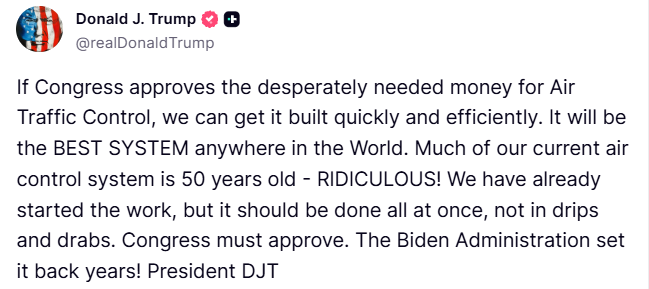
"If Congress approves the desperately needed money for Air Traffic Control, we can get it built quickly and efficiently," Trump wrote on his social media platform. "It will be the BEST SYSTEM anywhere in the World. Much of our current air control system is 50 years old - RIDICULOUS!"
Congress approved $12.5 billion for the Federal Aviation Administration as part of the Republican-backed tax legislation passed last year. However, Transportation Secretary Sean Duffy has repeatedly described that funding as an initial investment rather than enough money to complete the broader modernization effort.
Trump also criticized the previous administration's handling of the FAA, accusing former President Joe Biden's administration of making an already outdated system worse. Biden signed a major infrastructure law during his first year in office that allocated $25 billion for FAA improvements, including airport upgrades, air traffic control towers, terminal redevelopment and modernization of the agency's underlying infrastructure.
Duffy has been the administration's primary spokesperson on the ground stop, appearing on several Sunday news programs to explain the communications failure and press Congress for additional funding. He said contractor L3Harris Technologies had obtained two routers from FAA facilities in El Dorado, Arkansas, and Amarillo, Texas, and was conducting what he described as "deep diagnostics" on the equipment.
According to Duffy, the problem began while L3Harris was replacing outdated copper wiring with modern fiber-optic cable. After the new wiring was installed at the El Dorado facility and a router was turned back on, a problem emerged at the Amarillo facility and spread through the communications network, ultimately triggering the nationwide ground stop.
Duffy said the sequence of events was unexpected, telling ABC's "This Week" that officials did not anticipate the equipment problem would occur after the replacement work.
The transportation secretary also provided an update on airline operations, saying some delays remained but expressing confidence that the system would return to full capacity by the end of Sunday or Monday. He explained that a ground stop can leave aircraft and flight crews out of position, meaning airlines need additional time to reorganize their operations even after the underlying problem has been addressed.
Duffy said the recovery was well underway, but warned that restoring normal schedules would take time as airlines repositioned aircraft and crews. Meanwhile, the administration is seeking additional congressional funding to replace aging communications infrastructure and prevent similar disruptions in the future.

Comments
No comments yet. Be the first to share your thoughts.