
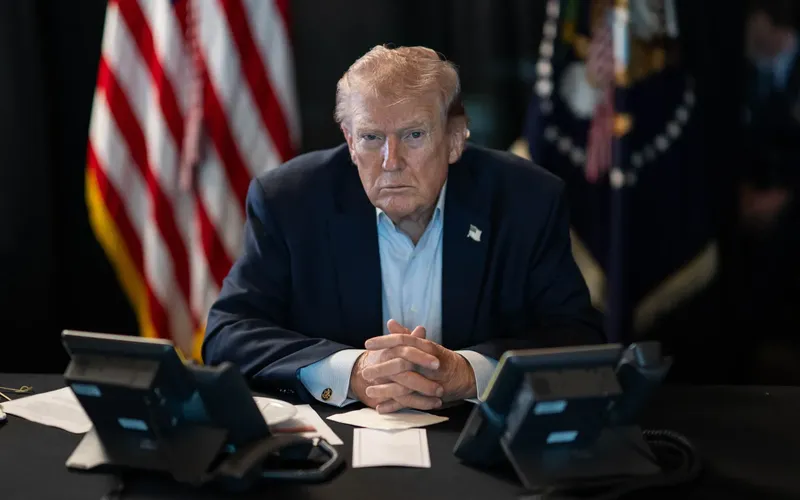
President Donald Trump slammed The New York Times for using fabricated polling numbers after Wedgewood Polls admitted to making up every survey it published since launching in June, arguing that the revelation strengthens his ongoing lawsuit against the newspaper.
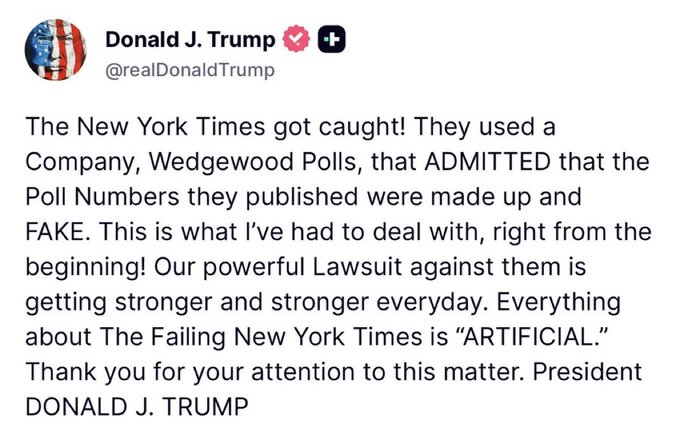
“The New York Times got caught! They used a Company, Wedgewood Polls, that ADMITTED that the Poll Numbers they published were made up and FAKE. This is what I’ve had to deal with, right from the beginning! Our powerful Lawsuit against them is getting stronger and stronger everyday. Everything about The Failing New York Times is ‘ARTIFICIAL.’ Thank you for your attention to this matter. President DONALD J. TRUMP”
The Wedgewood scandal erupted Tuesday, October 20, when the progressive-leaning polling firm acknowledged that it had fabricated every survey it released since its launch in June. Founded by Jack Sims and Andrew Prater, the firm presented itself as a legitimate polling operation and published purported results in several high-profile Senate and gubernatorial contests.
Its surveys covered Senate races in Maine, Michigan, Louisiana and Texas, as well as gubernatorial contests in Wisconsin, Ohio, Kansas, Iowa, Georgia and Nebraska. Wedgewood also collected money for several crowd-funded polls, presenting its work as an effort to measure public opinion.
However, none of its surveys were genuine. According to FiftyPlusOne, an outlet that investigated the firm, irregularities in the raw data raised questions about whether the surveys had ever been conducted. Respondent identification numbers and transaction identifiers did not match expected patterns for the online survey platform Wedgewood claimed to use.
Despite those concerns, Wedgewood’s fabricated results circulated through the political polling landscape. The New York Times included the firm’s polls on its polling page beginning in June, while FiftyPlusOne, Silver Bulletin, VoteHub and the conservative MacIver Institute also incorporated its results into polling averages or databases. The Times had indicated that Wedgewood did not meet its criteria for selected pollsters, yet the firm’s numbers still received exposure through its polling page.
FiftyPlusOne said it investigated discrepancies in Wedgewood’s data and contacted the firm for additional information. Wedgewood subsequently admitted that its surveys had been fabricated and criticized polling aggregators for failing to adequately vet its work. FiftyPlusOne has since removed Wedgewood’s results from its database and averages and said it would no longer include polls from firms founded or run by Sims or Prater.
The scandal has raised questions about how fabricated numbers managed to gain credibility and circulate among organizations that voters and political observers use to track elections. Polling averages can influence how the public views a race, which candidates appear to be gaining momentum, and whether a contest is considered competitive. When fake surveys enter those averages, they can distort the picture presented to voters, journalists, campaigns, and donors.
The Wedgewood controversy is not an isolated case. Earlier this year, The Public Sentiment Institute, also known as TPSI, acknowledged manipulating survey responses in Florida’s Republican gubernatorial primary. The firm admitted that it changed some respondents’ answers to make support for James Fishback appear stronger than it was, benefiting the candidate who commissioned the poll. The issue emerged after FiftyPlusOne investigated concerns about the poll’s sponsorship disclosure.
Another case involved Median Strategies, which admitted in August to fabricating political polls as a purported social experiment. Its fake results covered contests including the California gubernatorial race, Wisconsin’s Democratic gubernatorial primary and the Los Angeles mayoral election. Those numbers circulated online and were amplified by media outlets and political figures before the deception came to light.
Now, SoCal Strategies is facing questions of its own. FiftyPlusOne said it contacted the firm on Tuesday to verify its data quality and investigate possible ties to Wedgewood Polls. After the outlet reached out, SoCal Strategies’ website and X account went offline. The sequence has prompted further scrutiny, although the removal of its online presence does not independently establish that the firm fabricated polling data.
FiftyPlusOne has identified Wedgewood Polls, Median Strategies, PSI and SoCal Strategies in connection with polling controversies. The allegations and available evidence differ among the firms, but the cases have intensified concerns about the reliability of political surveys and the processes used to verify them.
One result that has drawn attention in the broader discussion is an early-year poll showing Democratic Texas state Rep. James Talarico leading Republican Ken Paxton by five percentage points. The result became part of the public discussion surrounding the Texas Senate race. Determining whether that particular poll was unreliable requires establishing its source and whether the concerns about polling practices apply to it.
Trump has long accused The New York Times of unfair coverage and has pursued legal action against the newspaper. In his latest statement, he portrayed the Wedgewood admission as further evidence supporting his claims. Whether the scandal strengthens his lawsuit legally, however, will depend on the claims in the case, the evidence presented, and how the court evaluates the matter.
The episode has also raised broader concerns about accountability in political journalism. Polling organizations need to be transparent about their sponsors, methodologies, samples, and underlying data, while news organizations and polling aggregators must determine whether the surveys they publish are authentic and credible.
With the 2026 midterm elections approaching, voters and campaigns are relying on polling to assess competitive races and public sentiment. The Wedgewood scandal demonstrates how fabricated numbers can travel through political coverage before their authenticity is established. The additional controversies involving other firms have intensified the central question facing the industry: how can the public trust polling averages if the underlying surveys are not adequately verified?

Comments
No comments yet. Be the first to share your thoughts.