
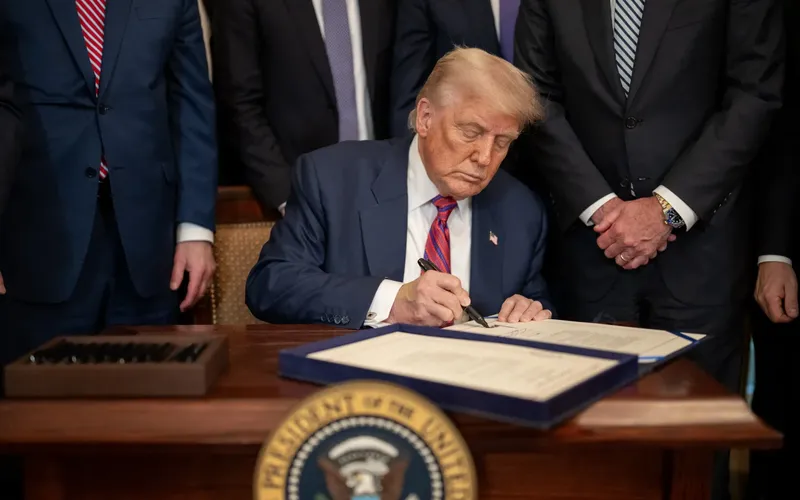
President Donald Trump is moving to officially rebrand artificial intelligence as “super intelligence,” tying the change to his administration’s broader effort to put the United States at the forefront of rapidly advancing technology.
Trump announced the terminology change Tuesday during the launch of America.gov, the administration’s new AI-powered portal designed to make it easier for Americans to access federal information and services.
“This kind of innovation in government is only a preview of what is possible with super intelligence, or SI,” Trump said. He said he would sign an executive order making the new terminology official.
Trump has argued that “artificial intelligence” does not accurately describe the technology because the word “artificial” can make it sound fake or less capable than it actually is. He instead has promoted “super intelligence” as a term that better reflects the technology’s growing capabilities.
The president first pushed the terminology change during his address to the United Nations General Assembly last week, where he said U.S. government documents would begin using the new name and urged others to adopt it as well.
The administration has already begun putting that approach into practice. The State Department instructed diplomats in its Bureau of International Organization Affairs to replace references to “artificial intelligence” with “super intelligence” in official communications following Trump’s U.N. remarks.
The announcement is part of Trump’s broader push to accelerate American AI development rather than impose regulations that could slow the industry. Trump has repeatedly emphasized that maintaining the United States’ technological advantage over China is a national priority.
“We have a very big lead, and we’re going to keep our lead,” Trump said Tuesday while discussing the technology. He has also argued that AI could become larger than the Industrial Revolution and has rejected efforts to “stifle” its growth.
Trump also brought together leading technology executives at the White House, including figures from some of the largest companies investing in AI infrastructure. The discussions focused on the future of the technology and the administration’s preference for industry self-regulation rather than broad new federal restrictions.
The America.gov rollout offered a concrete example of how Trump’s administration intends to use advanced technology inside the federal government. The platform is designed to give Americans a single digital entry point for services that have traditionally required navigating numerous government agencies and websites.
Trump pointed to potential uses including passports, Medicare, veterans’ services and other federal programs. The administration has also directed agencies to integrate their public-facing services with America.gov as quickly as possible.
The broader effort reflects Trump’s stated goal of making the federal government more accessible while ensuring that the United States remains a leader in a technology race increasingly viewed as strategically important. His administration is pairing the America.gov rollout with a pro-development approach intended to keep American companies moving quickly as AI capabilities expand.

Comments
No comments yet. Be the first to share your thoughts.