
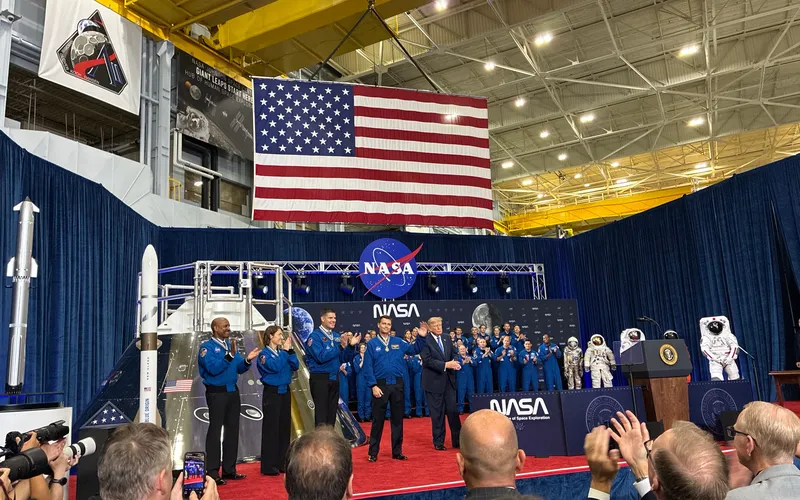
President Donald J. Trump signed an executive order Friday establishing a presidential commission to design the nation's first U.S. Space Academy, a NASA-led federal institution focused on technical education, leadership development, and public service in space. He also presented the Congressional Space Medal of Honor to the crew of Artemis II at NASA's Johnson Space Center in Houston.
The order creates the Presidential Commission on the United States Space Academy, chaired by NASA Administrator Jared Isaacman, with Deputy Administrator Matt Anderson serving as executive director. The commission has 120 days to submit recommendations on governance, curricula, service obligations for graduates, applicant requirements, location selection, pilot programs, partnerships, legislation, and implementation.
Trump described the academy as essential to train service members, engineers, and operators amid growth in the U.S. Space Force and commercial space sector, as well as expanded ambitions to the Moon and beyond. "A nation cannot be first on Earth if we're going to be second in space," he said. The academy will prepare graduates for careers supporting military, civil, and commercial space efforts, modeled in part after traditional service academies but open to a broader range of space professionals.
In the same ceremony, Trump awarded the Congressional Space Medal of Honor to NASA astronauts Reid Wiseman, Victor Glover, and Christina Koch, along with Canadian Space Agency astronaut Jeremy Hansen. The Artemis II crew launched aboard the Orion spacecraft on April 1 and splashed down in the Pacific Ocean on April 10 after a 10-day mission that included a lunar flyby. The astronauts traveled 252,756 miles from Earth, farther than any humans before, and covered a total of 695,081 miles.
The mission marked the first crewed flight of the Space Launch System rocket and Orion spacecraft, with the crew naming their vehicle Integrity. It was the first time humans traveled beyond low Earth orbit since the Apollo era. Trump called the crew "four intrepid space heroes" and praised the broader NASA team for the mission's success.
The actions align with Trump's prior space policy directives from his first term, which directed NASA to return astronauts to the Moon through the Artemis program. NASA Administrator Isaacman said the academy represents a "transformational step" to prepare the workforce needed for future lunar landings, a Moon base, nuclear propulsion, and other initiatives.
Trump noted that a location for the academy has not yet been selected but indicated he would choose one soon. He also mentioned ongoing work on a nuclear-powered interplanetary spacecraft planned for a Mars mission in 2028.

Comments
No comments yet. Be the first to share your thoughts.