
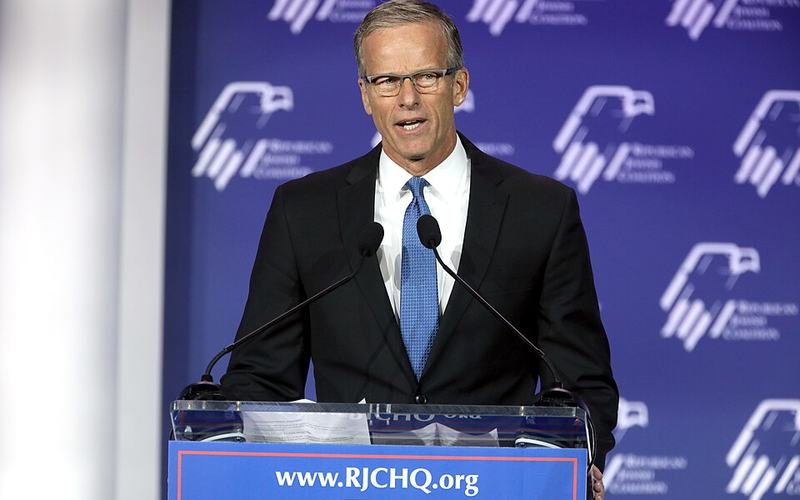
Senate Majority Leader John Thune (R-SD) drew criticism Monday after posting a message celebrating Native Americans’ Day in South Dakota without acknowledging Columbus Day, a federal holiday recognized nationwide.
“Today is Native Americans’ Day in South Dakota, an opportunity to celebrate the heritage and contributions of the Lakota, Dakota, and Nakota people,” Thune wrote.
Today is Native Americans’ Day in South Dakota, an opportunity to celebrate the heritage and contributions of the Lakota, Dakota, and Nakota people. pic.twitter.com/x7WoZ6yO8P
— Leader John Thune (@LeaderJohnThune) October 12, 2026
Toby Doeden, a potential Republican primary challenger to Thune in 2028 who previously ran for governor of South Dakota and finished second in the runoff, is one of many South Dakotans that responded directly to the senator’s post.
“Today is also Columbus Day, John. More than 35 years ago, Governor George Mickelson pushed to replace Columbus Day with Native Americans Day. His thought was this would bring better relations between South Dakota’s government, and our Native Americans. Whether relations have improved or not, isn’t the point. That could be argued. But if you’re going to recognize Native Americans Day, you should also recognize Columbus Day. It is still a federal holiday, correct?" Doeden wrote.
Today is also Columbus Day, John.
— Toby Doeden (@TobyForSD) October 12, 2026
More than 35 years ago, Governor George Mickelson pushed to replace Columbus Day with Native Americans Day.
His thought was this would bring better relations between South Dakota’s government, and our Native Americans.
Whether relations have… https://t.co/DFFD8Pa6iM
The dispute centers on South Dakota’s decision to replace Columbus Day with Native Americans’ Day more than 35 years ago. In 1990, then-Gov. George Mickelson established the state holiday as part of an effort to improve relations between South Dakota’s government and Native American communities. The state became the first in the nation to officially make the change.
South Dakota law designates the second Monday in October as Native Americans’ Day, honoring Native American leaders and their contributions to the state. The holiday recognizes the Lakota, Dakota, and Nakota peoples, whose histories and cultures are deeply connected to the region.
Critics, including Doeden, argued that recognizing Native Americans’ Day should not require overlooking Columbus Day, which remains a federal holiday. The response questioned why Thune would acknowledge one observance without also recognizing the other.
Columbus Day commemorates Christopher Columbus’s 1492 voyage to the Americas and is also associated with the contributions and heritage of Italian Americans. President Donald Trump issued a proclamation recognizing October 12, 2026, as Columbus Day, calling on Americans to observe the holiday and directing that flags be displayed on public buildings.
The controversy is not new for Thune. Last year, the senator also posted a message celebrating Native Americans’ Day without mentioning Columbus Day, drawing criticism from conservatives who argued that the holiday should continue to receive recognition. Thune’s office previously noted that South Dakota has observed Native Americans’ Day for decades and that the senator recognizes it annually.
The latest exchange highlights a broader debate over how Americans recognize the nation’s history and whether honoring Native American communities should come at the expense of traditional observances such as Columbus Day.
While South Dakota officially observes Native Americans’ Day at the state level, Columbus Day remains a federal holiday. The renewed criticism puts that distinction at the center of a political dispute that could carry into the next Republican Senate primary.

Comments
No comments yet. Be the first to share your thoughts.