
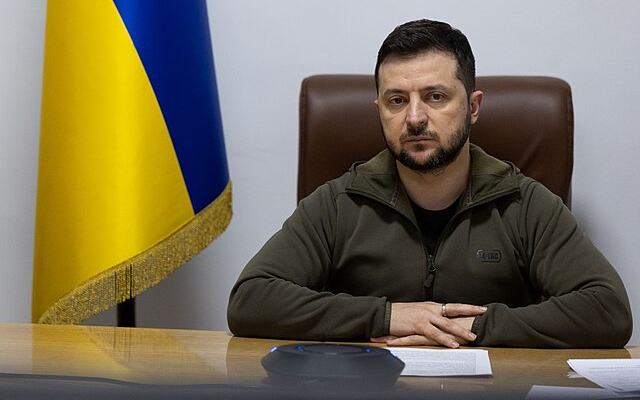
Ukrainian President Volodymyr Zelenskyy held a virtual meeting with U.S. lawmakers Monday to urge Congress to press President Donald Trump’s administration over alleged restrictions on intelligence sharing and delays in weapons deliveries to Ukraine. The closed-door call was led by Sen. Thom Tillis (R-NC) and Sen. Richard Blumenthal (D-CT) and included additional members of the House and Senate.
According to a transcript provided by Ukrainian officials to Axios, Zelenskyy told lawmakers that access to SpaceX’s Starlink satellite communications network and the U.S. military’s Starshield system remained partially restricted. He also claimed Ukraine had gone without early warnings of Russian ballistic missile attacks on three occasions during the previous week.
Zelenskyy further alleged that Secretary of War Pete Hegseth had not approved the delivery of Patriot air defense interceptors and AIM-9X missiles that NATO countries had already paid for. He suggested the reported restrictions reflected a deliberate political decision to slow American support.
Ukrainian officials have linked the alleged changes to recent talks in Miami, where Trump announced a diesel agreement with Russia. They have claimed that U.S. envoys Steve Witkoff and Jared Kushner warned Kyiv that continued Ukrainian attacks on Russian oil refineries could lead to reductions in intelligence assistance and weapons sales.
U.S. officials have denied making such threats, while Trump has maintained that Washington continues to share intelligence with Ukraine. The administration’s position contrasts with Zelenskyy’s account of the restrictions, leaving disagreements over the scope and purpose of U.S. support at the center of the dispute.
Trump criticized the Ukrainian president Monday, arguing that Zelenskyy was not doing enough to bring the war to an end. He suggested Ukraine’s leader should consider allowing someone else to negotiate on the country’s behalf and reiterated his view that an agreement could have been reached earlier.
The president also dismissed Zelenskyy’s reported criticism of his approach to the conflict, saying the Ukrainian leader did not understand what he was talking about. Trump’s comments underscore the continuing tension between the two leaders over negotiations, military assistance, and the path toward ending Russia’s war against Ukraine.
Despite the disagreements, Tillis said Congress remained committed to supporting Ukraine and European allies in opposing Russian aggression and pursuing a lasting peace. Blumenthal likewise emphasized bipartisan support for Kyiv, arguing that concessions to Russian President Vladimir Putin would not secure peace.
According to Politico, Zelenskyy also raised Trump’s decision to waive certain sanctions against Russia. Some lawmakers reportedly characterized the administration’s actions as obstacles to peace, reflecting concern among Ukraine’s congressional supporters that changes in U.S. policy could weaken Kyiv’s negotiating position.
Zelenskyy told lawmakers he had proposed a 30-day suspension of Ukrainian strikes on Russian oil refineries in exchange for the delivery of Patriot interceptors during that period. He said Witkoff and Kushner had not shown interest in the proposal.
The Ukrainian president is scheduled to visit Oslo next week, where he could meet with the American envoys before they continue to Moscow, according to a source cited by Axios.
Following the congressional call, Zelenskyy also said he had briefed lawmakers on a Russian drone attack in Ukraine’s Kharkiv region that killed six people, including a mother and her child. He reiterated that Kyiv had yet to receive an explanation from American officials regarding the reported intelligence-sharing and satellite communications restrictions.
The meeting represents another effort by Zelenskyy to enlist Congress in pressing the White House for continued military and intelligence support. The dispute comes as the Trump administration pursues negotiations involving Russia and Ukraine, with disagreements over military aid and attacks on Russian energy infrastructure complicating diplomatic efforts.

Comments
No comments yet. Be the first to share your thoughts.