
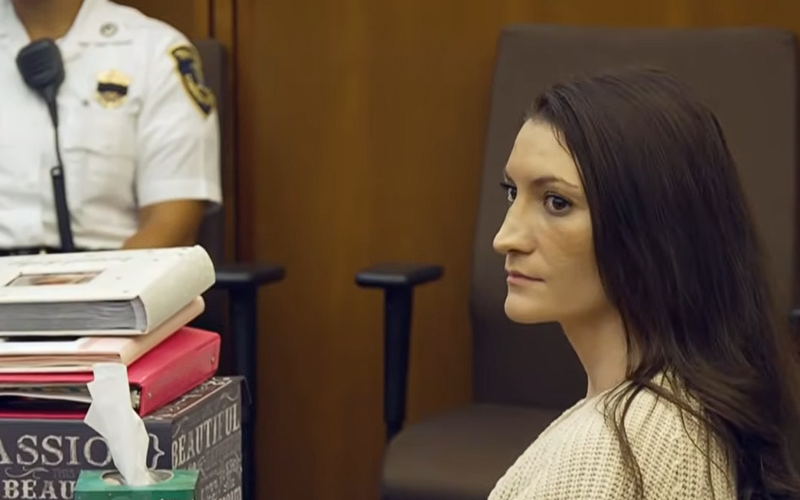
In January 2023, a seemingly idyllic life of the Clancy family was shattered in their Duxbury home, after prosecutors say husband Patrick found wife Lindsay strangled their three children to death and then attempted to take her own life.
Lindsay Clancy, 36, has entered day 17 of her trial, where she faces a mandatory life sentence if convicted of the first-degree murders of her three children, all under the age of 6.
Now paralyzed following her own suicide attempt, Clancy has pleaded not guilty to the killings but does not dispute carrying out the killings
However, a psychologist testified for the defense that she heard a male voice in her head ordering her to do it.
Her case has gained national attention, drawing in support for her alleged condition—including her ex-husband, Patrick. Supporters of Clancy say she did not receive the mental health care she needed, with many sympathizing that her postpartum healthcare was so atrocious that an unfortunate case like Lindsay’s was bound to happen.
In a public statement recorded by CBS Boston, Patrick spoke about his marriage and the immeasurable pain he’s experienced after the deaths of his children.
"Any parent knows it's impossible to understand how much you will love your kids until you have them," he said. "The same goes for understanding the devastation of losing them. Cora, Dawson, and Callan were the essence of my life, and I'm completely lost without them."
Patrick has gone on record defending his ex-wife, portraying her as a loving wife, mother, and nurse, saying: "She loved being a nurse, but nothing matched her intense love for our kids and dedication to being a mother. It was all she ever wanted. Her passion taught me how to be a better father."
He concluded his statement calling for the public's forgiveness on this subject, just as he had forgiven her, saying, "I want to ask all of you that you find it deep within yourselves to forgive Lindsay, as I have. The real Lindsay was generously loving and caring towards everyone - me, our kids, family, friends, and her patients."
Prosecutors claim her actions were deliberate, while Clancy’s defense team says she was suffering from undiagnosed postpartum psychosis at the time of the killings.
Clancy’s Mental Health Battle
According to media outlet The New Yorker, Clancy began to experience postpartum anxiety following the birth of both Cora and Dawson, and she was able to manage the symptoms through home remedies, i.e., exercise, meditation, and therapy.
Callan’s birth exacerbated her mental health struggles, and she claimed to experience hypomanic behavior, meaning heightened energy and mood, sleeping only approximately three hours per night, and exhaustion during the day. She also heard voices and experienced suicidal ideation.
Clancy sought help from mental health specialists, insisting that she be hospitalized in December 2022. According to an interview with Patrick, Lindsay was only diagnosed with generalized anxiety disorder; however, on January 1, 2023, she was admitted to an inpatient program at a top psychiatric institution, McLean Hospital, but was discharged after just five days.
Following her hospital stay, Lindsay was prescribed a variety of medications to curb her depression symptoms.
What Led to the Children’s Deaths?
On January 24, 2023, prosecutors say Lindsay took her daughter to the pediatrician and played in the snow with her children before asking Patrick to pick up takeout for dinner and medication at a nearby pharmacy.
She was allegedly fully coherent, according to witnesses.
Prosecution said when Patrick returned home, he found Lindsay semi-conscious and bleeding outside, claiming she jumped out the window in a suicide attempt.
Inside the home, Patrick found the three children in the home’s basement with exercise bands around their necks. Cora and Dawson were pronounced dead at the hospital the same day, while Callan was placed on life support.
He passed three days later.
Lindsay, recovering in a Boston hospital, was charged with three counts each of murder, strangulation, and assault and battery with a dangerous weapon.
According to a release by the Plymouth County District Attorney’s Office, she pleaded not guilty to the charges arraigned from her bed in a Boston hospital via Zoom.
Days before her trial began, on July 10, 2026, prosecutors dropped the three strangulation charges against Clancy—citing their redundancy when coupled with the first-degree murder charges.
Clancy’s Trial
Having officially begun on July 20, 2026, 16 jurors, consisting of 12 women and six men, were seated and expected to hear Clancy’s trial for about six to eight weeks total, according to ABC 5.
Early on, Patrick, called on by the prosecution, spoke extensively about Lindsay’s medical history and demeanor leading up to their children’s deaths—noting that “her mood seemed better, she was more active and was able to partake in more things.”
Both the prosecution and defense read aloud excerpts from her diary detailing her symptoms of brain fog, anxiety, and feeling like she was drowning in the days and months leading up to her children’s deaths.
The jury was taken to Clancy’s home to better understand the crime scene and environment Lindsay was in.
A medical examiner was called to the stand to describe the clinical examination of the three children. The jury was asked to examine the evidence presented to them with a clear, unbiased viewpoint.
“Sometimes there’s evidence that’s presented at a trial that creates an emotional reaction, but as jurors that have taken an oath to follow the law, you must separate reaction,” said Judge William Sullivan.
The in-depth analysis caused Clancy to break down in the courtroom, sobbing, “I can’t do it.”
Her outburst led to a sudden recess, allowing her to regain composure.

(Pictured: Dr. Paul Zeizel)
Dr. Paul Zeizel, a critical defense witness who visited Clancy in the hospital in early 2023, recalled her saying that the memory of that day was “fuzzy and foggy,” he said, and that she was taking medication for significant pain following surgery.
Having met with her numerous times, Zeizel testified to no evidence that would signify Clancy was faking or exaggerating psychiatric symptoms.
"Hallucinations are like waves at the beach: they come and go," Zeizel said, explaining to the prosecution and the jury that psychosis is intermittent and not constant. Zeizel testified that it was plausible for Clancy to have been suffering from postpartum psychosis but still be able to function normally in society. "She said she had 'horrible thoughts.' She felt that people could actually hear her thoughts. The thoughts were so loud that strangers could hear them."
After the prosecution rested on August 17, the defense began presenting its insanity defense.
Clancy’s former mother-in-law told the court that Lindsay was “begging for help”. Her mother, Paula Musgrove, on the court record said Lindsay would tell her on multiple occasions that she was not feeling like herself, and that she would experience hearing male voices in her head.
On Wednesday, the jury was dismissed early due to an unforeseen circumstance.
On Thursday, day 17 of her trial, local reporting noted a significant crowd of protestors, who donned pink and appeared in support of Clancy outside the courtroom.
All the jurors were asked they watched, heard, or overheard anything about the case that would affect their decision-making. They all said no.
Sheila Cavanaugh, a board-certified chaplain at Brigham and Women’s Hospital, was called by Kevin Reddington to the stand. Cavanaugh said that she met with Clancy several days after the killings, saying that Lindsay told her: “I am so glad that my children are safe.”
When asked about her note-taking, Assistant District Attorney Jennifer Sprague pointed out that Clancy had never mentioned disclosing hearing voices in her head.
“The chaplain notes are not verbatim,” Cavanaugh said. “I’m there to bear witness to their suffering.” Cavanaugh elaborated that conversations with clientele are confidential.
Following Cavanaugh’s appearance, the jury was dismissed for the day, and the judge called a short recess.
Clancy’s mental deterioration following the birth of her children has been at the forefront of her case and will be the deciding factor in whether she will be sentenced to life in prison or committed to a state mental health facility, on the grounds that she lacked criminal responsibility.

Comments
No comments yet. Be the first to share your thoughts.