
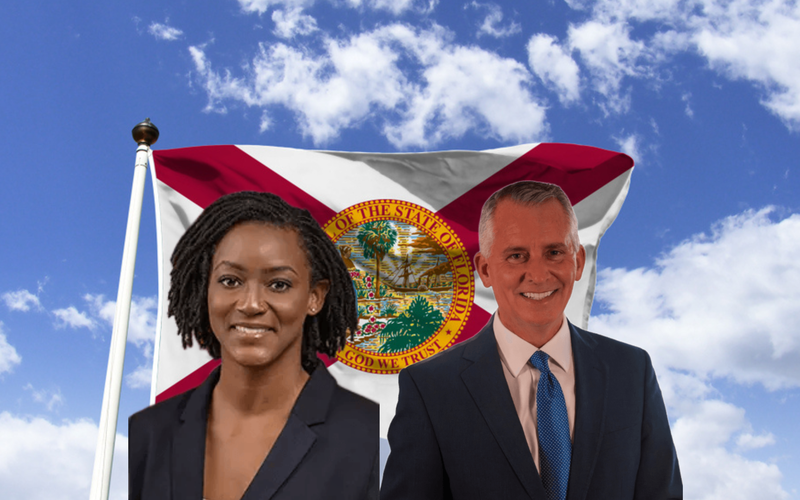
Tuesday’s primaries in Florida took center stage in the national media, as the once-battleground, now right-leaning state, has nominated an interesting a roster of candidates, ahead of the November elections.
Predictably, Byron Donalds secured the Republican nomination for governor, as he was the odds-on favorite heading into the primary, earning 49% of the vote over second-place finisher Jay Collins, who earned 24.7%.
Outgoing governor Ron DeSantis chose not to endorse a Republican to succeed him for office leading up to the election. Donalds maintained a large fundraising lead and received an early, critical boost from President Donald Trump's endorsement.
Donalds’ opponent, David Jolly, is an interesting choice by Democrats heading into the November election.
Jolly, a Republican turned Democrat, earned a clear majority with 61.6% of his party's vote, earning him the nomination over runner-up Dayna Marie Foster, who earned 14.8% of the vote.
Jolly opposed President Trump, opting to drop his party affiliation and become an Independent. He later announced his candidacy for Florida governor as a Democrat, where he ran his campaign on change, saying during one of his stops, “What I can tell you is that the values I speak of that the economy should work, that government can do a little bit to improve our lives, and that everyone should have the right to be protected those are the guideposts for how I’ll serve as governor.”
Democrats face a 1.5 million voter-registration disadvantage after years of Republican power accumulation in the state, according to the Florida Division of Elections page, 5,607,836 people are registered as Republicans and 4,066,503 are registered as Democrats.
However, if voters are not motivated to turn out for Donalds, the race for governor could be closer than anticipated.
The party hopes that, with Jolly representing the Democratic ticket, he can appeal to moderates, progressives, and on-the-fence Republicans who have grown tired of the current administration.
A win for the Democrats is considered unlikely; however, the tide can shift in Jolly’s favor, as Donalds’ opponents noted that the Democratic nominee is a strong choice to go against Republicans.
“We have to have a candidate who can win the general, I’ve been saying for months I have concern over Byron Donalds in the match up,” said Jay Collins in an interview with the Miami Herald. “David Jolly registers very well, he knows the talking points, he knows how to address things.”
Donalds is favored to win come election night, and if he does win, he’ll become the first black governor in Florida.
Running against incumbent Republican nominee Ashley Moody for the Florida Senate is Democratic Socialist Angie Nixon, who won her party's nomination over Army Lt. Col. Alexander Vindman, a one-time National Security Council official who testified in President Trump’s first impeachment in 2019.
Having overcome a significant campaign financial disadvantage, Nixon nabbed the nomination 55.9% to 44.1%.
Her victory is among several progressive wins that have occurred throughout the 2026 campaign cycle, joining the ranks of Minnesota’s Peggy Flanagan and Michigan’s Abdul El-Sayed.
While it was no easy feat, as Vindman’s name recognition and lengthy resume made him a strong opponent, Nixon must now unite traditional and progressive Democrats against Moody heading into November.
Nixon told Vindman supporters, "There is a place for you," as she campaigns against Moody. "The great thing about our movement is we are not trying to force everyone to agree with us and believe exactly the same thing," Nixon said.
Vindman, meanwhile, said that Nixon "ran a strong campaign." He pledged, "I will be standing by her side in the fight against Ashley Moody," while telling his supporters, "I hope you'll join me."
Nixon, in her post-win speech to her constituents, targeted Moody and her attacks on the Democratic nominee, calling her a radical.
Moody is favored to win the Senate Seat in November, but energized Democrats standing behind Nixon may give her a much-needed boost come election night.
If there are any takeaways from Tuesday’s Florida primaries, it's that the Democratic nominees in the statewide races are offering two very different perspectives. One is a middle-of-the-road former Republican, and the other is a very progressive democratic socialist. The question is: Will either of their stances have any sway when voters hit the polls in November?

Comments
No comments yet. Be the first to share your thoughts.