
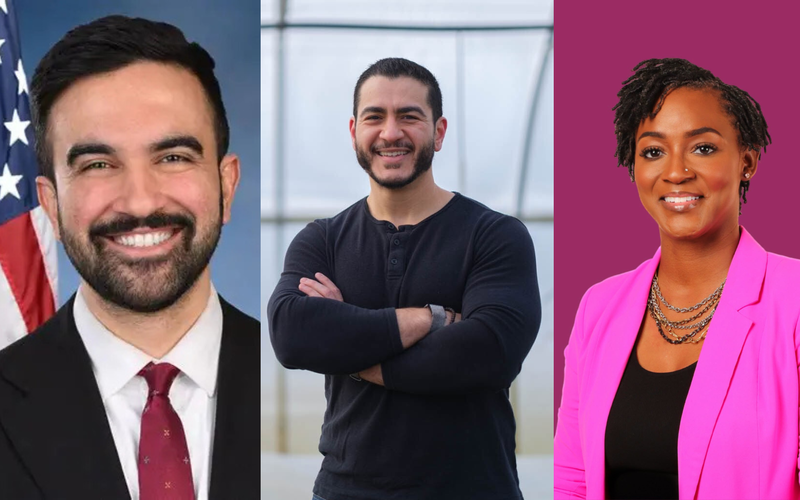
November midterms are rapidly approaching as Democrats prepare to battle for vital political positions; however, divided opinions on who best represents the party have sown doubt among voters.
While Republicans have shown signs of unity, most recently in the collective backing of Florida Rep. Byron Donalds and his bid for state governor, media outlets have begun circulating stories about how the Democratic Party's ideological divide could hurt its chances moving forward.
A story published by Florida Politics details how Democratic Socialist Angie Nixon, who won the nomination for state senator, may jeopardize the party’s chances of winning in November.
State Republicans are publishing media portraying the Senate candidate as in cahoots with the party’s nominee for governor, David Jolly.
“Angie Nixon is an unhinged nut job who shouldn’t be anywhere near a position of power,” said Republican National Committee Chair Joe Gruters, who serves with Nixon in Florida’s Legislature.
State Democrats have downplayed the heightened focus on Nixon’s political affiliation, largely supporting her win and candidacy. However, considering Jolly had previously aligned with Republicans before shifting parties, and Nixon’s socialist beliefs have left Florida Democrats confused about which direction their party has moved.
South Florida Democratic leaders have publicly stated that socialism does not resonate in their region.
Jolly has publicly rejected the Democratic Socialist movement, informing moderates that his campaign will not be influenced by Nixon.
“I reject the DSA,” Jolly said. “I reject socialists. I am a capitalist.”
Kathryn DePalo-Gould, a professor at Florida International University and political expert, says Nixon’s progressive views may be a drag on other Florida Democrats down the ticket.
“I absolutely think this is gonna impact down-ballot races. I mean, everybody from, you know, David Jolly who is saying, ‘This is not me. This is not what I embrace,’ some congressional races perhaps, but even everything else on the ballot from state legislative races, maybe local races,” she said. “I think this is going to increase Republican turnout.”
Both Nixon and Jolly face an uphill battle for office, as Florida has long favored Republicans, with public surveys backing Donalds and Republican nominee for state senator, Ashley Moody, ahead of the election.
In May, the New York Times published a poll surveying Democratic voters on their opinions of the political landscape. Among the questions, the New York Times asked whether the Democratic Party/candidates need to shift stances to win an election. Over 50% of respondents believed the party should shift center, and 25% said it needs to shift further left.
Respondents, on average, felt the party needed to shift center to appeal to voters ahead of elections; however, with candidates like Nixon, Abdul El-Sayed in Michigan, and N'Kiyla Jasmine Thomas in Oklahoma positioning themselves as Democratic Socialists, uncertainty within the party has grown about whether the candidates can win.
Their platforms, which have spotlighted tensions over issues such as Israel policy, economic proposals like Medicare for All, and broader critiques of capitalism, may have energized enough Democratic voters to show up in the primaries, but the real struggle has historically been motivating enough people to vote on election day.
Currently, the most influential Democratic Socialist is New York City Mayor, Zohran Mamdani. The 34-year-old mayor has been in office for about six months, and his agenda has hit headlines multiple times. His administration can be credited with lowering crime rates, delivering rent freezes on regulated apartments, and implementing his “Block by Block” plan, which has aimed to encourage construction, as well as identifying ways to speed permitting approvals.
However, Mamdani has been the centerpiece of criticism across New York State for a mix of policy moves, personnel decisions, and rhetoric tied to Israel and antisemitism, prompting organizing among business and centrist Democratic figures who worry about his agenda and political style. Concerns have been raised about proposed tax hikes and city-run groceries, with many worried that wealthy New Yorkers will flee the state for fear his policies will be too financially burdensome.
Centrist Democrats have pushed back, with some signing letters emphasizing that the party remains capitalist and warning that extreme positions could prove toxic in general elections. Polls show significant frustration among Democratic voters with the party's direction after the 2024 losses.
Party figures have attempted to downplay the rifts by stressing a "big tent" approach that accommodates diverse views. Senate Minority Leader Chuck Schumer has described ideological variety as a strength. However, recent episodes, including House Democrats crossing party lines on procedural votes and public clashes over socialism condemnations, have underscored the challenges of maintaining unity.
Analysts note that while Democrats have advantages in some competitive districts because of President Trump's relatively low approval ratings, intraparty battles risk distracting from a unified message on affordability and other voter priorities.
However, it remains to be seen whether selecting candidates with ideological clashes within the Democratic Party will improve or hurt their chances in November.

Comments
No comments yet. Be the first to share your thoughts.