
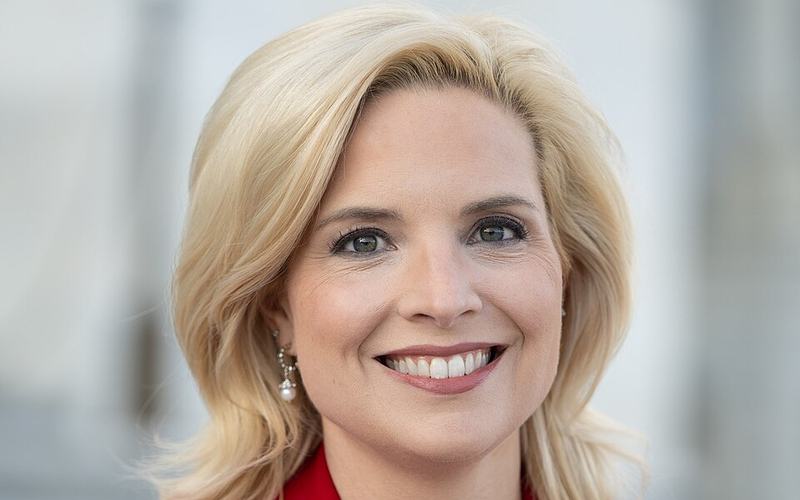
Rep. Ashley Hinson, R-Iowa, is walking a political tightrope in her campaign for the U.S. Senate, balancing her close relationship with President Donald Trump against concerns among some Iowa voters about rising costs, manufacturing job losses, and economic challenges facing farmers.
After dropping her sons off at school earlier this month, Hinson saw the initials “DJT” flash on her phone. The caller was Trump, who introduced himself by saying, “Ashley, it’s your favorite president,” Hinson recently recalled to supporters.
The anecdote reflects the relationship Hinson has cultivated with Trump, whose support could be crucial to turning out Republican voters in November. But Hinson has also increasingly emphasized her willingness to disagree with the president when she believes his policies conflict with Iowa’s interests.
During a debate with Democratic opponent Josh Turek, an Iowa state lawmaker, Hinson promised to support Trump when it benefited the state while making clear she would not automatically agree with him.
“I’ll be President Trump’s ally when it is important for Iowa, but I will push back on him,” Hinson said. “He knows this.”
That message marks a shift from the beginning of her campaign last year, when Hinson highlighted Trump’s endorsement and said she wanted to be his “top ally” in the Senate. She now describes herself as “Iowa’s best bipartisan fighter,” seeking to demonstrate independence without alienating the Republican base.
Trump appeared alongside Hinson at a rally Thursday in Sioux City, in Iowa’s conservative northwest corner. Speaking to hundreds of his supporters, Hinson highlighted the requests she makes of the president on behalf of her state.
“I’m not sure, frankly, that he’s always happy when we’re talking because I ask him for a lot of things for Iowa when we’re on the phone,” she said. “And that’s exactly what you would expect me to do, right? As your next United States senator.”
Trump is scheduled to return to Iowa on Nov. 1, shortly before Election Day. Iowa Republican Party Chair Jeff Kaufmann said the president is “anxious for Iowans to hear his message before they vote.”
The visits are intended to energize Republican turnout, but they also tie Hinson more closely to a president whose standing among some voters has become a potential liability for Republican candidates.
Iowa has faced economic pressures since Trump returned to the White House, including manufacturing job losses, health care clinic closures and reduced farm profits. Hinson’s challenge is to persuade voters that she can deliver for the state even when that means breaking with the administration.
She has offered several examples of those disagreements. In August, Hinson criticized Trump’s plan to increase beef imports from foreign countries in an effort to lower prices, calling it “a bad idea” that would hurt Iowa farmers.
She has also expressed concern about the cost of the war with Iran. Two Iowa Republican colleagues in the House voted last month to limit Trump’s ability to continue the conflict without congressional approval, but Hinson did not join them. She later argued that the war had become too costly for Americans and called for Trump to bring it to a “successful and immediate end.”
More recently, Hinson criticized Trump’s decision to ease sanctions on Russia in exchange for diesel fuel, saying the United States should not make deals that allow dictators to benefit from wars.
“I think the president and I share the goal of lowering costs for working families and for people who are using diesel,” Hinson told reporters Tuesday. “I, again, just don’t think we need to be making any deals with Russia.”
Hinson said she had not discussed the issue with Trump but suggested she might have an opportunity to speak with him during the Sioux City rally.
Turek has sought to capitalize on economic concerns, criticizing Trump’s tariffs and the war with Iran as factors driving up costs for Iowa families. He has also presented himself as willing to work across party lines, including with the president on immigration enforcement.
In one television advertisement, Turek discusses Interstate 35, which he says connects Iowa to the southern border and a broken immigration system that both parties have failed to fix.
“In the U.S. Senate, I’ll work with anyone to fix it, including President Trump, to secure the border, stop the flow of drugs into Iowa,” Turek says in the ad.
According to an Associated Press analysis of AdImpact data, Turek is the only Iowa candidate seeking federal office who explicitly mentions Trump in general election television advertisements. His approach allows him to signal a willingness to cooperate with the president on selected issues while criticizing other administration policies.
Republicans have dismissed Turek’s bipartisan message as an attempt to appear moderate to win votes. Mazie Stilwell, executive director of the progressive organization Progress Iowa, said his immigration message targets voters who prioritize border security without overshadowing his focus on the cost of living.
Stilwell argued that Trump’s visit could instead remind voters of the economic difficulties they have faced under his administration, calling it “a terrific reminder of the disaster that he has been and his administration has been for our bottom line, for everyday Iowans who are trying to make ends meet.”
The race is drawing substantial spending from both parties. Broadcast and cable television advertising has already surpassed $200 million this election cycle, according to AdImpact, although inflation-adjusted spending in the 2020 Senate race was even higher. Republicans have spent slightly more supporting Hinson than Democrats have spent supporting Turek. In 2020, Democrats spent nearly $30 million more than Republicans in their unsuccessful effort to unseat Sen. Joni Ernst.
Recent polling from late September and early October suggests Hinson’s strategy may be helping her appeal beyond Trump’s strongest supporters. She has attracted support from approximately one in 10 voters who disapprove of the president while maintaining overwhelming support among those who approve of him.
Hinson’s challenge is to maintain that balance through Election Day. She needs Trump’s supporters to turn out while convincing voters concerned about the economy that she will represent Iowa’s interests independently. With Trump preparing to return to the state before Election Day, the effectiveness of that strategy could prove decisive in the Senate contest.

Comments
No comments yet. Be the first to share your thoughts.