
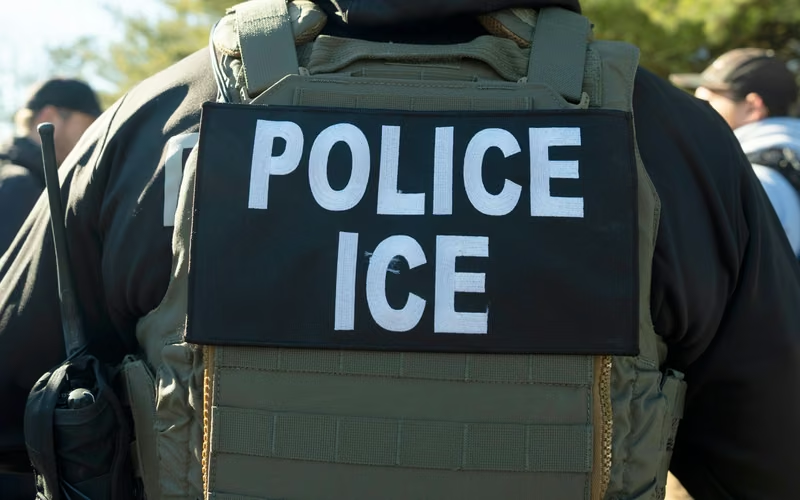
U.S. Immigration and Customs Enforcement is pushing back against recommendations to automatically activate agents’ body cameras when weapons are drawn, arguing that the technology could create operational risks and inadvertently record sensitive encounters. The Department of Homeland Security raised the objections in response to a Government Accountability Office review that identified weaknesses in body-camera training, oversight, and compliance at ICE and Customs and Border Protection.
DHS argued that automatic activation technology “presents significant operational risks, including inadvertent or false activations during routine movement.” The department also warned that unintended recordings could expose confidential conversations with informants and crime victims or capture people exercising their First Amendment rights.
According to Axios, DHS accepted six of the GAO’s seven recommendations but rejected the proposal involving automatic activation and additional safeguards to ensure agents record arrests, searches and detentions when required.
The two agencies currently use different approaches. Customs and Border Protection already has technology that automatically activates body cameras when officers draw their firearms or turn on emergency lights. ICE does not have the same capability.
The GAO found that uncertainty over existing recording requirements was widespread among personnel at the locations it reviewed. Employees at six of 10 locations expressed confusion about when cameras had to be activated, with some describing agency policies as “not mandated,” “up to interpretation” or containing “gray areas.”
Agents cited questions about recording during vehicle searches, detainee transportation, undercover operations, and interviews with people in custody. The watchdog warned that these gaps could result in important encounters going undocumented.
The report also highlighted limited disciplinary action for violations of body-camera policies. From the program’s launch through September 2025, ICE had issued no written reprimands for violations, while CBP had issued only one.
The findings come as federal immigration enforcement faces heightened scrutiny following several fatal shootings involving ICE agents. Body cameras have emerged as a key issue in broader debates over law enforcement transparency, accountability and officer safety.
Earlier this year, White House border czar Tom Homan defended efforts to expand ICE’s body-camera program, saying he had discussed the initiative with then-Homeland Security Secretary Kristi Noem, who approved the decision.
“We have nothing to hide,” Homan said, arguing that Americans “seek and deserve professional and trustworthy law enforcement.”
Homan also said $20 million included in a federal spending bill would help finance the expansion. He emphasized that agents would face consequences for misconduct, declaring, “Any misconduct will not be tolerated and will be swiftly addressed.”
At the time, Homan also defended the administration’s broader immigration enforcement strategy, arguing that agents focus on targeted operations against individuals with criminal histories rather than conducting indiscriminate sweeps.
“When we leave this building, we know who we're looking for,” Homan said.
The GAO concluded that without clearer standards and updated deployment plans, ICE and CBP cannot adequately determine whether their body-camera programs are meeting their stated goals of improving accountability, officer safety, and public trust. The dispute over automatic activation highlights the continuing challenge of establishing consistent recording requirements while protecting sensitive law enforcement operations.

Comments
No comments yet. Be the first to share your thoughts.