
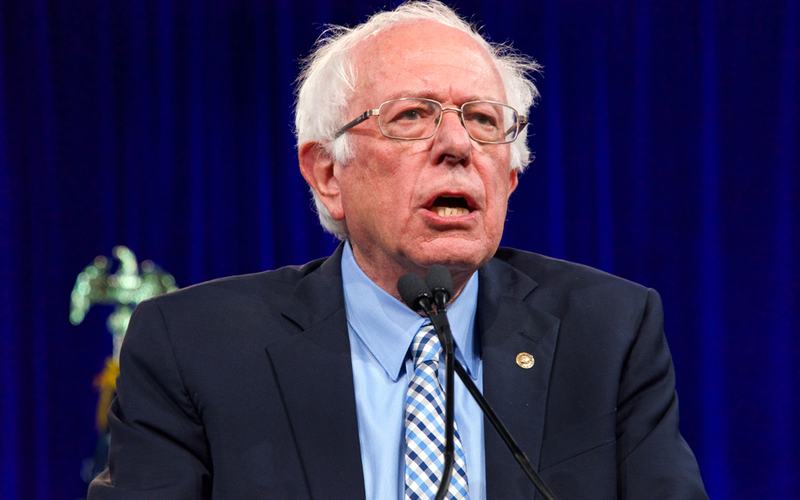
Sen. Bernie Sanders (I-Vt.) called Monday for a permanent ban on Super Intelligence and a halt to advanced development, taking aim at OpenAI CEO Sam Altman over warnings that society may have to accept serious cyberattacks as increasingly powerful technology becomes more widespread.
“No, Mr. Altman. We won't accept a severe AI cyberattack in exchange for 'liberty,'” Sanders wrote in a post on X. “We must PAUSE advanced AI and permanently BAN artificial superintelligence before it is too late.”
Sanders was responding to Altman's recent appearance on Politico's Decoded podcast, where the OpenAI chief warned of a “coming tidal wave of cybersecurity problems” involving open-source models. Altman argued that society would have to tolerate some serious cyber incidents in exchange for the freedom and benefits the technology could provide.
The Vermont senator challenged that position by raising the prospect of attacks on critical infrastructure, including international banking systems, hospitals, electrical grids and nuclear power plants.
“Should we 'accept' a global financial breakdown and massive economic pain if AI models hack into the international banking system?” Sanders asked. He also questioned whether Americans should tolerate hospital shutdowns, widespread blackouts or a nuclear disaster comparable to Chornobyl.
Sanders accused technology executives of placing profits and corporate power ahead of public safety, arguing that developers must remain accountable for the risks associated with their products.
“The creators of any AI model — open-source or not — are not above the law,” he wrote.
No, Mr. Altman. We won’t accept a severe AI cyberattack in exchange for “liberty.”
— Sen. Bernie Sanders (@SenSanders) October 12, 2026
74% of the American people don’t trust Big Tech Oligarchs. And for good reason.
Sam Altman, the co-founder of OpenAI, recently said: “There is a coming tidal wave of cybersecurity problems that…
The dispute comes as Sanders and Rep. Greg Casar (D-Texas) advance legislation introduced Sept. 23 that would permanently prohibit the development or deployment of Super Intelligence. The Ban Artificial Superintelligence Act would also impose a temporary halt on advanced development until federal regulators establish safety standards.
The proposal would create a Cabinet-level Department of Artificial Intelligence, pursue international agreements to restrict Super Intelligence and establish penalties for violations, including prison sentences of up to 20 years.
President Donald Trump has taken a different approach, promoting American technological development as a national priority and establishing a “Super Intelligence Force.” The contrasting positions reflect a broader debate in Washington over whether the government should impose sweeping restrictions or encourage innovation while addressing security risks.
Altman has warned that excessive regulation could concentrate technological power in the hands of a small number of companies or countries. He has also acknowledged the possibility of catastrophic threats, distinguishing between manageable risks and dangers that could cause a serious loss of human control.
Sanders, however, argues that Americans should not be expected to accept potentially devastating consequences as the price of technological progress.

Comments
No comments yet. Be the first to share your thoughts.