
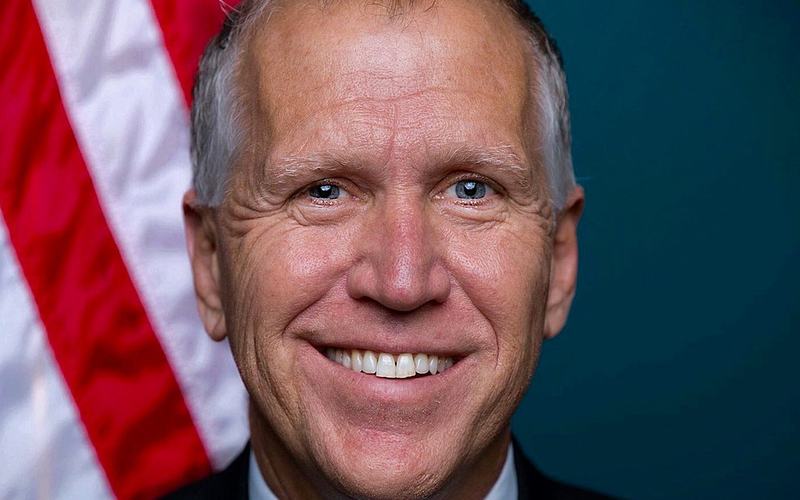
Sen. Thom Tillis, R-N.C., called on Elon Musk and SpaceX to explain unexpected restrictions affecting Ukraine’s military satellite communications after Ukrainian officials reported disrupted drone missions and unstable connections. The Republican senator warned that deliberately weakening Ukraine’s ability to defend itself could benefit Russian President Vladimir Putin, while Musk said the U.S. government controls restrictions on Starshield, the military satellite service.
In a post on X Wednesday, Tillis asked Musk to confirm that the overnight disruptions were unintended and that SpaceX was working to resolve what he hoped was a temporary technical problem.
“I’m confident this does not reflect a change in SpaceX policy because if so, intentionally degrading Ukraine’s ability to defend itself might be construed as aiding and abetting a mass murderer,” Tillis wrote, referring to Putin.
“Can you confirm that’s not SpaceX’s intent?” he added, arguing that supporting Ukrainian sovereignty should not be a gray area for the U.S. government or American corporations. Tillis also asked Musk to clarify SpaceX’s position on the restrictions.
.@elonmusk please tell me these overnight disruptions to Starlink terminals in Ukraine were unintended - that @SpaceX is doing everything it can to fix a temporary glitch.
— Senator Thom Tillis (@SenThomTillis) October 14, 2026
I'm confident this does not reflect a change in SpaceX policy because if so, intentionally degrading…
Musk responded that Starshield is owned and controlled by the U.S. government, not SpaceX acting independently.
“Any limits on speed or usage are decided by the US military and ultimately POTUS,” Musk wrote, referring to President Donald Trump.
Starshield systems are owned and controlled by the US government. Any limits on speed or usage are decided by the US military and ultimately POTUS.
— Elon Musk (@elonmusk) October 14, 2026
Starlink is a commercial service owned and controlled by SpaceX. Usage of Starlink is limited to civilian or defensive activities…
Ukrainian presidential adviser Serhii Beskrestnov said SpaceX imposed the restrictions overnight without warning, disrupting several military operations. The limits affected Starshield terminals moving faster than 100 miles per hour.
The restriction concerned terminal movement speed rather than internet download speeds. Ukrainian forces rely on satellite connectivity for battlefield communications, long-range strike drones, and interceptor drones used to counter Russian aerial attacks. Ukrainian officials also reported unstable connections at speeds below the stated threshold.
Service later stabilized, according to the Kyiv Independent, but the speed restriction remained in place.
Former Ukrainian Defense Minister Mykhailo Fedorov said Wednesday that Starlink connectivity for terminals traveling up to 100 mph was being restored. He thanked Musk for the assistance but stressed that removing the restriction entirely was essential.
“Removing Starshield’s speed limit entirely is now critical for Ukraine’s defense,” Fedorov wrote on X. “We hope for your continued support.”
Starlink connectivity at speeds of up to 160 km/h is being restored.
— Mykhailo Fedorov (@FedorovMykhailo) October 14, 2026
Removing Starshield’s speed limit entirely is now critical for Ukraine’s defense.
Thank you, @elonmusk. We hope for your continued support.
SpaceX describes Starshield as a government-focused service built on Starlink technology for national security applications. Starlink, the company’s commercial satellite internet network, has played a major role in Ukraine’s military communications since Russia launched its full-scale invasion in February 2022.
Ukrainian President Volodymyr Zelenskyy warned Wednesday that continued restrictions could cost lives if Russian attacks continued while the satellite network remained unreliable. He called the disruption a “big mistake” and expressed hope that it resulted from an error or technical problem rather than a deliberate policy change.
The dispute unfolded as Russia continued targeting Ukraine’s energy infrastructure. Zelenskyy said at least 600,000 people lost electricity following overnight missile strikes, adding to the pressure on Ukrainian authorities as they attempt to maintain essential services and military operations.
Ukraine’s reliance on Starlink has raised concerns about the vulnerability of its communications infrastructure. A global software outage in July 2025 disrupted Ukrainian military communications for approximately two and a half hours, prompting commanders to explore alternatives.
In February 2026, SpaceX also blocked unauthorized Starlink terminals in Ukraine after discovering that the devices were being used on Russian weapons systems and drones.
The latest disruption has renewed questions about Ukraine’s dependence on satellite networks operated by private companies and subject to government decisions. With Ukrainian forces relying on these connections for battlefield coordination and drone operations, restrictions on service could have immediate consequences for military effectiveness.

Comments
No comments yet. Be the first to share your thoughts.