
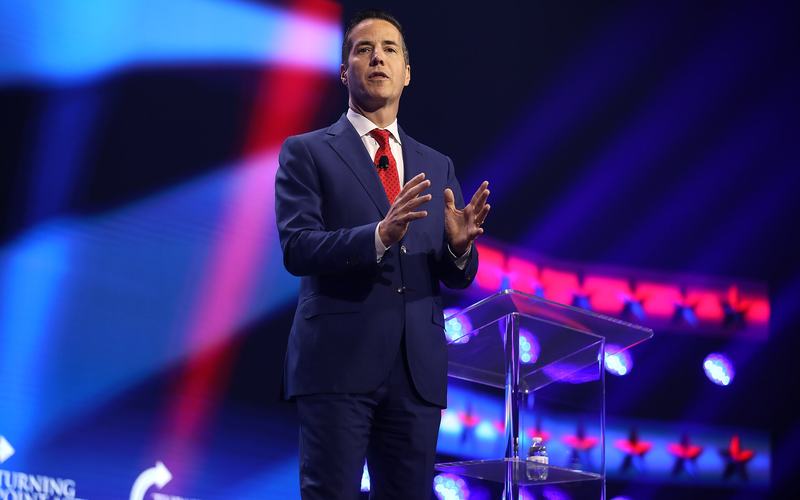
Sen. Bernie Moreno, R-Ohio, is beginning the search for a Republican candidate who can challenge incoming Democrat Sen. Sherrod Brown in 2028, as the party prepares for what Moreno described as a "savagely brutal" Senate election map.
Moreno, who will lead the National Republican Senatorial Committee (NRSC) for the 2028 election cycle, has already made finding a strong challenger in Ohio a priority. Brown defeated Republican Sen. Jon Husted in a special election this month and will have to defend the seat again when voters return to the polls in two years.
"Somebody who can beat the crap out of Sherrod Brown," Moreno said when describing the type of candidate he wants Republicans to recruit.
Husted has privately indicated that he probably will not seek another term, according to Politico, leaving Republicans searching for an alternative in a state that will be central to the party's efforts to rebuild its Senate majority.
Former state Sen. Kevin Coughlin is among the potential candidates being considered by Ohio Republicans. They are also looking at Rep. Mike Turner, R-Ohio, who recently lost his own reelection bid. A spokesperson for Turner said the outgoing congressman "is keeping all his options open."
The Ohio contest is only one part of a challenging national landscape facing Moreno as he takes over the GOP's Senate campaign operation. Following the November election losses, Republicans are expected to enter the next Congress with 44 Senate seats. To regain control of the chamber in 2028, the party will need to gain at least six seats while defending 19 of its own.
"Looking at it right now, it's absolutely a savagely brutal map," Moreno said.
Democrats will have several vulnerable seats they must defend, including those held by Sens. Mark Kelly of Arizona, Raphael Warnock of Georgia, Catherine Cortez Masto of Nevada and John Fetterman of Pennsylvania. All four are scheduled to face voters in 2028, giving Republicans opportunities to compete in states that could help determine Senate control.
Republicans, meanwhile, will have to defend seats in North Carolina and Wisconsin, adding to the number of competitive races the party must manage. Defending its own incumbents while trying to flip at least six Democratic-held seats leaves little room for recruitment mistakes.
Candidate selection is already emerging as a potential source of tension within the Republican Party. Some Senate Republicans have privately blamed Trump for contributing to the party's recent losses, particularly his decision to support a primary challenger to Sen. John Cornyn, R-Texas.
That contest helped produce a costly Republican primary and left the party spending more than $200 million on Ken Paxton's unsuccessful general election campaign, according to Politico. The criticism reflects concerns among some Republicans that internal divisions and poorly positioned candidates could drain resources needed for competitive general election races.
"There will be no patience for bad recruits this cycle," one senior Republican told Politico.
Trump has argued that Republicans lost because he was not on the ballot, while Moreno, a close ally of both the president and Vice President JD Vance, will have to balance the administration's influence with the need to recruit candidates capable of winning statewide elections.
Moreno offered few details when asked what role the White House would play in Republican primaries, responding, "We're going to work on all of that."
Senate Majority Leader John Thune, R-S.D., who is expected to become minority leader in January, also plans to take an active role in recruiting candidates for the next election cycle, according to Politico. His involvement could place both Senate leadership and the NRSC at the center of decisions about which Republicans receive support in key races.
Moreno's team has already begun organizing for the cycle, including interviewing candidates to serve as the committee's executive director. With Republicans facing a difficult path back to a Senate majority, the recruitment process is expected to play a major role in determining how aggressively the party can compete in 2028.

Comments
No comments yet. Be the first to share your thoughts.