
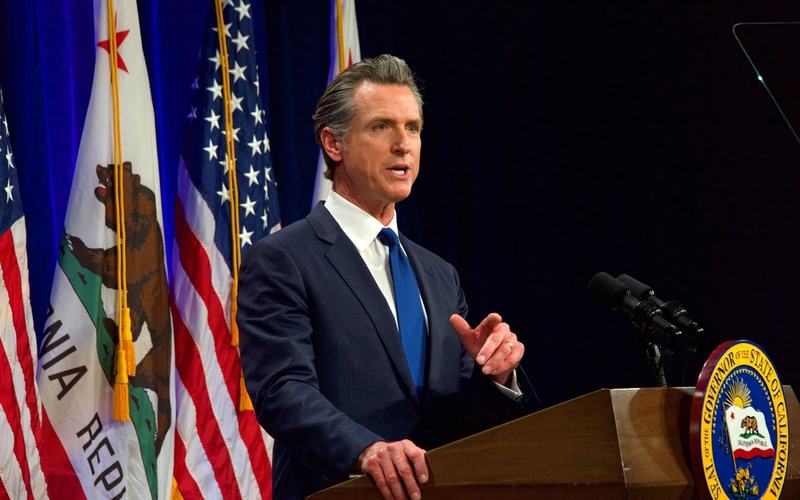
California Gov. Gavin Newsom announced Thursday that he will commute the death sentences of all 548 inmates currently on the state’s death row, converting their punishments to life in prison without the possibility of parole. The decision would prevent those prisoners from being executed, even if a future governor seeks to resume capital punishment in California.
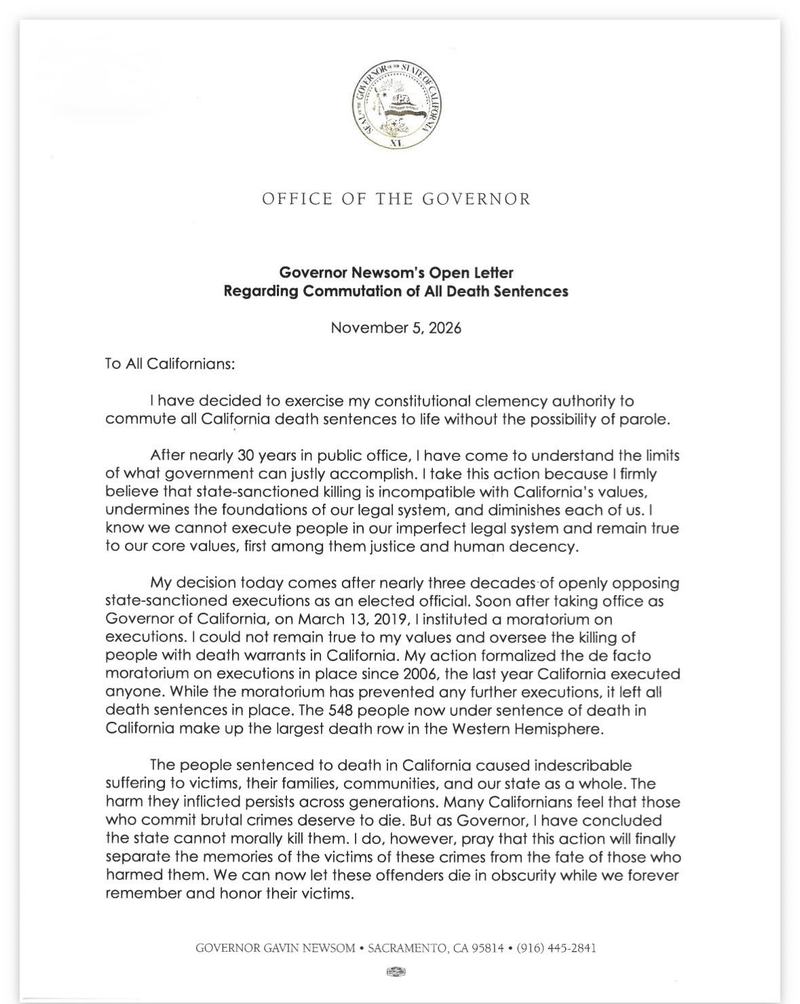
In an open letter to Californians, Newsom said he had wrestled with the decision for years and argued that the death penalty is incompatible with the state’s values and justice system. He also cited the possibility of wrongful convictions and what he described as fundamental problems with the way capital punishment is administered.
“I firmly believe that state-sanctioned killing is incompatible with California’s values, undermines the foundations of our legal system, and diminishes each of us,” Newsom wrote. He acknowledged that his decision could reopen painful memories for victims’ families but said he believed it was necessary.
The commutations represent the largest mass reduction of a death row in modern American history. However, the order does not formally abolish the death penalty in California. Voters have repeatedly rejected ballot measures to eliminate capital punishment, most recently in 2016, and the state will retain the death penalty as a legal sentencing option for future cases.
There are also legal hurdles to the order. The commutations apply immediately to an estimated 30% of the condemned prisoners, while the remaining cases must undergo review by the California Supreme Court because the inmates have multiple felony convictions. The court’s involvement means the process will not be completed for every prisoner at once.
Newsom’s announcement marks a major escalation of his longstanding opposition to capital punishment. In March 2019, shortly after taking office, he imposed a moratorium on executions and ordered the dismantling of the execution chamber at San Quentin State Prison. California has not carried out an execution since January 2006, although prosecutors have continued to pursue death sentences in some cases.
The state once housed more than 730 people awaiting execution. Its current death row population includes 529 men and 19 women, according to state figures. Some inmates have spent decades under death sentences, while others were convicted of high-profile murders, including killings of children, law enforcement officers and multiple victims.
The decision has drawn sharply divided reactions. Prison-reform and death-penalty opponents welcomed the move, arguing that capital punishment is unfairly applied and carries the risk of executing innocent people. Victims’ families, prosecutors and public-safety advocates criticized the blanket commutations, saying the decision disregards the severity of the crimes and the expectations of families who sought the death penalty for those responsible.
Former Sacramento County District Attorney Anne Marie Schubert, who leads the Criminal Justice Legal Foundation, said her organization and other groups were prepared to challenge the commutations in court. Marc Klaas, whose 12-year-old daughter Polly was kidnapped and murdered in 1993, also condemned the decision, expressing concern that changing the sentences could bring convicted killers closer to eventual release.
Newsom said he considered the circumstances of the cases and understood that many Californians would disagree with his decision. He maintained that converting the sentences to life without parole would ensure the prisoners remain incarcerated while preventing the state from carrying out executions.
The announcement comes as Newsom approaches the end of his governorship and considers a potential 2028 presidential campaign. His action also arrives amid renewed national debate over capital punishment following a botched execution in Tennessee and continued disagreements over the use of the death penalty by state and federal authorities.

Comments
No comments yet. Be the first to share your thoughts.