
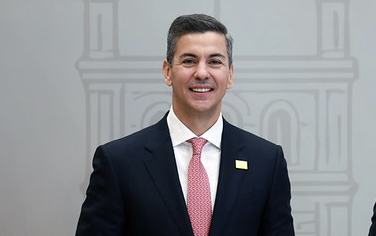
Paraguayan President Santiago Peña announced his resignation Thursday as the country’s political and financial crisis intensified following the collapse of Ueno Bank, a major digital lender with close ties to his administration. Just minutes after his announcement, Paraguay’s lower house voted unanimously, 78-0, to impeach him, marking a dramatic escalation in the scandal that has shaken the South American nation.
Peña announced his decision in a video posted to social media as lawmakers were debating his removal inside the Legislative Palace. He said he was stepping down to protect the country’s stability and democratic institutions, while offering an apology to Paraguayans affected by the banking crisis.
"I have made the decision to submit my resignation as president of the republic," Peña said. "I do so thinking of the stability of our country, social peace and the need to preserve our democratic institutions."
He also apologized to the public but stopped short of accepting responsibility for the collapse. "I also want to apologize to the people if I have failed them at any point. It was never my intention to betray the trust they placed in me," he said. Peña added that his priority was ensuring depositors recovered their money, saying that behind every account were years of work, sacrifice and family savings.
Under Paraguay’s constitutional process, Congress must address the president’s resignation, while impeachment requires approval by the Senate to remove him from office. Vice President Pedro Alliana is next in line to assume the presidency. The political transition comes after members of Peña’s own Colorado Party withdrew their support, allowing the impeachment effort to gain overwhelming backing in the lower house.
The crisis erupted after regulators seized Ueno Bank earlier this week, freezing access to accounts belonging to approximately 3 million customers. The lender claimed more than 60% of Paraguay’s adult population as customers and held roughly $800 million in public deposits, including funds connected to the country’s social security and pension systems. Thousands of employees also found themselves unable to access wages held at the institution.
Ueno had grown rapidly after receiving its banking license in 2023, expanding from a relatively obscure financial company into one of Paraguay’s most recognizable financial institutions. It attracted customers with cash-back promotions, opened more than 70 locations, sponsored Paraguay’s national soccer team and secured naming rights to the country’s main stadium.
The bank’s expansion coincided with substantial deposits from government institutions. Peña previously held an ownership stake in Grupo Vázquez, the conglomerate that controls Ueno, before ending his business ties in March 2025. His administration also appointed Carlos Carvallo, who previously led Ueno’s predecessor financial company, to head the Central Bank of Paraguay, the institution responsible for regulating and supervising lenders.
Those relationships became a central focus of the political backlash. Lawmakers and critics questioned how Ueno was able to accumulate so much public money despite concerns about its lending practices and the potential conflicts of interest involving government officials.
Regulatory scrutiny intensified after central bank inspectors reportedly identified substantial loans to companies connected to Ueno’s owners. Some of the lending allegedly exceeded legal limits and lacked sufficient collateral. On a single day in September 2025, nearly $39 million was reportedly extended to three companies linked to the bank’s owners.
Peña had previously defended Ueno and the central bank’s oversight, dismissing criticism as a campaign that was damaging public confidence. However, a subsequent examination of the lender’s finances uncovered poorly documented loans and expenses improperly recorded as assets. After regulators corrected the bank’s financial statements, its capital fell below half the minimum level required by law.
The central bank took control of Ueno on Tuesday, suspending its banking services and beginning a process to transfer customer accounts and remaining assets to other institutions. Its mobile application, payment cards and transfer services stopped functioning, leaving customers unable to access their savings. Panic spread as depositors rushed to open accounts elsewhere, temporarily overwhelming the digital services of other banks.
Authorities have begun arrangements to transfer accounts and repay depositors, including opening new accounts for approximately 280,000 customers who had banked exclusively with Ueno. The government has also moved to accelerate access to deposit-guarantee funds. Officials have insisted that the wider banking system remains stable, although the collapse has severely damaged public confidence.
The financial disruption has also affected public pension recipients and workers. Ueno held substantial funds belonging to Paraguay’s Social Security Institute, which administers pension and healthcare benefits. Thousands of retirees were concerned about receiving their payments, while approximately 7,000 employees affected by the bank’s closure faced uncertainty over their jobs and unpaid wages.
Protests continued for a third day Thursday, with demonstrators demanding access to their savings and calling for Peña’s removal. Hundreds of Ueno employees and workers from other companies owned by Grupo Vázquez gathered outside the Labor Ministry seeking unpaid salaries and severance payments. Earlier demonstrations in the capital, Asunción, included retirees, students, depositors and other workers.
Protesters carried signs demanding Peña’s impeachment and accusing his administration of betraying ordinary citizens. Some chanted, "We want your head, Peña!" Riot police used pepper spray and rubber pellets to disperse crowds during confrontations near government buildings.
The financial scandal has also produced criminal investigations. Authorities have detained eight senior Ueno executives, including founder Miguel Vázquez and bank president Juan Manuel Gustale. Prosecutors have charged 27 bank officials and business associates with alleged offenses including breach of trust and attempted fraud. The accused have not been convicted, and lawyers for several detained individuals said they needed time to review the allegations before commenting.
Peña’s resignation marks a major political setback for the Colorado Party, which has dominated Paraguayan politics for decades. The scandal has raised broader questions about the relationship between the governing party, financial regulators and powerful business interests, particularly as public institutions placed hundreds of millions of dollars with a bank connected to the president’s former business associates.
For millions of Paraguayans, however, the immediate concern remains recovering their money. The collapse has left families uncertain about their savings, retirees worried about their pensions and workers demanding wages from a financial institution that only days earlier had been one of the country's most prominent digital banks.

Comments
No comments yet. Be the first to share your thoughts.