
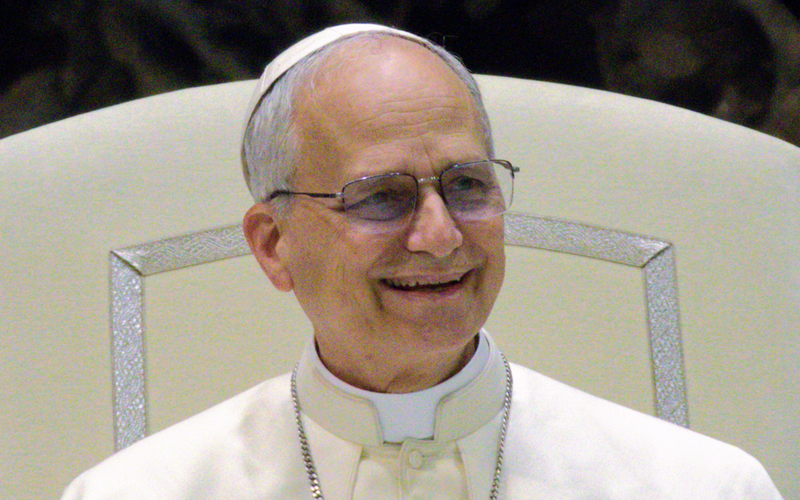
Pope Leo XIV underwent surgery Tuesday at Rome’s Gemelli Hospital to remove a lung nodule discovered during routine medical checks, with the Vatican announcing that the operation was completed successfully.
The 71-year-old pontiff returned to his room following the procedure, according to a statement from Vatican spokesman Matteo Bruni, who said further information would be provided later. The surgical team was led by Dr. Stefano Margaritora, Gemelli’s chief thoracic surgeon.
Leo arrived at the hospital through its main entrance earlier Tuesday and waved to dozens of well-wishers gathered outside. As the operation began Tuesday evening, medical staff gathered in the hospital chapel to recite the Rosary. Cardinal Baldassare Reina, the Vicar of Rome, led prayers for the pope and other hospitalized patients.
The surgery follows Leo’s public disclosure Sunday that doctors had discovered a small, localized nodule in his lung. The American pontiff has provided unusual transparency about the health issue during the first 17 months of his papacy. The Vatican canceled his scheduled audiences through Oct. 20, and the procedure was expected to require approximately a weeklong hospital stay.
Medical experts have said the outlook could be favorable even if the nodule proves cancerous, because it was detected while still localized. Dr. Lorenzo Spaggiari, director of thoracic surgery at the European Institute of Oncology in Milan, said such conditions can often be treated successfully when identified early. He is not involved in Leo’s care but is familiar with the Gemelli medical team.
Spaggiari said doctors would likely perform a biopsy to determine whether the nodule is cancerous and remove the affected section or lobe of the lung if necessary. The procedures could potentially be performed under the same general anesthesia, although the precise surgical techniques used on the Pope were not publicly confirmed.
Both Gemelli Hospital and the European Institute of Oncology have robotic technology that can assist with biopsies and minimally invasive lung surgery. Such procedures can allow surgeons to operate through small incisions while viewing the surgical area through high-definition, three-dimensional imaging.
The nodule was discovered during routine medical checks and had not caused noticeable symptoms, according to the Vatican. Lung nodules are small abnormal areas that can be either benign or malignant, and doctors may recommend removal to establish a diagnosis and treat a potential cancer before it spreads.
Spaggiari said that if the affected lymph nodes test negative for cancer, indicating the disease remains at an early stage, the prognosis would be very good and additional treatment might not be necessary. The Vatican has not announced a cancer diagnosis or released pathology results.
The pope’s recovery could also affect his upcoming international travel plans. Leo is scheduled to visit Uruguay, Argentina and Peru from Nov. 6 through Nov. 17. The itinerary would involve more than 19,000 miles of travel, approximately a dozen flights and two helicopter rides.
Medical guidance from the European Institute of Oncology recommends that patients avoid flying for three weeks after this type of surgery, although Leo’s doctors will determine his individual recovery requirements.
Cardinal Kikuchi Tsutomu, who met with Leo on Monday, said the pope wanted to undergo the procedure promptly to avoid disrupting future overseas trips.
“He has decided to undergo surgery soon to not change his plans for future overseas trips, so there is no need to worry, as it is not an emergency,” Kikuchi said.
The hospitalization is believed to be Leo’s second. As a young missionary priest in Peru in 1985, he was hospitalized with typhoid fever shortly after arriving in Chulucanas. In a 2025 biography, Leo recalled the illness as a pivotal experience that helped convince him to remain in Peru and continue his religious work despite the difficult conditions.
The Vatican has confirmed that the lung operation was completed as planned, but the nodule’s precise nature and any need for further treatment remain unknown.

Comments
No comments yet. Be the first to share your thoughts.