
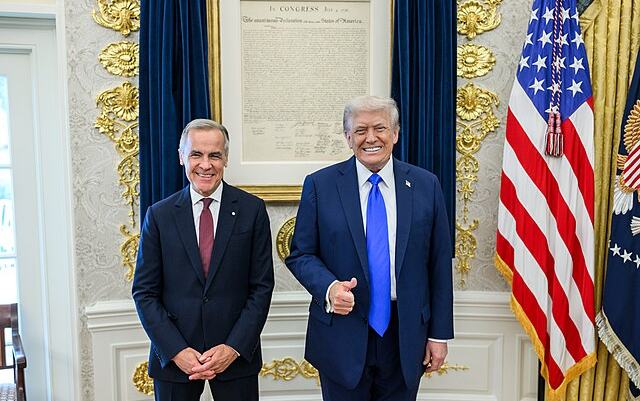
President Donald Trump and Canadian Prime Minister Mark Carney expressed renewed optimism Sunday about reaching a trade agreement between the United States and Canada, following a constructive conversation that both leaders said could lead to a mutually beneficial deal.
Carney announced that the two governments would work toward an agreement over the coming weeks, while Trump described the negotiations as being close to a potential breakthrough. However, neither leader announced a finalized agreement, and important questions remain over tariffs, energy infrastructure and market access.
"Our teams will now be working in the coming weeks to deliver that outcome," Carney wrote Sunday, saying their conversation built on recent discussions about an agreement that would create jobs, improve affordability and respect Canada's languages, culture and sovereignty.
Trump offered a similarly positive assessment after arriving in Iowa for a rally, telling reporters that the two sides had developed "the concept of a very good deal with Canada." He said he had spoken with Carney again Saturday and described the potential agreement as beneficial to American farmers and the broader U.S. economy.
"We've been losing money for many years with Canada, many, many years," Trump said. "So we have — we are now very close to having a deal."
The president also identified the Keystone XL pipeline as part of the discussions, saying Canada would build and pay for the project using a route that has largely been determined. Trump said the agreement could also eliminate tariffs American farmers pay on Canadian products, although the precise terms have not been established and Carney's government has not publicly confirmed those details.
The latest developments represent a shift from August, when Canada suspended negotiations after Carney rejected proposed U.S. terms that his government said threatened Canadian sovereignty, French-language protections and the country's automotive industry. Trump subsequently moved forward with 50% tariffs on a range of Canadian goods, prompting Ottawa to impose retaliatory duties.
The dispute has affected major industries on both sides of the border, particularly steel, aluminum and automobile manufacturing. Recent discussions have focused on potential tariff relief for Canadian steel and vehicles, but the two governments have yet to release specific terms or announce when an agreement might be signed.
The timing has also placed the negotiations squarely into American politics. The trade dispute has become an issue ahead of Tuesday's midterm elections, particularly in Michigan and Maine, where competitive Senate races could be influenced by economic concerns and the impact of tariffs on manufacturers, farmers and consumers.
Republican Senate candidate Mike Rogers of Michigan has called for an end to the tariff dispute, reflecting concerns among some Republicans that the trade conflict could hurt American businesses and become a political liability in states with close economic ties to Canada.
Political observers have offered differing assessments of the potential electoral impact. Daniel Béland, a political science professor at McGill University, said recent adjustments to U.S. tariffs indicated that the Trump administration recognized the political risks of the dispute, particularly in states along the Canadian border.
Robert Bothwell, a historian at the University of Toronto, cautioned against assuming that the improved tone between Trump and Carney would produce an immediate agreement or significantly influence Tuesday's elections. He compared the apparent diplomatic thaw to "five minutes of variable sunshine," warning that tensions could return.
Meanwhile, Carney has been pursuing a broader strategy to reduce Canada's economic dependence on the United States. His government recently announced a new partnership with the European Union, known as the Alliance for the Future, while pursuing a deeper relationship that could give Canada associate-member status. Carney has also set a goal of doubling Canadian exports to markets outside the United States over the next decade.
The effort reflects growing tensions between the two North American neighbors, particularly after Trump repeatedly raised the possibility of Canada becoming the 51st U.S. state. Carney has emphasized Canadian sovereignty and economic independence as central priorities in his government's trade policy.
Canadian Conservative opposition leader Pierre Poilievre welcomed the prospect of an agreement but urged Carney to produce concrete results rather than continue announcing progress. He argued that Canadian businesses and families could not afford an extended trade dispute.
"It's time for Mr. Carney to put the big talk in the past and deliver real results," Poilievre said.
For now, both governments appear willing to continue negotiations, but the latest statements amount to an expression of optimism rather than a completed deal. The coming weeks will determine whether Trump and Carney can translate their discussions into an agreement that addresses tariffs and provides greater certainty for businesses and workers on both sides of the border.

Comments
No comments yet. Be the first to share your thoughts.