
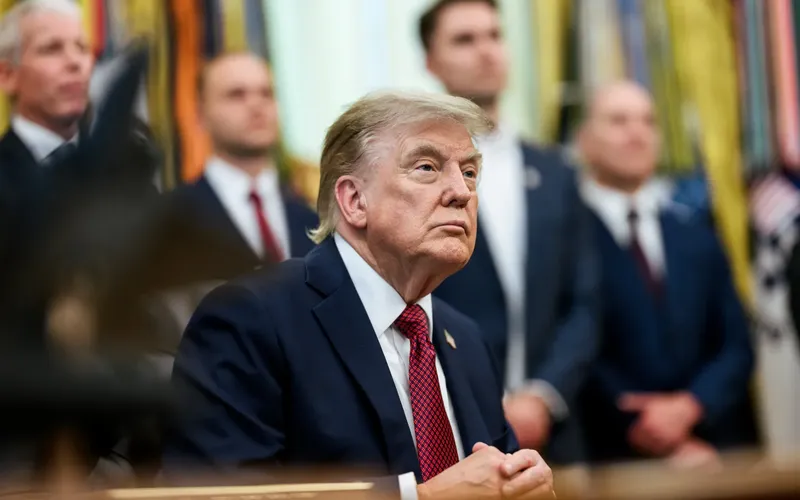
President Donald Trump said Monday that disruptions to oil-refining capacity in Russia and refinery closures in Democratic-led states are contributing to higher gasoline prices, arguing that the problem is no longer primarily a shortage of crude oil.
Trump made the claim in a Truth Social post, pointing to Ukrainian strikes on Russian refineries and the loss of refining capacity in California. “What's driving up Gasoline is no longer the Strait of Hormuz, because Record Numbers of Barrels are coming out now on an almost daily basis, but the word, ‘Refineries,’” Trump wrote.
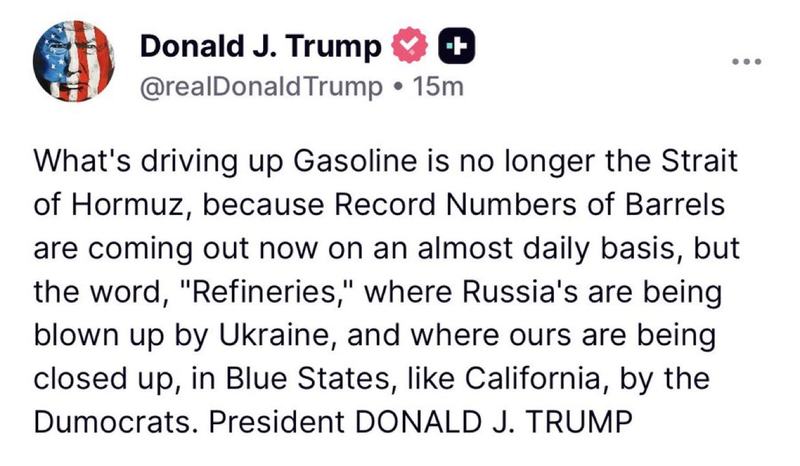
Trump specifically criticized California, writing that Russian refineries are “being blown up by Ukraine” while American refineries are “being closed up, in Blue States, like California, by the Dumocrats.”
Ukraine said Sunday that its long-range attacks have knocked out 51% of Russia's oil-refining capacity, although the claim has not been independently verified. The strikes have targeted facilities across Russia as Kyiv seeks to disrupt Moscow's ability to finance and supply its war effort.
The International Energy Agency estimates Russian diesel production has fallen by about 30%, while Moscow has restricted diesel exports and recently extended an export ban through October. Russian President Vladimir Putin also acknowledged last week that Ukrainian attacks on refineries had damaged the Russian economy, estimating the impact at roughly 1% of gross domestic product.
Trump has previously urged Ukrainian President Volodymyr Zelenskyy to stop targeting Russian refineries, warning that the attacks could contribute to fuel shortages and higher prices.
California has also lost significant refining capacity. Phillips 66 stopped processing crude at its Los Angeles-area refinery in October 2025, while Valero completed the shutdown of its Benicia refinery in April 2026. The two facilities represented roughly 17% of California's refining capacity. The Energy Information Administration has warned that the closures could increase fuel-price volatility because the West Coast has limited pipeline connections to major refining centers elsewhere in the country.
The refinery closures have become part of a broader dispute over California's energy policies. Trump has blamed the state's Democratic leadership, while California officials have rejected the idea that state policy alone caused the closures. Phillips 66 CEO Mark Lashier said the company's Los Angeles shutdown was driven by its expectation that refining in California would become increasingly difficult, rather than by any single policy change.
With gasoline prices rising nationally, Trump is arguing that the availability of refining capacity has become a key factor behind higher prices, even as geopolitical disruptions involving Iran, Ukraine and Russia continue to affect global energy markets.

Comments
No comments yet. Be the first to share your thoughts.