
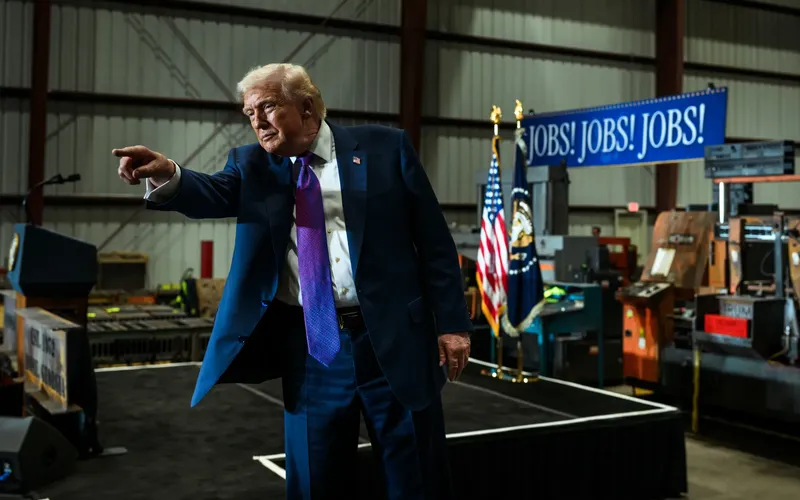
President Donald Trump is expected to announce executive actions Monday aimed at lowering diesel costs as elevated fuel prices put pressure on farmers, truckers and other businesses ahead of the midterm elections.
Trump is expected to promote the measures during a campaign stop in Nebraska during the peak of harvest season. The plans include a Treasury Department review of certain diesel-related taxes and an executive order encouraging states to expand access to tax-exempt red-dyed diesel.
The order is also expected to encourage states to waive certain fuel taxes and direct federal agencies toward nonenforcement of some restrictions involving dyed diesel, according to people familiar with the plans.
The national average price of diesel was $6.32 per gallon Monday, according to AAA. Although the price fell 13 cents from the previous week, it remained $2.63 higher than the same period last year.
Diesel prices have become a particularly sensitive issue in agricultural states, where the fuel is essential for tractors, combines, trucks and other equipment used during planting and harvest. Republican lawmakers, including Iowa Sen. Chuck Grassley, have urged the administration to take stronger action to increase domestic supply.
Trump had repeatedly considered banning U.S. diesel exports in an effort to keep more fuel at home. He ruled out that option Friday after European countries agreed to draw on their own diesel reserves.
The administration has instead shifted toward tax relief and expanding access to dyed diesel. Red-dyed diesel is chemically similar to conventional diesel but is intended primarily for off-road use and is generally exempt from certain federal and state fuel taxes.
Ten states representing roughly one-third of U.S. diesel sales had taken steps to expand dyed-diesel use by Friday, according to ClearView Energy Partners. Several states have also waived taxes on diesel used by agricultural vehicles.
The approach could provide greater savings for trucking and other on-road users if states expand eligibility, while offering less relief to farmers and construction operators who already qualify for tax-exempt fuel. GasBuddy petroleum analyst Patrick De Haan argued that supply, rather than taxes, is the central problem.
The administration has blamed the broader fuel-price spike in part on disruptions to global energy markets caused by the war with Iran and Ukrainian attacks on Russian oil refineries.
The proposed tax measures could also create challenges for states that rely on fuel-tax revenue to maintain roads and other infrastructure. Oil analyst Denton Cinquegrana said suspending fuel taxes may reduce prices in the short term but could leave states needing to make up the lost revenue later.
The measures represent a more limited response than the diesel export ban Trump and some agricultural Republicans had advocated as the administration seeks to address high fuel costs without restricting international fuel markets.

Comments
No comments yet. Be the first to share your thoughts.