
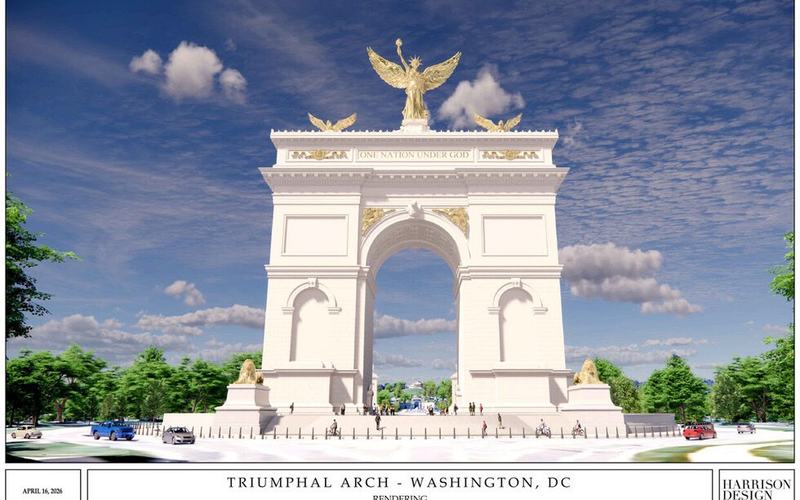
President Donald Trump’s proposed 250-foot triumphal arch in Washington received final approval from the National Capital Planning Commission on Thursday, advancing one of the administration’s major projects to reshape the nation’s capital. The decision clears a significant federal planning hurdle, although ongoing legal challenges could still prevent construction from moving forward.
The commission approved the final plans for the monument at Memorial Circle, near the Arlington Memorial Bridge and the entrance to Arlington National Cemetery. The proposal includes a massive arch topped by three gold statues, including a winged female figure holding a torch with an eternal flame. The structure would also feature an observation deck, interior offices and program spaces, elevators and significant changes to nearby roads and traffic patterns.
Commission Chairman Mark Paoletta praised the project as a historic undertaking, arguing that the monument would contribute to the nation's identity. Paoletta has described the proposal as a major opportunity to protect and enhance the capital, while the administration has presented it as a tribute to America's military, national accomplishments and 250 years of independence.
Trump has repeatedly said he wants the structure to surpass the famous Arc de Triomphe in Paris. "The most beautiful one is the one in Paris, the Arc de Triomphe," Trump previously said. "It's beautiful, big. Ours is going to be bigger and more beautiful."
The president has also discussed giving the monument a national security function, including the ability to house military drones and ammunition. However, those specific features were not detailed in the publicly submitted plans reviewed by the commission. The National Capital Planning Commission said information concerning certain national security functions had been submitted under seal and was not available for public review.
The approval comes as the administration faces multiple lawsuits seeking to stop the project. Veterans, preservationists, the District of Columbia and Virginia have challenged the construction, arguing that Congress must specifically authorize the monument under the Commemorative Works Act. The Trump administration disputes that interpretation, maintaining that Congress authorized a memorial at the site more than a century ago when it approved plans for a bridge across the Potomac River.
Opponents also argue that the arch would disrupt historic views connecting the Lincoln Memorial and Arlington National Cemetery and undermine the solemn character of the cemetery, where American service members are buried. Rep. Don Beyer (D-Va.) joined protesters Wednesday in condemning the proposal, calling it a "monumental abomination of one man's ego" that disrespects those buried at Arlington.
A National Park Service review released in August found that the project could have adverse effects on as many as 42 historic properties, including Arlington National Cemetery and the Lincoln Memorial corridor. The review considered alternatives such as reducing the arch's size or moving it to another location, but the administration maintained that the monument's purpose was inherently tied to its proposed site near the Potomac River.
The administration also ended a historic preservation consultation process after failing to reach an agreement with participating groups, prompting additional criticism from opponents who argue that required safeguards were bypassed.
U.S. District Judge Tanya Chutkan, who is overseeing the legal challenges, has imposed notification requirements on the administration as the project moves through the approval process. Her order requires officials to notify the court within an hour of decisions by federal agencies and provide 30 minutes' notice before construction-related activity. The order does not itself prohibit construction, leaving the possibility of additional judicial action as the lawsuits proceed.
During a hearing last week, Chutkan questioned why the administration was moving so quickly despite the pending litigation. "What's the harm to the government to wait three or four months? What's the rush to put this arch up?" she asked, also questioning whether Trump's goal was to "bedazzle the city."
The administration has outlined an accelerated construction schedule involving two 10-hour work shifts each day. However, the Justice Department has told the court that above-ground construction would not begin before May 2027 and that the full project could take 33 to 39 months. That timeline would extend beyond Trump's stated goal of completing the monument before he leaves office in January 2029.
Thursday's commission vote therefore represents a major step toward Trump's proposed monument, but it does not resolve the central legal dispute over whether the administration can build the arch without additional congressional authorization. The courts could still determine whether construction can proceed.

Comments
No comments yet. Be the first to share your thoughts.