
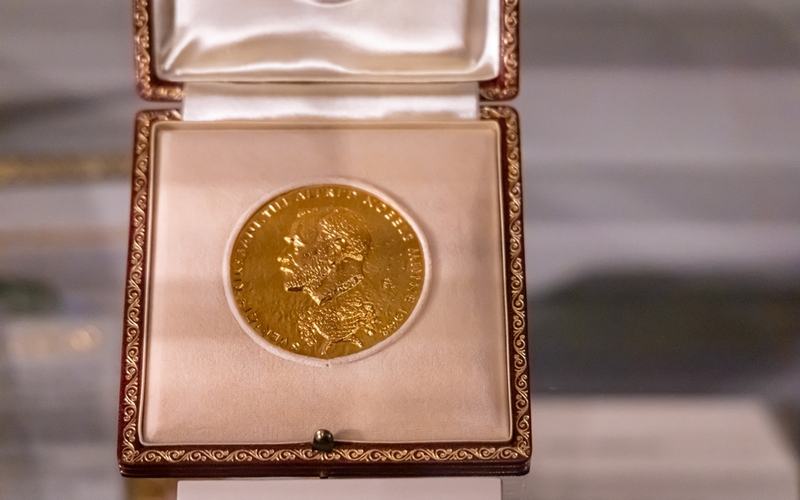
American economists Robert E. Hall of Stanford University and Michael Woodford of Columbia University received the 2026 Nobel Memorial Prize in Economic Sciences on Monday.
The Royal Swedish Academy of Sciences awarded the prize for their development of models that provide a microeconomic foundation for macroeconomic stabilization policy. These models help governments and central banks respond to economic shocks such as energy crises or shifts in household consumption.
Hall, born in Palo Alto, California, in 1943, and Woodford, born in Chicopee, Massachusetts, in 1955, each will receive half of the 12 million Swedish kronor prize, equivalent to about $1.2 million.
The academy noted that the laureates' contributions have supplied a stable theoretical basis for models now used by central banks and governments worldwide. Their approach rebuilt macroeconomic models on individual and household decision-making rather than relying solely on statistical links between aggregate variables like inflation and production.
This marks another year of U.S. dominance in the economics prize, which has gone primarily to American researchers since its inception in 1969. The award is formally known as the Sveriges Riksbank Prize in Economic Sciences in Memory of Alfred Nobel.
Last year's prize went to three researchers for work on business innovation and creative destruction. The 2026 economics prize concludes this year's Nobel announcements, which included categories in medicine, physics, chemistry, literature, and peace.

Comments
No comments yet. Be the first to share your thoughts.