

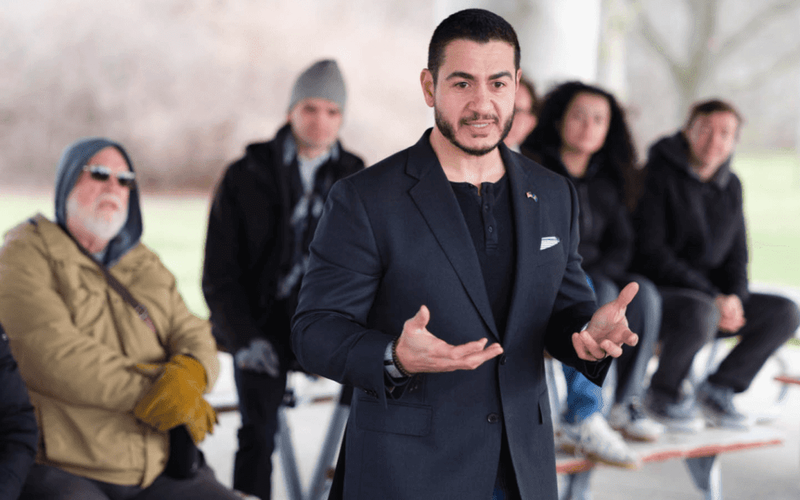
Democrat Abdul El-Sayed has defeated Republican Mike Rogers in Michigan’s 2026 U.S. Senate election, becoming the first Muslim elected to the United States Senate. El-Sayed will succeed retiring Democratic Sen. Gary Peters, who announced he would not seek another term, and represent Michigan in a chamber where control was a central issue in the midterm elections.
El-Sayed, a former public health official, entered the general election after winning a closely contested Democratic primary against Rep. Haley Stevens. His primary victory came despite substantial spending by outside groups supporting Stevens and opposition from prominent members of the Democratic establishment. El-Sayed built his campaign around progressive economic policies, healthcare reform and criticism of corporate influence in American politics.
Born in Michigan to Egyptian immigrant parents, El-Sayed built his professional career in public health before entering electoral politics. He served as director of the Wayne County Department of Health, Human and Veterans Services and later ran for Michigan governor in 2018, losing the Democratic primary to Gretchen Whitmer. Although he did not hold elected office before the Senate campaign, he developed a national profile through his public health work, writing and political commentary.
During the Senate campaign, El-Sayed promoted Medicare for All, campaign finance reform and greater government involvement in addressing healthcare costs. He also called for ending American military aid to Israel, making the conflict in Gaza a significant issue in both the Democratic primary and the general election. His positions drew support from progressive leaders, including Sen. Bernie Sanders and Rep. Alexandria Ocasio-Cortez.
El-Sayed's campaign also focused on economic concerns, including the cost of housing, groceries and healthcare. He argued that Washington's political establishment had failed working families and presented his candidacy as an alternative to traditional Democratic leadership. His message helped him build support among progressive voters, younger Americans and voters dissatisfied with the direction of the federal government.
Rogers, a former Republican congressman and FBI agent, sought to return to Washington after narrowly losing Michigan's other U.S. Senate race in 2024. He emphasized tax relief, manufacturing jobs, national security and border enforcement while presenting himself as an ally of President Donald Trump. The open seat attracted significant national attention because Michigan remains a closely contested battleground state and the outcome had implications for the balance of power in the Senate.
The campaign became increasingly contentious in its final weeks, with disagreements over Israel, Gaza and El-Sayed's Muslim faith drawing national attention. Rogers and Republican allies repeatedly questioned El-Sayed's positions and associations, while El-Sayed accused his opponents of focusing on his religion rather than the economic issues facing Michigan voters. The controversy became a defining feature of a race that also drew substantial spending from outside political organizations.
The contest also exposed divisions within the Democratic Party. Stevens, who had lost the primary to El-Sayed, endorsed Rogers shortly before Election Day, citing disagreements with the Democratic nominee. Her decision highlighted the lingering tensions from the expensive primary and created an unusual situation in which a prominent Democrat backed the Republican candidate in the general election.
El-Sayed's victory carries historical significance beyond Michigan. His election makes him the first Muslim to serve in the U.S. Senate, adding another milestone to a 2026 election cycle that produced several historic firsts across the country. His victory also gives Democrats another Senate seat as the party sought to regain control of the chamber.
El-Sayed will take office in January 2027, replacing Peters and becoming one of Michigan's two U.S. senators alongside Democratic Sen. Elissa Slotkin. His election sends a new progressive voice to Washington after a campaign centered on healthcare, economic policy, campaign finance and American involvement in the Middle East.

Comments
No comments yet. Be the first to share your thoughts.